Machine vision systems

MisterBill2

Joined Jan 23, 2018
27,519
The way that the encoder is useful is that it serves to increment a shift register, shifting the results down the line as the items move. Thus whern a rejected item reaches the ejection position, it's reject status reaches the position at the same time, and the software knows to reject the item at that position. This is a classic method of handling the reject process.
 

MaxHeadRoom

Joined Jul 18, 2013
30,661
I used to service machinery in the soft drink/beer bottling industry, for empty container or contamination after washing etc, the defective unit would be ejected down the line by counting the subsequent container positions between the detector and the ejector.
Done in a few ways, one was a proximity detector/counter on the conveyor in order to register the distance, ejection took place without stopping the conveyor.
Max.
 

Thread Starter

daljeet795

Joined Jul 2, 2018
295
The way that the encoder is useful is that it serves to increment a shift register, shifting the results down the line as the items move. Thus whern a rejected item reaches the ejection position, it's reject status reaches the position at the same time, and the software knows to reject the item at that position. This is a classic method of handling the reject process.
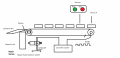
I am making a block diagram for better understanding

upload_2018-12-25_10-24-12.png

Sensor A detects product on the conveyor belt and scanner will detect if it is good or defected and needs to be rejected.

I am getting basic but I am having a problem how to implement it in real time

Sill I am on the same question
  1. Which camera needs to select for the project ?
  2. Which encoder needs to select for the project ?
 

LesJones

Joined Jan 8, 2017
4,511
You need to provide some FACTS.
1 - What is the diameter of the roller that the encoder is coupled to.
2 - What is the distance between the scanner and the air jet
3 - What is the length (In the direction of travel.) of the items on the conveyor.

We can then show you how to calculate a suitable counts per revolution value for the encoder.
Your rejection bin seems to be at the end of the conveyor. Where do the items that are not regected go ?
I think you would have been better choosing a project that you have a better understanding of as you don't seem to understand conveyors.

Les.
 

Thread Starter

daljeet795

Joined Jul 2, 2018
295
You need to provide some FACTS.
1 - What is the diameter of the roller that the encoder is coupled to.
2 - What is the distance between the scanner and the air jet
3 - What is the length (In the direction of travel.) of the items on the conveyor.

We can then show you how to calculate a suitable counts per revolution value for the encoder.
Okay what would be an encoder for following parameters
  1. Diameter of roller = 50 mm
  2. Distance between the scanner and the air jet = 1100 mm
  3. What is the length of the items on the conveyor H= 85 mm, L = 190 M
 

Thread Starter

daljeet795

Joined Jul 2, 2018
295
ems on the conveyor.

Your rejection bin seems to be at the end of the conveyor. Where do the items that are not regected go ?
I think you would have been better choosing a project that you have a better understanding of as you don't seem to understand conveyors.

Les.
if the item is rejected upward flapper will be open else it will be closed

Please see the image post #21
 

LesJones

Joined Jan 8, 2017
4,511
As I forgot to ask the distance between sensor A and the scanner we will assume sensor A is positioned to detect the object just as it reaches the scanner.
Circumpherence = 50mm x Pi = 157mm
So the object will take 190/157 revolutions of the roller to pass a point = 1.2 revolutions. We need to choose enough pulses to to be able to judge about the centre of the object. I then 10 pulses should be enough. So we would need 10/1.2 = 8.3 pulses per rev. I don't think you would get any encoder with such low resolution. So let us assume we could find one with 200 pulses per revolution. If we use that then the object would take 200 x 1.2 = 240 pulses to pass. ( So the centre would be 120 pulses after the leading edge was detected.) As 157mm is one revolution this is 200 pulses. so 1mm would be 200/157 = 1.274 so 100 mm would be 127.4 pulses. If we assume that the scanner makes the decision to reject/ not reject at halfway along the length of the object the we want the air jet to be triggered when the centre of the object was in front of it. The distance between when the centre of the object is under the scanner and when it needs to be blown off the conveyer is 1100mm then we need to count 1100mm x 1.274 = 1401 pulses after the scanner makes it's decision to reject the object. Even if we miss or pick up a few extra pulses the object should still be blown off the conveyer.
If the sensor A was positioned before the scanner as shown in the diagram then then the scanner would need to be told when the object was in front of it by calculating the number of pulses that would occure between sensor A and the scanner.
I suggest you add this information and work out tyhe number of pules between sensor A and the scanner and between sensor A and the air jet.

Les.
 

MaxHeadRoom

Joined Jul 18, 2013
30,661
Why do you need an encoder in the first place when a simple proximity switch will do the job for low resolution counting, and you evidently only need unidirectional sensing.
Max.
 

Thread Starter

daljeet795

Joined Jul 2, 2018
295
Why do you need an encoder in the first place when a simple proximity switch will do the job for low resolution counting, and you evidently only need unidirectional sensing.
Max.
Because the speed of conveyor is not constant it may be changing I want the rejection based on the position, not the time based.

I have seen encoder use to reject item on position based

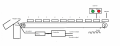
see this example

upload_2018-12-25_23-8-29.png


multiple items moving on the conveyor and camera scanner decide it would be rejected or pass. I need the position of the item on the conveyor for exact rejection

when rejected item reach at the end point, flapper should be open otherwise flappers should be closed to collect good items
 
Last edited:

MaxHeadRoom

Joined Jul 18, 2013
30,661
Because the speed of conveyor is not constant it may be changing I want the rejection based on the position, not the time based.
Exactly, that is what a prox detector does?
Even if a momentary stop occurs, the position is always registered!
Using it as a counter is essentially an encoder.
Max.
 

Thread Starter

daljeet795

Joined Jul 2, 2018
295
I suggest you add this information and work out tyhe number of pules between sensor A and the scanner and between sensor A and the air jet.

Les.
Your explanation is very well. I have to understand this calculation. Still I feel there is something left over. I will understand it and then come back to you
 

Thread Starter

daljeet795

Joined Jul 2, 2018
295
Exactly, that is what a prox detector does?
Even if a momentary stop occurs, the position is always registered!
Using it as a counter is essentially an encoder.
Max.
I am being confused here. I have seen in many places they use an encoder so I thought if i want to reject based on the position I have to use encoder and if I want rejection on time based then I have to use sensor

Why most of places encoder used in rejection system . why they don't use sensor in place of encoder ?
 

MaxHeadRoom

Joined Jul 18, 2013
30,661
Why most of places encoder used in rejection system . why they don't use sensor in place of encoder ?
From my experience, per #42, they mostly have, the only time I have seen encoders used is in material dispenser from a reel or spool where the length of material taken off will depend on the diameter of the spool material at any given time.
Otherwise it is the prox/sensor method, which is a form of encoder/counter.
Max.
 
Last edited:

Thread Starter

daljeet795

Joined Jul 2, 2018
295
If we assume that the scanner makes the decision to reject/ not reject at halfway along the length of the object the we want the air jet to be triggered when the centre of the object was in front of it. The distance between when the centre of the object is under the scanner and when it needs to be blown off the conveyer is 1100mm then we need to count 1100mm x 1.274 = 1401 pulses after the scanner makes it's decision to reject the object. Even if we miss or pick up a few extra pulses the object should still be blown off the conveyer.

Les.
upload_2018-12-31_16-54-34.png
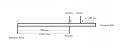
Let's assume At the A point sensor detect the object and at the B point camera will decide object is pass or rejected

if the objects are defective Can encoder give 1401 pulse between the gap of two objects

my doubt if first rejection happen and encoder are on 800 pulses and if the second rejection happen encoder will start from the beginning

What should be the minimum gap between two objects so that encoder can gives complete 1401 pulses?
 

LesJones

Joined Jan 8, 2017
4,511
You still don't seem to be thinking clearly about what is happening. If there are a number of object between the camera and the rejection point the in the control software you will need to have a counter running for each object. The number of counters you have to code into the software must be greater than the number of objects that can fit in the space beteen the camera and the reject point. This is why we all keep telling you that each system has to be designed to match the situation.

Les.
 

Thread Starter

daljeet795

Joined Jul 2, 2018
295
You still don't seem to be thinking clearly about what is happening. If there are a number of object between the camera and the rejection point the in the control software you will need to have a counter running for each object. The number of counters you have to code into the software must be greater than the number of objects that can fit in the space beteen the camera and the reject point. This is why we all keep telling you that each system has to be designed to match the situation.

Les.
Thanks for clarifying the doubt

Yes I understand I need encoder of 200 pulse per revolution. I have to write a program for rejection system

Now I do not understand how to select the camera. I have searched a lot about it on the internet. But I still can not decide which camera will be suitable ?
 

MisterBill2

Joined Jan 23, 2018
27,519
The reason to use an encoder instead of a counter would be that using a sensor might not be workable. For some types of items it is difficult to sense them adequately, and so an encoder must be used to know when the failed item has moved to the ejection position. So much of the choice depends on the materials handling system and what your system is checking.
I recently saw an ad for cameras for barcode inspection, so my suggestion is to go to the "vision systems" magazine website and look at the recent issues. Both cameras and software are advertised in that publication.
 

MaxHeadRoom

Joined Jul 18, 2013
30,661
From what I am seeing in the OP's system, it is not necessary to count the items, just the position of the defective item, this system will not be concerned if there is a 'missing' item.
Just the location slot or position on the conveyor.
More mechanical details of the conveyor and items is necessary for more informed decisions.
Max.
 

Thread Starter

daljeet795

Joined Jul 2, 2018
295
I recently saw an ad for cameras for barcode inspection, so my suggestion is to go to the "vision systems" magazine website and look at the recent issues. Both cameras and software are advertised in that publication.
I will follow the suggestion and if I get something so I will update here
 

Thread Starter

daljeet795

Joined Jul 2, 2018
295
From what I am seeing in the OP's system, it is not necessary to count the items, just the position of the defective item, this system will not be concerned if there is a 'missing' item.
Just the location slot or position on the conveyor.
More mechanical details of the conveyor and items is necessary for more informed decisions.
Max.
Hello Max.
Exactly Counting is not issues I can add the sensor to count total good product. the important things to remove the defective product on the conveyor at the endpoint

More mechanical details of the conveyor and items is necessary for more informed decisions.
Please tell me, what type of information required?
 
Top