Machine vision systems

Thread Starter

daljeet795

Joined Jul 2, 2018
295
No, I couldn't do that. I have no idea of what is required.
.
Please let me know what details you want to know. I have explained in my first post. I know this is not the easy task that's I want to start with small steps to accomplish big task

I have two points
  1. Camera selection
  2. Rejection system
I am still not clear about which camera would be suitable for the project ?.

I googled for rejection system. I found encoder is used for rejection of faulty product on the conveyor in many companies

When defective label found on the conveyor, flapper would be open

I imagine outlook of the machine like here
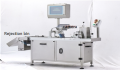
upload_2018-12-20_22-59-41.png
 

Attachments

Last edited:

MisterBill2

Joined Jan 23, 2018
27,522
Where I worked they used the 'Vision' system on the presses that made terminals. They looked at 4 or more areas on connector terminals as they were being made, to make sure they met the standards. These presses ran at 1300 strokes per minute, or 1300 terminals per minute. When a defect was found they shut the press down within 10 seconds of finding the third bad terminal in a row. These were 25 Ton mechanical stamping presses.
The system that you described was making accept/reject tests on parts that were all supposed to be identical. Those tests are far simpler and thus much easier to do very rapidly. Most such testing, accept / reject, is also much less demanding on any analysis. It is a lot different than determining if all of the labels on a package are right. In addition, there was no need to track items being checked, the sole choice was to stop the presses. The system inspecting the terminals could even have been made using ordinary high speed industrial logic, without any central processor at all.
Check the stated requirements in post#1 and see that they are far more complex.
 

BR-549

Joined Sep 22, 2013
4,931
Yes the stamping machine is a different animal.

I have done sorting, but not with these parameters. If the updated parameters or templates can be kept at scanner and comparison done locally....I'm sure it can be done.

I am not familiar with the tracking software or the imaging software.

They probably have digital imaging techniques I haven't heard of.

The camera will depend on imaging software needs.

I'm used up on this one.
 

MisterBill2

Joined Jan 23, 2018
27,522
It will probably need to be a fast and high resolution camera with a good lens. And if there is more than one label to check it may take a separate system for each label location. And for 500 items per minute it will also need a good package handling system for both supply and accepted part discharge. Rejects will seldom be a handling issue.
 

Thread Starter

daljeet795

Joined Jul 2, 2018
295
Yes the stamping machine is a different animal.

I have done sorting, but not with these parameters. If the updated parameters or templates can be kept at scanner and comparison done locally....I'm sure it can be done.

I am not familiar with the tracking software or the imaging software.
.
Scanner camera will pass or fail the barcodes on labels, I have to write a program that would check good and defective barcodes

If the barcode is good then It will go to a collection bin and if it defective it will go to a rejection bin

Here the main challenge is making the rejection system. we have to reject labels based on the position
 
Last edited:

BR-549

Joined Sep 22, 2013
4,931
One could use air to reject the object. A air solenoid and some shields to protect preceding and following objects. Limit the belt area hit by air blast. Air can blow the defect in another side bin.

Aim, shield and control an air blast from a solenoid. The only thing that can wear out is the solenoid.

Make sure hardware can blow 2 or 3 out in succession.
 

BR-549

Joined Sep 22, 2013
4,931
I mean something like that. I do not know your requirements. Like weight and size or area of object.

And the air volume required.

It might be hard or expensive to find components for the duty cycle required. You can array(cross) 4 solenoids and the driving circuits.

This cuts down on duty cycle and driver power requirements. Sequentially cycle thru four solenoids.

You want the reject system to be able to reject 2000 objects in a row without a sweat. (time to shut down line)

It also gives redundancy. If one solenoid goes down.....you can sequence 3 and continue til maintenance break.

Get with your plant mechanics. They should be familiar with this stuff.
 

Thread Starter

daljeet795

Joined Jul 2, 2018
295
Get with your plant mechanics. They should be familiar with this stuff.
This is my idea only. have you seen my first post in the thread?

I have mentioned there, I wanted to make my own system

Now I am just researching to make hardware setup. somehow started to collect information
 

MisterBill2

Joined Jan 23, 2018
27,522
I mean something like that. I do not know your requirements. Like weight and size or area of object.

And the air volume required.

It might be hard or expensive to find components for the duty cycle required. You can array(cross) 4 solenoids and the driving circuits.

This cuts down on duty cycle and driver power requirements. Sequentially cycle thru four solenoids.

You want the reject system to be able to reject 2000 objects in a row without a sweat. (time to shut down line)

It also gives redundancy. If one solenoid goes down.....you can sequence 3 and continue til maintenance break.

Get with your plant mechanics. They should be familiar with this stuff.

In most testing systems there is a shutdown, or at least a serious warning if there are more than three failures in a row. That is because a string of failures means some part of the process has failed, not just a random out of tolerance fault. At least Ford and GM demanded the three failure in a row warning, and shutdown in most cases.
 

shortbus

Joined Sep 30, 2009
10,050
The system that you described was making accept/reject tests on parts that were all supposed to be identical.
Yes the stamping machine is a different animal.
While this is true, I was just stating what Vision is capable of.

But to get back to the original questions -
1. Where would the "counterfeit" products come from on an assembly or packaging line? People working in the factory would need to be placing them on the conveyor, so they should be terminated, end of problem.

2. Why on earth would anyone use a camera to look at 'bar codes'? As it was mentioned earlier a bar code scanner is the correct thing to use. Use said scanner end of problem.

This whole thread/problem seems like more of a class room asignment than something real.
 

Thread Starter

daljeet795

Joined Jul 2, 2018
295
2. Why on earth would anyone use a camera to look at 'bar codes'? As it was mentioned earlier a bar code scanner is the correct thing to use. Use said scanner end of problem..
I have read many links on google and found that camera-based scanner more efficient then others scanners, camera-based barcode scanners perform complex operations when reading a barcode.

I have been also visited on many companies website who makes vision system to read the barcode. They are also using camera-based scanner

reference https://corp.trackabout.com/blog/lasers-vs-imagers
https://www.scnsoft.com/blog/why-use-cameras-for-barcode-scanning-in-logistics

This whole thread/problem seems like more of a class room asignment than something real.
I am not an expert person. I still have to lean a lot of things. And I also know that I can not learn all the things.

I have fixed my product And I have started to make into real life
 
Last edited:

MisterBill2

Joined Jan 23, 2018
27,522
The 2-D codes seem to need something more than a standard bar code scanner. So that may be another good reason for using cameras. In addition, a camera may be able to spot a bar code that is not exactly where it should be. There is also the concern that a scanner may become obsolete. And finally, a camera is probably faster than a scanner.
 

Thread Starter

daljeet795

Joined Jul 2, 2018
295
One could use air to reject the object. A air solenoid and some shields to protect preceding and following objects. Limit the belt area hit by air blast. Air can blow the defect in another side bin.

Aim, shield and control an air blast from a solenoid. The only thing that can wear out is the solenoid.

Make sure hardware can blow 2 or 3 out in succession.
I am confused with rejection on the convayor belt with encoder and air pusher.

let's assume some bottles are moving on the conveyor belt.

Does encoder give instruction to air pusher?

How does air push know he has to reject the object

upload_2018-12-23_12-48-13.png

rejection of defective product on the conveyor
 

BR-549

Joined Sep 22, 2013
4,931
This is where "preparing the sort" comes in. If you evenly space the objects.....you can do all this with the software.

In the previous example, there was 111 msec between each object. AND one foot of distance. So...if you start a timer at time of each image snapshot....the object will be at 111 msec increments(1 foot) down the line. You can adjust nozzle to X ft down the line for time needed for computation.

Do you understand what I mean?
 

Thread Starter

daljeet795

Joined Jul 2, 2018
295
This is where "preparing the sort" comes in. If you evenly space the objects.....you can do all this with the software.

In the previous example, there was 111 msec between each object. AND one foot of distance. So...if you start a timer at time of each image snapshot....the object will be at 111 msec increments(1 foot) down the line. You can adjust nozzle to X ft down the line for time needed for computation.

Do you understand what I mean?
I didn't understand I looked into some example they are using the encoder to reject product on the basis of pulses

Enoder can be use to generate pulses and Air pusher can open / close flapper

What does encoder in the rejection system ?
 

LesJones

Joined Jan 8, 2017
4,511
Using time to determine when to trigger the reject unit depends on the conveyor traveling at a constant speed, If an encoder is used then speed variation of the conveyor does not matter. Using an encoder you would count pulses rather than units of time. In both cases the time or number of pulses represents a distance along the conveyor.

Les.
 
Last edited:

Thread Starter

daljeet795

Joined Jul 2, 2018
295
Using time to determine when to trigger the reject unit depends on the conveyor traveling at a constant speed, If an encoder is used then speed variation of the conveyor does not matter. Using an encoder you would count pulses rather than units of time. In both cases the time or number of pulses represents a distance along the conveyor.

Les.
Thank's a lot Les. I understood I need to use encoder in rejection system.

can you suggest me suitable encoder for my project?
 

LesJones

Joined Jan 8, 2017
4,511
The enocoder will depend on many factors. If the roller driving the conveyor is large and the items on the conveyer are closely spaced you will need a lot of pulses per revolution, It is unlikely you would choose the same encoder for a conveyor scanning SMD resistors as one scanning shipping containers.

Les.
 

Thread Starter

daljeet795

Joined Jul 2, 2018
295
The enocoder will depend on many factors. If the roller driving the conveyor is large and the items on the conveyer are closely spaced you will need a lot of pulses per revolution, It is unlikely you would choose the same encoder for a conveyor scanning SMD resistors as one scanning shipping containers.

Les.
What are those factors? or How to figure out requirements for encoder?
 
Top