LW/MW Amplifier current problem

Thread Starter

tmarco

Joined May 31, 2018
22
Hi guys,
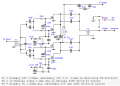
I recently built a class AB amplifier for the LW/MW band, and am in the process of testing it. The schematic of the output stage
is shown below. The driver stage is a TDA2030 audio amplifier module, whose output is connected to the input of
impedance-matching/phase-splitting transformer T1. A signal generator drives the TDA module. The bias (12V) and the TDA
driver stage are both supplied with a linear power supply, 15V 2A. The amplifier itself is supplied with a Basetech 30V 5A SMPS.
I'm using a 50 ohm 250W dummy load.
lwamp.png amp2.png

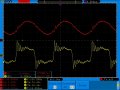
I started by setting the SMPS supply at 20V and current limited at 0.1A. This produces waveform 1 - red trace is at the gate of
one of the MOSFETs (the signal is identical at other mosfets, except for inverted phase in other pair), and yellow trace is at the
drain of the MOSFET.
Now I increase the current limit on the SMPS to 0.3A. This gives waveform 2, which is essentially the same as waveform 1, maybe
a bit more noisy and the power is higher as expected.
However, when I now increase the SMPS current limit beyond approximately 0.35A, something weird happens - waveform 3. The
signals both at the gate and drain become distorted and other peaks/oscillations appear. As soon as I lower the current back to
0.3A or lower it goes back to normal. I have also tested the output with one of those AC voltage sensing pens, and the power does
increase when I increase the current limit on the SMPS beyond 0.35A (the pen senses further from the output ), but the waveform
becomes unstable and distorted. Does anybody have any idea what could be happening?
rgate1_yout_Is01A_Vs29V.jpg rgate1_yout_Is03A_Vs73V.jpg rgate1_yout_Is035A_Vs105V.jpg

There also is some oscillation at the transitions. I tried placing two 10nF caps at the drains and this works
quite well in eliminating it. Is this an acceptable way of solving it? Also the waves are square
waves, they are supposed to be filtered through a LPF which I have disconnected for the purposes of testing
the amplifier.
 

dendad

Joined Feb 20, 2016
4,637
Your layout could be the problem. Can you add a metal shield between the input and the output?
As it is, it looks like there is a real chance of feedback. Often RF amps have a number of separate compartments for shielding.

This is of course assuming the circuit is correct.
 

Thread Starter

tmarco

Joined May 31, 2018
22
I tried placing a aluminum plate in between different components to see whether I could spot
a difference but no luck. You're right about the shielding, I read about it before starting the
build (it's my first build of this kind), but I guess I didn't take it seriously enough. The circuit
itself should be correct, I have re-drawn it from the connections and it looks as it should. I got
the schematic from this website (g0mrf.com/lf.htm), and have followed the construction details as specified.
The only significant thing that differs is that the toroid for T1 that they have is a low-permeability core (fair-rite 59 series),
whereas I have a ferrite one with what i think is a higher permeability (chinese generic). Still there are
no saturation issues there so it should be ok. The circuit itself is well-known and has been reproduced many
times.

With regards to shielding, do you mean to shield only the output BNC plug from the rest of the circuit,
or to shield the whole output section, so starting from the secondary of T3, from the rest? Aside from that, is
there anything else you would advice doing/measuring, before I would start any re-wiring process to insert
shielding?
 

dendad

Joined Feb 20, 2016
4,637
If you look at the layout of the amp on that web site, for one thing, it is on a PCB with a ground plane. And each toroid id a right angles fromthe previous one. There are no long wires at all in that amp.
Your constructing is not real good for RF. All the connections need to be as short as possible. Try to imagine each wire as a transmitting antenna, and the others as receivers. The idea is to ensure no wire picks up a signal from another. It is like speakers and microphones, you do not want feedback unless you design it in on purpose. I would suggest you try the PCB version if you can.
At least put the driving amp in a separate shielded area. And the same for each transformer if you can.
But Sort Wires are a must.

What is your reason for building this amp?
 

Thread Starter

tmarco

Joined May 31, 2018
22
Well I don't really have a particular reason for building it, it was more out of interest and for learning
purposes. I had read that it is good to keep connections short in RF, but I thought
that the LW/MW bands still have very long wavelengths compared to any wire I'm using so I assumed
that it would be acceptable in this case. I guess I was wrong. The PCB version is part of a kit - since I've
already acquired the components myself I'd prefer to somehow modify the existing version. I have some
copper sheet metal that I can use for isolation, and I can see how to rearrange things so that wire lengths
are minimized. With regards to the ground plane, is it possible to use the bottom of the aluminum enclosure
for this purpose? Or should currents not flow through there? Otherwise, I have another 20x10 cm copper sheet that I could mount on the bottom (isolated from enclosure), and use this as ground plane. Thanks for the input.
 

Bordodynov

Joined May 20, 2015
3,431
By increasing the current, you increase the gain of the transistor and its boundary frequency, and this can increase the instability of the amplifier. Sometimes ferrite beads are used to eliminate parasitic generation. Sometimes it helps even a small ferrite ring (D=4mm) on the gate.
 

dendad

Joined Feb 20, 2016
4,637
For a start, mount the driver amp on the chassis beside the input socket, but close to the input transformer to the FETs. The chassis is a good heatsink so you can toss the finned one.
Keep the input wires very short. As bordodynov mentioned, some ferite beads on the FET gates can help knock the high frequency enough to help stability. If there is an input volume control, have the shielded wires to it short as well, and far from the high power outputs.
Do your best to keep any output signal from being picked up on the inputs. An aluminium wall between the in and out sounds like a good idea.
 

Thread Starter

tmarco

Joined May 31, 2018
22
Hi guys,
I have rebuilt the amplifier according to your instructions - short(er) and less wiring, ground plane, and copper plates inbetween
sections for isolation. I have also built the LPF separately. Now I'm getting a nice clean sine wave (137kHz) at ~85 Vrms,
this is about 145 Watts. The current draw is also in accordance with this number (4.5A at ~31V).
My SMPS can only deliver 150 Watts so I figure this is as much as I'll pull from it. The only thing
I noticed is that the 27ohm gate resistors get hot during operation, but it's because their power rating is less than the TDA
is putting out. I'll replace them. I also ordered some ferrite beads but it doesn't look like I'll need them for now.

Thanks for your help @dendad and @Bordodynov, it is really satisfying to finally get the amp to work!
 

Thread Starter

tmarco

Joined May 31, 2018
22
@dendad
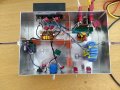
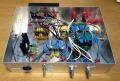
Below you can see the amp as it is now. There are still some wires which I would've liked to have shortened,
like the 12V supply leads and the T2/T3 leads, but I think this is the best I could do without rebuilding it completely.
You can see I used some tape, but that was only temporary - it's not holding anything together that isn't
fastened otherwise, I just didn't remove it yet. Also the LPF is shown (5th order Cauer filter). It still needs an
enclosure because I didn't have any at hand when making it.

Cheers

amp.jpg lpf.jpg
 
Top