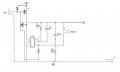
Have been using a bench supply for development but power is to come from 3.6V lithium batteries. Circuit works fine on 3.6V but when I connect the transmitter it stops working...
The Tx is quite powerful (100mW) and draws c125mA during transmit. When the battery has to deliver that in addition to the 10mA or so for the circuit and LED it drops to below 2.9V and stops driving the opto led. If I hold set, it goes into some kind of looping condition.
In the solution that this is being designed to replace we use three ER17505 batteries in parallel. I'm thinking I may have to separate the power for the circuit/LED (1 battery) and the transmitter (2 batteries).
The 4.5v is the recommended minimum supply to meet specs. Obviously it will work in this circuit but component values needed to be changed due to the lower voltage limitations.
SG
As it should. Here's the break down. The output from the LM555 as loaded is 2.2 volts with a 3.6 volt supply. The typical forward voltage across the IR LED in the opto is 1.3v. Now 2.2 - 1.3 = .9 volt left across the 390 ohm resistor R2 and .9v/390 = 2.23ma.
The typical current required to operate the VO14642 is only .5ma with worst case at 2ma so you still have plenty of drive current to operate the opto.
SG
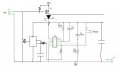
Looking at the original circuit I got to wondering if it could be fixed. I believe the original problem is that Pin 3 (out) cannot rise above Pin 1 (V+), so the addition of a N-type FET and a pull up resistor ought to resolve that.
Rearranged like that I'd expect it to idle with both FETs off and no power to IC1. The resistor on Set should hold the P-FET off.
Supplying set will turn on the P-FET, power the IC, and cause pin 3 to go/stay low. With Pin 3 low the N-FET should turn on, holding the P-FET gate low.
When pin 3 goes high the N FET will turn off, the P FET will follow, at which point IC1 will be powered down and Pin 3 will fall to ground again.
Incidentally a small NPN transistor with a reasonable base resistor (100K?) could be used instead of a N FET.
Thanks, that might indeed address the original question.
Could it be modified to accommodate the requirements to hold power on for at least a second after timeout or Reset and also to run from two different batteries so that the control circuit isn't upset by the volt drop when the transmitter is in operation (draws 125mA for 720mSecs)?
OK the power hold shouldn't be hard, you could use the 555 circuit like on the other version. Since the output of the 555 goes from high to low at time-out you could wire the N FET the normal way with the 555 timer output going to the N-FET gate.
Regarding voltage drop there's a very simple trick you could add to make the timer harder to disrupt. Currently your timer has no DC bypass capacitor. If you also add a schottky diode (low voltage drop) you can prevent backflow from the timer's supply, enabling it to "ride through" short disruptions. That should avoid the need for a second battery.
Agreed, but I'm keen to understand the options. The FETs would save 2.5mA of opto drive current. That would increase control circuit battery life by c38%.
Message board won't let me reply (and quote) to your post, anyway regarding the microcontroller it comes down to priorites.
The ICM7242 timer is relatively expensive, I'm seeing a list price of over £5 for 1-off, but you could get a PIC10F200 for under 50p.
The timer needs external RC components, the microcontroller has on-chip oscillator, on-chip reset, and the logic output drive might even be enough to switch your load directly if it is of the order of 5-10mA. Also if you need two timing stages using hardware you'd need two timers, with a microcontroller you just add stages to the program.
If you want to avoid programming there are some logic IC alternatives worth looking at. The CD4541 timer is arguably much more flexible, but being 4000-series MOS it is rated down to 3V, not 2V.
Using HCMOS gets you 2V operation, but the chip count may creep up.
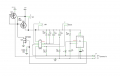
Here's an option with all FETs I think should work but have not verified on breadboard.
You can also save about 1.3ma by using a TLC555 instead of the LM555.
OK the power hold shouldn't be hard, you could use the 555 circuit like on the other version. Since the output of the 555 goes from high to low at time-out you could wire the N FET the normal way with the 555 timer output going to the N-FET gate.
Regarding voltage drop there's a very simple trick you could add to make the timer harder to disrupt. Currently your timer has no DC bypass capacitor. If you also add a schottky diode (low voltage drop) you can prevent backflow from the timer's supply, enabling it to "ride through" short disruptions. That should avoid the need for a second battery. View attachment 215827
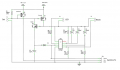
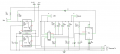
Quite like the separation of power so did a sort of double version of your original circuit and then started playing around trying to find a way to hold the power up for a second or so after Reset without the complexity of a 2nd timer.
Ended up with this which seems to working. Look OK to you?

 Facebook
 Google
 GitHub
 Linkedin

 .
.