Low volume tube amplifier issue

Thread Starter

Skylar Coy

Joined Apr 29, 2017
133
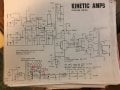
Hello, It has very little volume, with everything on 10 it barely sounds louder than an iphone lol. I have replaced all filter capacitors, a new output transformer, new master volume pot and i do not know where to go from here. The two diodes i circled in red I know are broken and I am going to pick up some new ones monday. Would those impact the volume? enlighten me with some troubleshooting steps I can take to diagnose the problems. It is getting old just replacing parts unit it works
IMG_0909(1).JPG
 

bertus

Joined Apr 5, 2008
22,922
Hello,

How many threads do you need for this amplifier?
You have several threads under this name and also on the other name you use.

The leds will have no influence on the volume.
The main pot will (it is a double ganged potmeter of 1M).

Bertus
 

Thread Starter

Skylar Coy

Joined Apr 29, 2017
133
sorry, got that cleared up. Its a post phase inverter master volume. It has a 500k pot in there now would having a 1meg make a volume increase?
 

ian field

Joined Oct 27, 2012
6,536
Hello, It has very little volume, with everything on 10 it barely sounds louder than an iphone lol. I have replaced all filter capacitors, a new output transformer, new master volume pot and i do not know where to go from here. The two diodes i circled in red I know are broken and I am going to pick up some new ones monday. Would those impact the volume? enlighten me with some troubleshooting steps I can take to diagnose the problems. It is getting old just replacing parts unit it works
View attachment 127322
Dodgy filter capacitors would cause hum - you should look at cathode bypass capacitors instead.

A low emission tube would also kill volume.
 

Thread Starter

Skylar Coy

Joined Apr 29, 2017
133
Unless you have an ESR tester, replacement is probably easiest.

They don't have to be anything special - but I'd use brand new parts rather than recovered spares.
It does have a decent ammout of gain and some early breakup. I'll get some new ones and throw them in there, along with some new diodes.
 

ian field

Joined Oct 27, 2012
6,536
It does have a decent ammout of gain and some early breakup. I'll get some new ones and throw them in there, along with some new diodes.
If it ain't broke don't fix it. Check the rectified rails - if they're up to spec it isn't the diodes. The schematic shows series HT diodes but no balancing resistors. They're probably avalanche protected, if you use regular rectifiers in series; leakage spread can result in unequal sharing of PIV and breakdown.
 

Thread Starter

Skylar Coy

Joined Apr 29, 2017
133
If it ain't broke don't fix it. Check the rectified rails - if they're up to spec it isn't the diodes. The schematic shows series HT diodes but no balancing resistors. They're probably avalanche protected, if you use regular rectifiers in series; leakage spread can result in unequal sharing of PIV and breakdown.
Well, upon inspection they are black and charred and my diode test on my multimeter shows them bad.
Also the 4 diodes shown on the schematic (not the 1n4005) is a rectifier tube.
 

ian field

Joined Oct 27, 2012
6,536
Well, upon inspection they are black and charred and my diode test on my multimeter shows them bad.
Also the 4 diodes shown on the schematic (not the 1n4005) is a rectifier tube.
A rectifier tube can also have low emission.

Once I put silicon rectifiers in parallel with the rectifier tube in a guitar amp - it was a fair bit louder and there was a pretty blue glow around the edges of the output tube plates. If you do silicon in a guitar amp - you're supposed to put about 100R power resistor in series with it.
 

Thread Starter

Skylar Coy

Joined Apr 29, 2017
133
A rectifier tube can also have low emission.

Once I put silicon rectifiers in parallel with the rectifier tube in a guitar amp - it was a fair bit louder and there was a pretty blue glow around the edges of the output tube plates. If you do silicon in a guitar amp - you're supposed to put about 100R power resistor in series with it.
Im going to try that also. I prefer solid state rectification anyway. Just making sure, could it be the power transformer? What is a list of suspicion? I am going to do the cathode bypass capacitors next, then convert to solid state rectification. Where after that? Tube sockets?
 

ian field

Joined Oct 27, 2012
6,536
Im going to try that also. I prefer solid state rectification anyway. Just making sure, could it be the power transformer? What is a list of suspicion? I am going to do the cathode bypass capacitors next, then convert to solid state rectification. Where after that? Tube sockets?
Bear in mind that thermionic rectifiers don't usually fail short circuit and silicon rectifiers usually do.

A fuse might save the mains transformer from such a failure - but its a thin margin between reliability and blowing when it needs to.

A tube with grids can short relatively easily - it takes a pretty catastrophic failure to cause a short in a rectifier tube.

Failing short circuit is very easy for silicon rectifiers. You need single diodes with a substantial voltage safety margin - or series diodes with parallel balancing resistors across each diode to swamp out leakage spread and unequal voltage sharing.

Avalanche protected rectifiers might be OK in series - but its not something I have hands on experience.
 

Thread Starter

Skylar Coy

Joined Apr 29, 2017
133
Well, i adjusted the tube bias to the proper 70% of 37ma from 17ma. That did help. The post phase inverter master volume is also too low of a value. It is 500k when it should be 1meg. Probably is still draining signal to ground. I'll get a new 1 meg pot and get back to you guys.
 

yevgeny

Joined May 20, 2017
15
If filter cap's are not good - it sounds 120Hz on output, or even amplifier will self oscillating. If cap has leak - filter resistor will hot.
Low output can be if potentiometer 5K (feedback level) is open.
 

Thread Starter

Skylar Coy

Joined Apr 29, 2017
133
well guys, after a bit of digging and trouble shooting i have it back to what I believe is norma volume. Now I am just making some modifications to make it more my style. It has was too much bass which I figure I can change those two .12 coupling caps to .022 to allow some more treble through but the distortion also sounds pretty crappy as in it is buzzy and not very smooth. I would usually say a low pass filter would help here but i don't think so because it would cut more highs when I already need more of them. It sounds like it clips and is not very smooth. Preamp gain purely mind you. when i roll back the treble knob it does smooth out but it sounds muddy and very off then. If i changed those coupling caps to a lower value, therefore letting more highs through but cutting some right after the preamp (where the distortion is coming from) with a low pass filter would that help? I can smooth out the preamp gain while getting more highs. My theory is since those coupling caps are so large it is cutting all the highs but the preamp still has that really spikey distortion so that defeats it lol. any ideas
 
Last edited:

yevgeny

Joined May 20, 2017
15
You aren't allow some more treble through. You cut off low frequency.
Preamp's have different gain and frequency respond. For frequency correction play with bypass caps.
 
Top