Low Power Schmitt Trigger with BJTs

B-JoJo-S

Joined Jan 3, 2026
332
I need a circuit made of discrete components to start charging a Lipo battery (inside a wall clock) rated 1.2v and 800mA when the voltage goes down to 1 v and stop when it is 1.2v.
I was referring to the only battery I'm familiar with is one that is nominally 1.2V, which is a NiCad.
You aren't familiar with NiMH (Nickel Metal Hydride) cells?
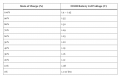
No. Not until looking them up. https://batteryskills.com/nimh-battery-voltage-chart/ But I am now.
 

B-JoJo-S

Joined Jan 3, 2026
332
Cut & Paste from the above link:
NiMH cells have a nominal voltage of 1.2V, with a fully charged cell reaching up to 1.4V. The voltage of a NiMH battery drops quickly to about 1.2V during discharge and remains relatively constant until it nears complete discharge at around 1.0V.
If the TS wants to shut charging off at 1.2V then the battery is never going to reach a full charge.
Screenshot 2026-03-30 at 12.04.31 PM.png
 

Thread Starter

vandveuser16776

Joined Feb 21, 2026
230
NiMH cells have a nominal voltage of 1.2V, with a fully charged cell reaching up to 1.4V. The voltage of a NiMH battery drops quickly to about 1.2V during discharge and remains relatively constant until it nears complete discharge at around 1.0V.
If the TS wants to shut charging off at 1.2V then the battery is never going to reach a full charge.
That is why I was looking for 1v to 1.2v hysteresis in the first place. The battery may fill up to 1.5v but that just depletes the battery. 1.1v to 1.2v is the best range to keep them if you want to leave them on shelf, or constantly charging/discharging them.
 

crutschow

Joined Mar 14, 2008
38,532
1.1v to 1.2v is the best range to keep them if you want to leave them on shelf, or constantly charging/discharging them.
You may find that 1.2V is to low to maintain a decent charge, but perhaps it will work okay for your wall-clock application.

What type of clock is it?
My wall clocks run about a year on one rechargeable NiMH AA.
 

Thread Starter

vandveuser16776

Joined Feb 21, 2026
230
You may find that 1.2V is to low to maintain a decent charge, but perhaps it will work okay for your wall-clock application.

What type of clock is it?
My wall clocks run about a year on one rechargeable NiMH AA.
It is one of those silent ones that do not tick-tock. It has a tiny motor and spins pretty fast. But I guess the downside of that no-ticking is more battery consumption. Even regular batteries do not last as long. I noticed that. Compared to those one that tick, tis one is a battery hog
 

crutschow

Joined Mar 14, 2008
38,532
t is one of those silent ones that do not tick-tock. It has a tiny motor and spins pretty fast.
It similar to the standard clock motor that steps once/second expect it steps faster (i.e. 16 step/second) so the clock second-hand appears to move in a smooth motion.
Of course that means it uses more current than the ticking type.

They can take 1mA or more of current, so you will need to likely charge about 24mAH of capacity every day.
Can your solar panel deliver that much on an average day of sunshine?
 
Last edited:

Thread Starter

vandveuser16776

Joined Feb 21, 2026
230
It similar to the standard clock motor that steps once/second expect it steps faster (i.e. 16 step/second) so the clock second-hand appears to move in a smooth motion.
Of course that means it uses more current than the ticking type.

They can take 1mA or more of current, so you will need to likely charge about 24mAH of capacity every day.
Can your solar panel deliver that much on an average day of sunshine?
Interesting! I knew there must be some pulse at work and that needs to be governed by that crystal, but i didnt know it was like a stepper motor.
The wall that the clock is on, does not see direct sunlight, but I connected the cell to a white LED and from the light from the ceiling bulbs, it sort of turned on. It gives at least 4mA, so, the battery should get its juice back in 6 hours.
 

schmitt trigger

Joined Jul 12, 2010
2,093
That is why I was looking for 1v to 1.2v hysteresis in the first place. The battery may fill up to 1.5v but that just depletes the battery. 1.1v to 1.2v is the best range to keep them if you want to leave them on shelf, or constantly charging/discharging them.
I don’t think this is correct.
But I can accept being wrong with the proper facts presented to me.

Edit: where did you find this information?
 

Thread Starter

vandveuser16776

Joined Feb 21, 2026
230
I don’t think this is correct.
But I can accept being wrong with the proper facts presented to me.

Edit: where did you find this information?
I did not have any fact other than the rated voltage on the battery's package that says "1.2v" and that other than NiCad batteries, complete depletion can damage rechargeable batteries. The second part was just somewhere in the back of my mind, not based on any deep research. But the clock wont work if the battery drops below 1v so, I did not even think much about factuality as I had in mind functionality. So what do the facts say about NiMH batteries? I appreciate insights.
 

schmitt trigger

Joined Jul 12, 2010
2,093
I wasn’t talking about low voltage depletion.
But rather as B-jojo mentioned, limiting the upper charging threshold to only 1.2 volts will leave a lot of unused battery capacity. Go to at least 1.35 volts.
 

Thread Starter

vandveuser16776

Joined Feb 21, 2026
230
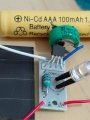
I saw these lawn lamps and thought get a few of them to see what is inside. They all have the same IC YX805 which is designed for 1.2v batteries. They come in different size and different batteries but the IC is the same. Now I am testing one of them to see if they work. Just removed the LED and the inductor
 

Attachments

Last edited:

Thread Starter

vandveuser16776

Joined Feb 21, 2026
230
It was B-JoJo-S #22

"NiMH cells have a nominal voltage of 1.2V, with a fully charged cell reaching up to 1.4V. The voltage of a NiMH battery drops quickly to about 1.2V during discharge and remains relatively constant until it nears complete discharge at around 1.0V."
that bolstered my guess that 1.2v is the best
 

crutschow

Joined Mar 14, 2008
38,532
It was B-JoJo-S #22

"NiMH cells have a nominal voltage of 1.2V, with a fully charged cell reaching up to 1.4V. The voltage of a NiMH battery drops quickly to about 1.2V during discharge and remains relatively constant until it nears complete discharge at around 1.0V."
that bolstered my guess that 1.2v is the best
If you find it's not charging sufficiently to keep the clock running than you may need to increase the charge voltage to greater than 1.2V.
The charge voltage tends to be a little higher than the discharge voltage for a given battery charge level.
 
Last edited:

Thread Starter

vandveuser16776

Joined Feb 21, 2026
230
If you find it's not charging sufficiently to keep the clock running than you may need to increase the charge voltage to greater than 1.2V.
The charge voltage tends to be a little higher than the discharge voltage for a given battery charge level.
The main issue is not having sunlight where the clock is. The solar cells that come with those garden lights are too weak. I replace them with a 4.5cm x 8cm cell that gives about right voltage but still not enough current. Still appreciate the design you came with. I have to start a new thread and need your help, the title will be "Shcmitt Trigger for Mini PC" so, it needs a new thread. I do not know how to calculate the resistors.
Cheers!
 

Danko

Joined Nov 22, 2017
2,172
The main issue is not having sunlight where the clock is. The solar cells that come with those garden lights are too weak. I replace them with a 4.5cm x 8cm cell that gives about right voltage but still not enough current.
May be solar cell power is enough, but clock consumes current as very short, high current pulses.
Connect capacitor 100 - 470 μF parallel to solar cell for experiment. It should help.
1775008789674.png
ADDED: Do not use accumulator in experiment!
 
Last edited:

crutschow

Joined Mar 14, 2008
38,532
How about a different approach--
Is there room in the clock for an added battery holder?
For example, an alkaline D-cell has 4-6 times the capacity of an AA alkaline.
For even more capacity, you could put two or more D-cells in parallel.
 

Thread Starter

vandveuser16776

Joined Feb 21, 2026
230
I can add 10 AA batteries behind the clock face. The thing is, I am sort of obsessed with "greenness" and hate contributing to the landfill. It is more about producing less waste than hassle of changing batteries. Plus, it feels good to look at it and know it is harnessing the energy that bounces off anyway if you dont catch it !
 

crutschow

Joined Mar 14, 2008
38,532
The main issue is not having sunlight where the clock is. The solar cells that come with those garden lights are too weak. I replace them with a 4.5cm x 8cm cell that gives about right voltage but still not enough current.
How did you determine it's not enough for the clock?
I am sort of obsessed with "greenness" and hate contributing to the landfill.
I am with you on that.
We have over a dozen battery-operated clocks in our house (we love clocks) and I am using rechargeable batteries in all that use AA batteries, except for one that doesn't work properly with the lower NiMH voltage.

So options would seem to be: use a larger solar cell, or use two or more AA rechargeable batteries in parallel to give a decent interval between charges.
 

Thread Starter

vandveuser16776

Joined Feb 21, 2026
230
How did you determine it's not enough for the clock?
Based on that 1mA. Even the big ones (4.5x10) give about 50uA with artificial light, and ~300uA with the indirect light of the day. Sunlight is like 6 times more powerful. Even when the ambient light seems to be about the same as 2x100w LED (each about 1000 lumens)
 
Top