That's why I suggested a current transformer, 500 turns for a dollar or two. Alternatively, I wonder if a sensitive Hall Effect sensor would work if stuck to the side of the coil.
Hi all,
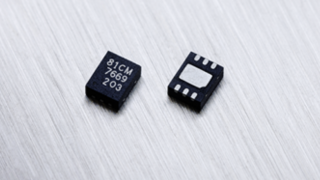
Newbie here. I'm into restoring electromechanical arcade games. I would like to design a sensor/circuit that can detect when a AC relay coil is energised. This circuit would output a TTL HIGH when the coil is on and a TTL LOW when it is not on. I have tried using a reed switch but when the coil is energised the reed is switching at 120Hz. The AC relays in question are show below. In this game the relay coils are rated for 50VAC.
Thanks in advance.
Use a Bridge Rectifier in series with the coil, this will drop 1.4V with a 10ohm load, and you can use that to feed a mosfet transistor to switch on a light or another sensor
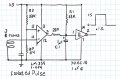
Operates great on bread board. With manual shorting SW on input was able to shrink clean output pulse down
to 75 ms. R2 = 33k, R3 = 33k. 3 turns on 120V AC relay coil. Vdd = 5 V. Schmitt trigger = 74 HC14.
Out of time now.
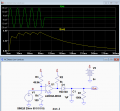
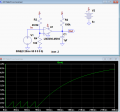
I'll throw in the circuit as bread boarded with pin numbers. Waveform at C1 is the same as post # 46, except that the recharge time is shorter. If using this or similar I would connect new turns to circuit board with twisted pair of wires. Ea. relay with own pair with common ground at CB.
Not so much luck with Hall effect IC, but ID unknown & seems to be not very sensitive, might be RS or Archer # 276-1646. Could make it conduct if sticking it directly between armature and polepiece, but then we have a choke rather than a relay.
Has any one tried with a sensitive Hall ?
Not so much luck with Hall effect IC, but ID unknown & seems to be not very sensitive, might be RS or Archer # 276-1646. Could make it conduct if sticking it directly between armature and polepiece, but then we have a choke rather than a relay.
Has any one tried with a sensitive Hall ?
When I was searching for Hall Effect sensing options, I was shocked by the wide tolerances on most Hall Effect "switches," by which I mean sensors with a binary, on/off output, as opposed to ratiometric sensors with analog outputs.
Your sensor's operating point can be anywhere from 70-350 gauss. That's a factor of 5! So the next sensor you grab, same make and model, could potentially be 5 times more (or less) sensitive.
By comparison, the SS495A ratiometric Hall Effect sensor provides an analog output, sensing +/-670 gauss, with only +/-4% error. It outputs 3.125mV/gauss, so if you could start with a signal as low as 10mV, as in one of the earlier circuits, you could detect as little as 3 gauss!
I'll try to remember when I get to work tomorrow to measure field strength on a few of our solenoid coils. I'll let you know what I find.
So, I forgot that the magnetic field would be alternating rapidly and that my SS495s are already wired in circuits that would only read DC, not AC, so I didn't get SS495 measurements, but I did get measurements with a Hamlin 55100 (maybe now Littelfuse 55100?) which is perhaps better suited to this application anyway. It's higher sensitivity (11mV/gauss vs. 3.125mV/gauss) and is in a flange-mount package with wire leads, so it wouldn't take much preparation to attach it to the side (or top) of a coil.
I measured two valves, one a 24VDC, 5W solenoid valve being driven by PWM, and the other 240VAC, 9W:
24VDC, 5W (top of coil): 70mV DC (6.4 gauss)
240VAC, 9W (top of coil): 300mV AC (27.3 gauss, RMS?)
240VAC, 9W (side of coil): 100mV AC (9.1 gauss, RMS?)
I've gotta get to work now, but let me know if you have any questions about these readings.

 Facebook
 Google
 GitHub
 Linkedin