Long Range PIR sensor.

Thread Starter

BuildStuff

Joined Jan 18, 2025
7
Hello Everyone:

I am looking for assistance in finding a long range PIR Sensor. I am working on a security project and am trying to get a detectin range of 100 feet or roughly 31 meters.

So far, the longest range PIR sensor I could find is from Panasonic. The EKMC4604112K which has a range of 17 meters and a detection angle of 100 degrees.

I know I can increase that range slighty with a Fresnel lens but that would likely only get me to roughly 20 meters.

Does anyone know of a longer range PIR sensor that could get me to my desired range. Or, if anyone has any oher suggestions to accomplish the distance, I would be very grateful to hear them.

Thank you and have a wonderful day.
 

Thread Starter

BuildStuff

Joined Jan 18, 2025
7
No. I'm speaking of an infrared beam that when broken activates the alarm.
Sorry, I misunderstood. I want to detect movement of predators on the farm and there are other moving items lke tree branches, etc which is why I am designing it based on a heat signature movement. Thanks you....
 

ronsimpson

Joined Oct 7, 2019
4,645
I tried motion sensor cameras. They almost work. My problem is the cameras light up the field with IR so they can see. In the summer nights bugs gather around the cameras because of the IR. I have some good pictures of bats eating bugs near the cameras. I don't have a good answer.
 

MisterBill2

Joined Jan 23, 2018
27,159
Given that the mechanism of PIR motion sensing is the variation in energy detected as the source image moves past the variations in the lens on it's way to the detector. There are two limitations, the first being that the energy detected drops as the distance gets longer, and the second being that the angular movement slows as the source angle crossed gets smaller.
The "quick fix" is a drop in the ambient temperature, because it increases the contrast. That is why my one sensor detects folks and animals moving by at a much greater distance in the colder weather.

One scheme would be to rapidly sweep the monitored area with an IR beam, effectively making the predator's radiation brighter. That could be a rotating mirror and an IR floodlight, or a group of bright IR LEDs. The IR LEDs will need to be aimed away from the sensor, and the flashes could be rather short. In fact, the LED IR source would not need to rotate, just short pulses, long enough to be seen by the PIR sensor system.
 

Dayod

Joined Dec 3, 2021
7
Maybe we can install 3 units of the longest range PIR in a straight line to cover 31 meters. The 2nd or 3rd unit beam coverage should overlap with the previous to avoid blind spot..
 

ronsimpson

Joined Oct 7, 2019
4,645
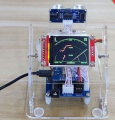
I am looking into "sonic radar using Arduino". They can only do 10m depending on the price.
It uses a sonic range finder to measure the distance to an object.
Some of these projects are using real radar not sound.
I don't know much about it.
1737254000073.png
 

GetDeviceInfo

Joined Jun 7, 2009
2,270
Tune your setup with sensor/lens combination. Too broad a field, or multiple lens, floods the sensor with noise, reducing its sensitivity. Long range is a tradeoff with a broad range. A single lens fresnel such as This one, has a 10 degree viewing angle, but can reach out. Consider the sensors viewing angle as well, as it should match the lens diameter at the focal length. Generally, the larger the single lens is, the more radiation it will send to the sensor, extending it's range.
If you wanted to illuminate the target area, you could use a similar fresnel to culminate the source into a spot light.
 

GetDeviceInfo

Joined Jun 7, 2009
2,270
Maybe we can install 3 units of the longest range PIR in a straight line to cover 31 meters. The 2nd or 3rd unit beam coverage should overlap with the previous to avoid blind spot..
Years ago I was involved in a project where satellite eyes would trigger a central camera by radio, where the camera would motor to, then zoom into the triggered area, to capture images. One installation observed a 1/4 section of land, where the owner was monitoring ungulates prior to the hunting season.
 

ericgibbs

Joined Jan 29, 2010
21,390
I am designing it based on a heat signature movement.
Hi Build.
If the animals you are trying to detect are wet, say with rain or snow and are fur covered, it significantly reduces the PIR detection range.
If you have remote mains or battery power at the required detection areas, use standard PIR's and low cost RF HC12 TX/RX or any other type of RX/TX module, to relay the detection signals to your house.

E
 

Ya’akov

Joined Jan 27, 2019
10,226
I would suggest you investigate FMCW radar-based presence detectors, particularly ones offered by Hi-Link. PIR sensors are extremely bad at almost everything that requires discrimination. The way they operate makes long distance operation extremely unlikely.

The new FMCW radar detectors actually use intelligent discrimination and they are quite inexpensive, less then $20.00USD for a very sophisticated one. You can tune the parameters via a supplied app that uses BLE to connect.
 

Thread Starter

BuildStuff

Joined Jan 18, 2025
7
Given that the mechanism of PIR motion sensing is the variation in energy detected as the source image moves past the variations in the lens on it's way to the detector. There are two limitations, the first being that the energy detected drops as the distance gets longer, and the second being that the angular movement slows as the source angle crossed gets smaller.
The "quick fix" is a drop in the ambient temperature, because it increases the contrast. That is why my one sensor detects folks and animals moving by at a much greater distance in the colder weather.

One scheme would be to rapidly sweep the monitored area with an IR beam, effectively making the predator's radiation brighter. That could be a rotating mirror and an IR floodlight, or a group of bright IR LEDs. The IR LEDs will need to be aimed away from the sensor, and the flashes could be rather short. In fact, the LED IR source would not need to rotate, just short pulses, long enough to be seen by the PIR sensor system.
That is a very interesting concept that I never thought about before to focus the IR energy on specific zones. My main concern would be power consumption since I am planning on running this on battery and have the images sent back to me via RF. Thank you very much. I am going to definitely look into this further.
 

Thread Starter

BuildStuff

Joined Jan 18, 2025
7
Maybe we can install 3 units of the longest range PIR in a straight line to cover 31 meters. The 2nd or 3rd unit beam coverage should overlap with the previous to avoid blind spot..
I thought that exact same thing. However, more sensors will not extend me range. It will however boost the sensitivity so upon learning that, I will likely use multiple PIR sensors. Thank you for the suggestion.
 

Thread Starter

BuildStuff

Joined Jan 18, 2025
7
Hi Build.
If the animals you are trying to detect are wet, say with rain or snow and are fur covered, it significantly reduces the PIR detection range.
If you have remote mains or battery power at the required detection areas, use standard PIR's and low cost RF HC12 TX/RX or any other type of RX/TX module, to relay the detection signals to your house.

E
Thank you... I do intent to use a RF HC12 or similar device to relay a signal. Great minds....
 

Thread Starter

BuildStuff

Joined Jan 18, 2025
7
I would suggest you investigate FMCW radar-based presence detectors, particularly ones offered by Hi-Link. PIR sensors are extremely bad at almost everything that requires discrimination. The way they operate makes long distance operation extremely unlikely.

The new FMCW radar detectors actually use intelligent discrimination and they are quite inexpensive, less then $20.00USD for a very sophisticated one. You can tune the parameters via a supplied app that uses BLE to connect.
I never even considered that. That is a very good idea. I am definitely checking into this as well. Probably get a lot more range as well. I imagine it will require a microcontroller and I will have to see what interface it comes with but I could definitely see this as a viable option for monitoring the farm. My only concern is how much power it will require. Thank you very much for this suggestion.
 

MisterBill2

Joined Jan 23, 2018
27,159
One possible alternative would be a smart camera scanning the area, and then software to spot motion in the areas where the livestock does not go. THAT should be much simpler than actual image analysis.
An additional option would be several PIR devices much closer to the perimeter, each with a motion triggered wireless link to let you know where to point the video camera. That might not consume so much power since it would be passive until triggered.
 
Top