long or short beep detector?

Thread Starter

ShelbyDogg

Joined Jun 28, 2024
11
I'm trying to find a circuit that can distinguish between a 1/2 second tone and a 1 second tone. I'm working with a hearing-impaired employee and a device that beeps a 1 second beep when new orders come in, then emits a 1/2 second beep when a button is pressed to fill it. These come out of a speaker on the device now.
I have a circuit that will trigger a strobe doorbell with any beep, so I need help with a simple circuit to compare the length of beeps and send a voltage to trip a relay or LED. It only has to trigger on the longer one of the 2 beeps. Thanks in advance.

I can send a short video with the sounds if you e-mail me. I can't attach it with the current extension.
 

Thread Starter

ShelbyDogg

Joined Jun 28, 2024
11
A 555 timer one-shot circuit could do that.
What is the output voltage and pulse length of the strobe doorbell circuit?
my strobe doorbell is a unit off of ebay. so this circuit just has to trigger the wireless battery powered push button that would normally be mounted outside a front door. Doing that with an NPN transistor across the contacts.
 

Attachments

Thread Starter

ShelbyDogg

Joined Jun 28, 2024
11
Depends upon how many blinks there are.
Sounds like there may be only one.
It would be just like a compare circuit. A one second pulse turns on a green LED, a 1/2 second pulse turn on a red LED. Anyone able to help these 2 timed noises with a simple circuit?
 

MrChips

Joined Oct 2, 2009
34,630
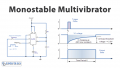
The circuit you need is called a monostable multivibrator, usually simply called monostable.

1719671750637.png

An input trigger signal charges a capacitor. The capacitor then discharges until a given voltage level is reached. The time between the trigger signal and the end of the discharge cycle is determined by external resistance R and capacitance C and is called the time period. The device outputs a logic signal during this period.

In your case, you can solve the problem with two monostables. It can also be solved with a single monostable with a time period of 0.75 seconds.
 

crutschow

Joined Mar 14, 2008
38,331
.
It would be just like a compare circuit. A one second pulse turns on a green LED, a 1/2 second pulse turn on a red LED. Anyone able to help these 2 timed noises with a simple circuit?
Do you want the LEDs to stay on until they are manually reset?
my strobe doorbell is a unit off of ebay. so this circuit just has to trigger the wireless battery powered push button that would normally be mounted outside a front door. Doing that with an NPN transistor across the contacts.
So what is the signal that will go to the compare circuit?

I'm confused as to the function of the doorbell module in this application.
 
Last edited:

Thread Starter

ShelbyDogg

Joined Jun 28, 2024
11
Thank you everybody that answered. I’ll start experimenting. I just need the short output pulse when the 1 second beep comes in. That will be enough to trigger my simple transistor circuit.
The circuit you need is called a monostable multivibrator, usually simply called monostable.

View attachment 325796

An input trigger signal charges a capacitor. The capacitor then discharges until a given voltage level is reached. The time between the trigger signal and the end of the discharge cycle is determined by external resistance R and capacitance C and is called the time period. The device outputs a logic signal during this period.

In your case, you can solve the problem with two monostables. It can also be solved with a single monostable with a time period of 0.75 seconds.
 

AnalogKid

Joined Aug 1, 2013
12,055
I need help with a simple circuit to compare the length of beeps and send a voltage to trip a relay or LED. It only has to trigger on the longer one of the 2 beeps.
1. What voltages are available to power the circuit and the LED?

2. Flashing LED, or the LED is on for the remainder of the long beep, or just one long blink like 1 or 2 seconds?

Envelope detector for the incoming beep (called a missing-pulse detector)
Monostable triggered by the first cycle of a beep
Comparator to see if the beep is still going after 1/2 second
Output driver for the LED

Schematic later.

ak
 

Thread Starter

ShelbyDogg

Joined Jun 28, 2024
11
So you don't need two LEDs as you stated in your post #6?
No, I was just kind of trying to explain something to differentiate the difference between the one second and 1/2 second beep. I just need the one second trigger and will try the multi- vibrator circuit.
 

crutschow

Joined Mar 14, 2008
38,331
No, I was just kind of trying to explain something to differentiate the difference between the one second and 1/2 second beep. I just need the one second trigger and will try the multi- vibrator circuit.
Okay, since that bit of information was incorrect, can you tell me if you want the output to latch after the one second beep or just a long signal pulse?

It's not possible to suggest good solutions to your problem if you don't answer our questions to clarify what exactly you want.
 
Last edited:

sparky 1

Joined Nov 3, 2018
1,218
Distinguishing two different tones with light assist for the hearing impaired is complimented with
a "frequency to voltage conversion". In the same natural manner a blind person has better touch sensory,
With frequency to voltage a chip, in a small way, does the listening for a person with a hearing impairment.
The dit and Dah or timing has always limited hearing impaired persons.

edited 7/3 I should have explained better.
It is better to use two tones. If they want to go that route. I would love to improve devices that accommodate hearing impaired like this.
I think tone distinction would result in future improvements. It simply uses " frequency to voltage conversion"

There are ways to improve the signal duration of a single frequency has been historically very important in wireless communication.
I like monostable circuit for most applications it widens the pulse width. That is what they asked for, sorry.
 
Last edited:

Thread Starter

ShelbyDogg

Joined Jun 28, 2024
11
You haven't responded to my post #8 so will ask again. What is this circuit and/or is it a module?
You said the beep is from a speaker so I would guess there's a microphone involved, correct?
My Question was answered by Mr Chips with his quick reply of the Monostable Multivibrator circuit. Thanks again MR.CHIPS!
My device puts out a 1/2 second beep and a 1 second beep through a speaker. My circuit request was to trigger a pulse with the 1 second tone. That's all I needed here. MY simple NPN transistor circuit will connect to the speaker and trigger off every beep. The monostable multivibrator circuit will toggle on the 1 second pulse only, ignoring the 1/2 second pulse then drive another NPN transistor across the doorbell button, which will wirelessly alert the strobe device. Those wireless doorbell/strobe devices are all over EBAY and I posted a pic of the unit that I purchased for $22. No latching of the signal or Microphone is involved. Thanks MR CHIPS! I'll start experimenting with the resistor and capacitor values to delay the 555 timer.
 

sghioto

Joined Dec 31, 2017
8,633
MY simple NPN transistor circuit will connect to the speaker and trigger off every beep.
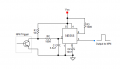
Does that NPN transistor output go low and stay low for the duration of the beep?
If so, this modification of the monostable works using a single 555.
When the NPN trigger goes low the output is delayed until C1 discharges below 1/3 Vcc.
C1 and R2 set the delay at appx .75 second.

1719768237758.png
 
Last edited:

Thread Starter

ShelbyDogg

Joined Jun 28, 2024
11
Does that NPN transistor output go low and stay low for the duration of the beep?
If so, this modification of the monostable works using a single 555.
When the NPN trigger goes low the output is delayed until C1 discharges below 1/3 Vcc.
C1 and R2 set the delay at appx .75 second.

View attachment 325864
Exactly what I was looking for to try.
Thank You sghioto!
Thank you everyone that replied also. I knew what I wanted to do and believe some commercial device is probably already available but after waiting weeks for a response from the manufacturer of the equipment, with their equipment manual stating that it comes equipped with 4 USB ports, 2 serial ports and 1 audio jack for connecting "many devices", They could not answer with any devices or sound devices to plug in or how to activate or program anything. Response was "never done before". Really??!! I'll update with a working model or link to a video on my YouTube after I get it working.
 
Top