Locating a Short

MrChips

Joined Oct 2, 2009
34,810
If all the indicators are correct, with 5V/cm setting, then the scope is showing about 2cm deflection which would be about 10V.
Since the DMM is more reliable we have to assume that something is wrong with the scope setting.

Turn the VOLTS/CM know fully counter-clockwise the fully clockwise to make sure the the know is set correctly and stops at the minimum and maximum range settings.

With the VOLTS/CM set to 1V, test with a 1.5V battery known to be good. You should get 1½ divisions offset.

In any case, we can still use the scope to continue testing the rest of the board.
 

MrChips

Joined Oct 2, 2009
34,810
Look at the connector from the board to the CRT.
With the DMM, measure the voltage at each pin.
With the scope, measure the signals at each pin.

In particular, you want to look at three digital signals:
Horizontal sync
Vertical sync
Video

When you get there we will need to adjust the TIME/CM and TRIGGER section accordingly.
 

Thread Starter

Lorne Allaire

Joined Apr 17, 2017
26
I have the oscilloscope calibrated properly and it’s giving me the proper voltages at the pin header from the smps to the Main pcb. Also measured the 15v signal from the main pcb header to the crt and it’s reading fine as well.

I do not know how to test the video input or v/h sync signals, nor how to check for 60hz ripple.
Can you help me with that?
 

MrChips

Joined Oct 2, 2009
34,810
I have the oscilloscope calibrated properly and it’s giving me the proper voltages at the pin header from the smps to the Main pcb. Also measured the 15v signal from the main pcb header to the crt and it’s reading fine as well.

I do not know how to test the video input or v/h sync signals, nor how to check for 60hz ripple.
Can you help me with that?
The key issue here is you need to identify which connector pins output the Hor, Vert, and Video signals.
Then with your oscilloscope you want to be able to measure voltage and frequency of each signal.

All three signals, Hor, Vert, and Video should have 5V pulses.
Vertical frequency should be 60Hz
Horizonal frequency should be something like 15kHz (Don't worry about the exact frequency).

For video, we are just looking to see if there are any pulses there.

Without all of the three signals, there will be no video on the CRT, which means that there is a problem with the main board.
 

Thread Starter

Lorne Allaire

Joined Apr 17, 2017
26
I know what pins are Video, Vsync and Hsync. With the oscilloscope, I probed these pins and found no signal on either the Hsync or Video pins. I do get a reading of 5v on the Vsync pin.
 

MrChips

Joined Oct 2, 2009
34,810
I know what pins are Video, Vsync and Hsync. With the oscilloscope, I probed these pins and found no signal on either the Hsync or Video pins. I do get a reading of 5v on the Vsync pin.
Ok. Now we need to go back and examine issues on the main board.
Without a complete circuit diagram it will be a walk in the dark.
Go back to the issues with the crystal clocks. Take a photo graph of the chips surrounding the crystals. Let us see if we can reverse engineer the xtal oscillators and take a measurement of the clock frequencies.
 

Thread Starter

Lorne Allaire

Joined Apr 17, 2017
26
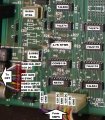
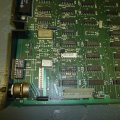
Here's a couple of pictures of the area where the pin headers and xtals are located.
The 5.0688 xtal tested fine but the 19.584 did not and was replaced.
I traced the 5.0688 xtal to pin 1 and 18 of COM8116.

Main PCB Pinouts.jpg Main PCB 03.JPG
 

MrChips

Joined Oct 2, 2009
34,810
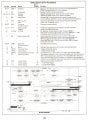
U27 is a MOSTEK MK3807P-4 microprocessor. It is being used by Standard Microsystems Corporation to implement a CRT Video Timer and Controller part number CRT5037.

CRT5037-1.jpg

CRT5037-2.jpg

CRT5037-3.jpg

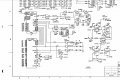
Here is an example of the CRT5037 in use on an Eagle I computer.

Eagle CRT5037.jpg


The first thing to check is
+5V on pin-14
+12V on pin-13

Next check for pulses at:
pin-12 DCC
pin-11 VERT SYNC
pin-15 HOR SYNC
 

Thread Starter

Lorne Allaire

Joined Apr 17, 2017
26
Probing U27 at the various pins you listed above gave me the following results. Some of the waveforms were very dim and out of focus on my scope. Adjusting the Focus/Brilliance/Astig did little to clear it up. Had to dim the lights in the room for the pictures to turn out.

Pin 11: Vert Sync
Time/cm = 0.5 micro sec
Volts/cm = 20mv
87A49788-F27C-4D0D-B441-D7F8B4AE93DA.jpeg

Pin 12: DCC
Time/cm = 0.2 micro sec
Volts/cm = 50mv
BFEF5A39-EE11-44D4-BE4A-3A8573D1A3B4.jpeg

Pin 13: Vdd
Volts = 11.86v reading on my DMM

Pin 14: Vcc
Volts = 4.81v reading on my DMM

Pin 15: Hor Sync
Time/cm = 0.2 micro sec
Volts/cm = 10mv
F3A2C08B-CBAE-4983-8E97-C7A6BF01C834.jpeg
 

MrChips

Joined Oct 2, 2009
34,810
Sorry, you are looking at switching noise.
Set the VOLTS/CM to 2V or 5V.

For VERT SYNC, the expected signal is 60Hz. Set TIME/CM = 5ms

For HORT SYNC, the expected signal is 15.7kHz. Set TIME/CM = 20μs

For DCC, the expected signal is about 1MHz. Set TIME/CM = 2μs (You might have difficulty seeing this.)

In all cases, you may have to adjust the TRIG LEVEL to get the trace to be stationary.

(You do not have .2μs setting on your scope. The range is 2 - 50μs, .1 - 50ms, and .1 - .5s)
 

Thread Starter

Lorne Allaire

Joined Apr 17, 2017
26
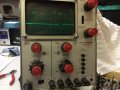
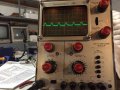
I took some more measurements as you specified. The VERT SYNC was a flat line with the oscilloscope set to those settings. The other two HORT SYNC and DCC gave me a measurable waveform.

VERT SYNC: TIME/CM = 5ms. VOLTS/CM to 2V
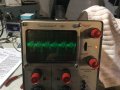
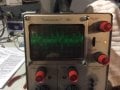
71D692AB-2758-4A20-AAC9-D91D14CAF630.jpeg

HORT SYNC: TIME/CM = 20μs. VOLTS/CM to 2V.
B1E6A467-10D8-4E47-B01A-78C17F82EC4D.jpeg

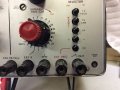
DCC: TIME/CM = 0.5μs VOLTS/CM to 5V.
C30E5FB3-0D31-4072-A129-73A3E6733BC0.jpeg

I think I’m reading it right but to me it looks like 0.2μs on the scope I have.
B53EF17C-625C-41F2-B947-1B3690A22FA8.jpeg
 

Thread Starter

Lorne Allaire

Joined Apr 17, 2017
26
Just bumping this thread to see if anyone (and by anyone I mean MrChips) has any suggestions as to how to proceed next. I followed the video traces back to other ICs but then got stuck.
 

MrChips

Joined Oct 2, 2009
34,810
DCC looks like 2 divisions x 0.5μs = 1μs. That translates to 1MHz clock.

HOR SYNC is not so clear. Adjust the TIME/CM until you can get pulses equally spaced like what you see in DCC. Try adjusting the TRIGGER LEVEL also. We would like to be able to measure the HOR SYNC period.
Sometimes trace overlap may appear because of the shutter speed of your camera.

VERT SYNC shows no signal. Try adjusting the TIME/CM and see if anything appears. You might be looking for very short pulses.
Adjust the TRIGGER LEVEL as well.
 
Top