LM358 single voltage : how to reduce offset voltage ?

Thread Starter

Philexium

Joined Oct 15, 2017
110
@ericgibbs

Hello again Eric
Great job thank you very much !

It raises some questions and unfortunately the webmaster informed me that until I reach 10 post I can't send a private message.
Could we contatct on Linkedin?
Hello Eric,

Here are my questions :

1 -I think you are using a software like LT spice, which one is it ?

2 - Could you explain me what are the roles of C3, C4 and C5 ?

3- On the left of R3, there is an arrow. Where should it be connected to ?

4- The 2 circuits are connected together or is it on the left just an example to get a VG (Virtual Ground ?) ?

Thank you !

Philippe
 

ericgibbs

Joined Jan 29, 2010
21,464
hi P,
1 -I think you are using a software like LT spice, which one is it ?
LTSpice XVII

2 - Could you explain me what are the roles of C3, C4 and C5 ?
Smoothing and Filter caps, for the DC voltages

3- On the left of R3, there is an arrow. Where should it be connected to ?
You see R3 is enclosed in a dotted line rectangle, for the Simulation ONLY, not used on the actual circuit.

4- The 2 circuits are connected together or is it on the left just an example to get a VG (Virtual Ground ?) ?
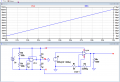
The left circuit is the method of creating a dual supply of +/-4.5Vdc from a 9V battery.
Note: the +4.5V and -4.5V are used to supply the right hand OPA

E
 

Attachments

Thread Starter

Philexium

Joined Oct 15, 2017
110
hi P,
1 -I think you are using a software like LT spice, which one is it ?
LTSpice XVII

2 - Could you explain me what are the roles of C3, C4 and C5 ?
Smoothing and Filter caps, for the DC voltages

3- On the left of R3, there is an arrow. Where should it be connected to ?
You see R3 is enclosed in a dotted line rectangle, for the Simulation ONLY, not used on the actual circuit.

4- The 2 circuits are connected together or is it on the left just an example to get a VG (Virtual Ground ?) ?
The left circuit is the method of creating a dual supply of +/-4.5Vdc from a 9V battery.
Note: the +4.5V and -4.5V are used to supply the right hand OPA

E
Eric,

Thank you again you are so fast and nice to answer

Last list of questions !

5- The 2nd op amp is a non-inverting amplifier, right ?
6- How to you calculate the gain ? 1+ R2/R1 ? = 441
7- What if I reduce R1 to 2,2 k to get x 1 000 gain ?
8- What does Mtr 1000 means ?
9- What are the advantages of replacing LM358 with CA 3140 ? For example this IC has 2 pins for an offset voltage nulling and you don’t use them ?
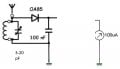
10 -And the most important : how to connect the existing left part of my circuit and the 100 ua galva to your circuit ?
 

Attachments

ericgibbs

Joined Jan 29, 2010
21,464
hi.

5- The 2nd op amp is a non-inverting amplifier, right ?
Yes.
6- How to you calculate the gain ? 1+ R2/R1 ? = 441
Correct.
7- What if I reduce R1 to 2,2 k to get x 1 000 gain ?
I would recommend that you try increasing the gain to 1000, after you have it working with present gain level.

8- What does Mtr 1000 means ?
That is a LTSpice load resistor that represents your meter, I have assumed a resistance of 1000 ohms.

9- What are the advantages of replacing LM358 with CA 3140 ? For example this IC has 2 pins for an offset voltage nulling and you don’t use them ?
The CA3140 is a CMOS high input impedance Non Inverting OPA

10 -And the most important : how to connect the existing left part of my circuit and the 100 ua galva to your circuit ?

Connect the meter in place of the Mtr 1000 ohm resistor, bear in mind what Dick said about protecting the meter movement.

Your present circuit requires a modification, the Non Inverting must have a resistive path to the 0v common, say 1mega ohm

E
 

Audioguru again

Joined Oct 21, 2019
6,826
The input bias current of a LM358 opamp is 0.25uA max. Then into a 1M to ground input resistor the input voltage without a signal is +0.25V.
The CA3140 Has a Mosfet input with NO input bias current. Its input leakage current is only 50pA (50 micro micro amps).
 

ericgibbs

Joined Jan 29, 2010
21,464
Hi Philippe,
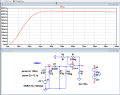
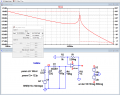
This is the detector part of the circuit.
The V1 signal is a test Sine wave at 144Mhz at 10uVppk level, as test signal ONLY.

Note, I do not have your Diode type, so I have used an ideal diode.

E
 

Attachments

Thread Starter

Philexium

Joined Oct 15, 2017
110
Hi Philippe,
This is the detector part of the circuit.
The V1 signal is a test Sine wave at 144Mhz at 10uVppk level, as test signal ONLY.

Note, I do not have your Diode type, so I have used an ideal diode.

E
Hi Eric !

Thank you so much !

That is exactly the schematic I was going to send to you !

The 1 M resistor in parallel with the 470 pF is an excellent idea for both reasons :
- The 100 nF I used before had a too high value. In fact if there is no VHF field, due to the high impedance of the CA3140, the capacitor would have no time to discharge !
- The 1 M resistor allows the capacitor to be discharged

That is really a great circuit now !

I will have to do now my homework and once the new circuit is ready I'll send you a photo with my comments.

Thank you again for the rich and instructive discussions.

I would like to thank too @DickCappels and @Audioguru and @Irving again for their contributions !
 

Thread Starter

Philexium

Joined Oct 15, 2017
110
Hi Philippe,
This is the detector part of the circuit.
The V1 signal is a test Sine wave at 144Mhz at 10uVppk level, as test signal ONLY.

Note, I do not have your Diode type, so I have used an ideal diode.

E
Hello Eric

Hope you have had a nice week-end.

I have to order some CA 3140. I have 2 CA3130 in stock only.
What is the best one to order 3130 or 3140 ?

Thank you
Philippe

I
 
Top