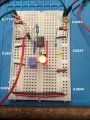
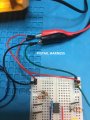
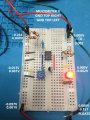
To the gnd rail next to the jumper. Measuring it directly across the jumper which should not be possible across 0.1Ω. That's 2.45A which ain't there.
What did you use to modify my ckt diags? Using CircuitLab online to generate them and don't see a way to import and edit except by another user posting on their site. If there is a better or preferably free desktop app I would like to know.
Something is wrong either with your DMM or your wires somewhere.
I did not modify your circuit drawings. I just cut & pasted the drawings posted by @sghioto.
If I had to modify the drawing I would copy it (even off the screen if I had to do that) and edit it in Corel Photo House.
I plugged both meters in and pinned bb connections adjacent to each other and now get 168mV on both meters and even w/ only 1 meter plugged in. So it's drifting around and that's 1.6A that doesn't exist. Tapping the breadboard causes it to move a couple hundredths so it's really there which it can't be. Now it's 98mV. I moved the PS input to the Pin7 side rail and now 159mA. I use jumpers to tie the rails together( unless I need dual voltages) and typically connect PS to rail supplying chip Vcc. The 0.1Ω I measured for the jumpers is probably high so the actual calculated A would be even higher. Has me baffled and I don't believe in ghosts.
FWIW... There was some discussion as to what type output the 311 is. "The Art of Electronics" 3rd Edition by Horowitz and Hill on pg. 813 lists it's output as FL (floating) because -V can be used on pin4 to give it up to +15 to -15V input range. The TI PDF states it is Open Collector and Open Emitter. National Semiconductor, Fairchild, and Phillips don't state it, but the ckt diag shows open collecter at pin7 with emitter tied to gnd w/ a resistor.
I plugged both meters in and pinned bb connections adjacent to each other and now get 168mV on both meters and even w/ only 1 meter plugged in. So it's drifting around and that's 1.6A that doesn't exist. Tapping the breadboard causes it to move a couple hundredths so it's really there which it can't be. Now it's 98mV. I moved the PS input to the Pin7 side rail and now 159mA. I use jumpers to tie the rails together( unless I need dual voltages) and typically connect PS to rail supplying chip Vcc. The 0.1Ω I measured for the jumpers is probably high so the actual calculated A would be even higher. Has me baffled and I don't believe in ghosts.
Forget the 0.1Ω measured and the 1A or 2A estimate. This is a distraction.
You should not be reading voltage across a short jumper. You need to get to the bottom of this before moving on.
Start with both DMM probes connected to the GND rail. What is the reading?
Then gradually move the red probe away from the black.
What happens when you turn off the PSU?
Start with both DMM probes connected to the GND rail. What is the reading?
0.000V
Then gradually move the red probe away from the black.
As I moved the +probe further from the -probe the readings became more erratic and waited for them settle, some didn't.
So there is voltage on the gnd.
What happens when you turn off the PSU?
w/ PS off 0.000V everywhere
After the 1st test I eliminated my rail jumpers and pigtailed the PS input to both rails and tried again
Problem solved, it was a bad batch of chips from??? New chips arrived from Arrow and it works perfectly now. Even the weird voltage on gnd is gone. Thanks for the help Chippy!
Yes I bought those chips from China and have sent the seller a nastygram. 77¢/10 and spent more than that in time and aggravation. As I always remind the wife "you get what you pay for".
1. No bypass caps.
2. No Hysteresis
3. Some Comparitors need a low Z source at their inputs.
4. A divider to the power supply isn't sometimes a good reference. It's ratiometric to the supply providing the the resistor values are OK. It;s not 2.5V.
Look at the LT6700 from LT/Analog devices.
LM311 is NOT open-collector. Only a BJT has a 'collector'. People saying the OPAMP is open-collector leads me to believe most people don't understand what that means. 'open collector' by definition means the collector of a BJT is held high by a weak pull-up resistor, and the emitter is tied to GROUND. When the BJT is activated, the circuit is grounded, overcoming the pullup.
I have a TI datasheet for it, and it does not have the word 'collector' anywhere in it. Furthermore, no schematic of it's suggested use in the datasheet treats the output as an open collector- because it isn't.
LM311 is NOT open-collector. Only a BJT has a 'collector'. People saying the OPAMP is open-collector leads me to believe most people don't understand what that means. 'open collector' by definition means the collector of a BJT is held high by a weak pull-up resistor, and the emitter is tied to GROUND. When the BJT is activated, the circuit is grounded, overcoming the pullup.
You either need new glasses or training how to use the ^F search function in a PDF document. Look at the 3rd paragraph.
This is then followed by the output stage that consists of an open collector NPN (pulldown or low-side)transistor.Unlike most open drain comparators, this NPN output stage has an isolated emitter fromVCC–, allowing this device to set the VOL output value for collector output.
True.
But that doesn't mean it has to be a discrete transistor all by itself.
The LM311 has a number of BJT's in its internal design, with one of them having its 'collector' and 'emitter' connected to external pins.
Yeah but what happens if you accidentally plug a chip or something polarity sensitive in backwards? That's why you have supplies with current limits. I normally set mine at 100ma with low voltage circuits.
SG
Spot on. Sticking 500-mA into a prototype circuit can do a lot of damage.
I tend to start very low, say 10-mA current limit on my bench PSU (Thurlby EL302RD, thoroughly recommend) and watch the overcurrent LED and voltage/current displays. Slowly ease the current up and watch the voltage. If the voltage creeps up with the current, you are probably good to go.
Perhaps an oscilloscope would solve the mystery. I suspect that when the power supply hits it’s current limit it is oscillating as the comparitor cycles on and off giving the illusion of an analog output signal. Put your dmm in ac mode and measure your signals, they should read 0 or very low millivolts

 Facebook
 Google
 GitHub
 Linkedin