LM2577 Boost from 5V source intermitantly works...?

Thread Starter

danielantonic

Joined Sep 22, 2019
68
Hello all

I have a couple of issues with my current project. I'm using an LM2577 to boost 5V to 25V in a micro-controlled TENS machine like circuit that I want to be battery powered/rechargeable via USB.

Firstly, using my benchtop supply, the 25V is stable and can handle a load, but when I use my Li-Ion Battery power pack, the output of the LM2577 gets up to about 15V and then the pack turns off after a few seconds. I haven't used one of these packs before so I'm not sure if there is too much current drain (even with no load on the pack) or something else. Here is a link to the power pack: https://www.jaycar.com.au/power-pack-for-raspberry-pi-with-li-ion-battery/p/XC9060

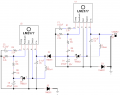
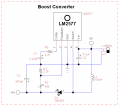
The pack still powers the micro-controller etc. fine, it is only when the LM2577 Circuit is connected that it plays up. Below is my schematic:
1641134668769.png

Secondly, I'd like to monitor the battery levels and display a percentage. Is it a simple matter of running a line from the battery through an ADC? What would the cutoff voltage be (a level of 0%) using this pack's 3.7V 3800mAh Li-ion Battery?

Thank you all in advance for your help :)
 

Irving

Joined Jan 30, 2016
4,996
What frequency/duty cycle is the LM2577 running at?

Your problem is you have a switch-mode boost converter with approx 1A peak pulse current draw running off a boost converter designed to give 500mA continuous output. I suspect the boost chip on that board is overheating and shutting down and/or the short-circuit protection is being triggered. A large, >1000uF, low-ESR, electrolytic capacitor on the input to the LM2577 might help.

Monitoring battery voltage on a Li-ion battery is pointless. It'll go from 4.1v fully charged,unused, to 3.7v as soon as you start using them and then drop to around 3.5v as they discharge before rapidly dropping to below 3v when fully discharged. But voltage isn't a proxy for state of charge - you can't determine run time from voltage. You can only determine state of charge by monitoring charge current (A x time) in and discharge current (A x time) out.
 
Last edited:

sghioto

Joined Dec 31, 2017
8,633
Firstly, using my benchtop supply, the 25V is stable
Using the bench supply how much current does the boost converter draw with no load?
If you say it works fine with the bench supply I would suspect it's the battery
Check the 5 volt input voltage level on the LM2577 when connected.
How much current does the TENS machine draw?
 
Last edited:

Irving

Joined Jan 30, 2016
4,996
Using the ADC would work. In this case I would prefer to monitor the 5 volt output on the power pack.
All using the ADC on the 5v output will tell you is if its 5v or not. The boost converter on the power pack board will give you 4.9 - 5.1v depending on load until the battery volts drops below the LV cutoff on either the boost chip or the protection chip in the power pack (if fitted), whichever is higher.

I'll say it again VOLTAGE is NOT a useful proxy for state of charge of a Li-Ion battery.
 

Irving

Joined Jan 30, 2016
4,996
When the 5 volt out on the power pack starts dropping below say 4.8 volts then the battery needs charging.
Most of the commonly used boost conversion chips will still give >4.8v out at 3v input (depending on current demand). The ones most commonly used don't have low-volt cutoff so will run until the battery volts are dangerously low for the battery (ie <2.9v) or the battery discharge protection kicks in, if fitted. Either way, its not a reliable measure.
 

sghioto

Joined Dec 31, 2017
8,633
Most of the commonly used boost conversion chips will still give >4.8v out at 3v input (depending on current demand
That maybe true in his setup. If that's the case then 3 volts would represent zero percent of battery charge.
I don't see an issue with that.
 

Thread Starter

danielantonic

Joined Sep 22, 2019
68
Ok, I did some research and it turns out I'm trying to get too much out of the LM2577 - with a 5V input, the datasheet suggests a 15V maximum stable output. It was a fluke that I got 25V out of it at all!

I think I need to redesign this voltage boost. Any suggestions on what I can use to get 25V (or more) supplying 2mA from this sort of 5V battery pack?

Thanks for the suggestions on the LiPo levels - I'll play around with 3V as my "0%" level, and see how quickly it drains. I can adjust the function in software so it compensates for any non-linear discharge rate if I have to, but just knowing that 0% is coming up is enough of a warning for the user to put it on charge :)
 

Thread Starter

danielantonic

Joined Sep 22, 2019
68
I have had success! Since I had a spare LM2577, I thought "why not cascade the them?". That thought lead me to this design:

1641291027379.png

Because both regulators act as oscillators, I figured the ground references would need to be protected to prevent interference - hence diodes D3 and D5. D2 is to prevent feedback from U2. I just did a test using these values. With no load it took about 5 seconds to get up to 32V, and once there consumes 59mA. I think I might make C6 smaller as according to the LM2577 datasheet, I calculated about 180uF minimum value for it (I only have 470uF in the higher voltage ranges though - at least I know it will work now :) )
 

sghioto

Joined Dec 31, 2017
8,633
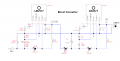
That schematic in post #10 doesn't look correct to me. I would simply cascade 2 boost circuits with a diode in between.
1641349990945.png
 
Last edited:

Thread Starter

danielantonic

Joined Sep 22, 2019
68
Good call! I just tried with only one diode and it worked! I thought there was an issue with the ground being part of the feedback circuit and having 2 on the same ground was a problem.

I am noticing that it is taking a few seconds to build up to 30V. Is that purely due to the size of the output caps (C4 and C6)?
 

sghioto

Joined Dec 31, 2017
8,633
I am noticing that it is taking a few seconds to build up to 30V.
Not sure. I don't have one to test so would need your feedback on the situation. If you connect just one booster circuit to 5 volts how long does it take to get to full output with and without a load. Also curious about the current draw per booster. Smaller output caps might make a difference and it may require some minimum load to regulate properly.
What is the minimum input voltage to maintain 30 volts output with load?
 

Irving

Joined Jan 30, 2016
4,996
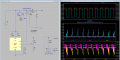
An arguably better solution is a flyback converter as this has the benefit of a transformer and can readily achieve 10x boost or more. Here's a simple example using an LT1172 chip; the LM2577 may possibly be used in this configuration, using the same off-the-shelf transformer from CoilCraft. However the LM2577 is a very old bipolar design dating from pre-1999. Its 52kHz switching is low by today's standards requiring much larger inductors so the switching currents may be excessive for that transformer. I couldn't find a Spice model for it to try it.

Top traces are output voltage (26v, 30mV ripple) and current for a 10kHz pulsed load of approx 6mA showing it holds up well...
Centre traces show input & output powers and chip dissipation (141mW, 85mW and 18mW respectively), while the bottom traces are input current (yellow) showing we're running in discontinuous mode, the switch output (green trace) and the output of the transformer secondary into the diode D1 (pink).

1641392532867.png
 
Last edited:
Top