LISA Pathfinder's femptometer feat

Thread Starter

cmartinez

Joined Jan 17, 2007
8,759
This is mind-blowing, at least for me:

The cubes were released within the spacecraft shortly after launch, and are now in free fall together, meaning they are barely moving with respect to each other. The first results, released today, show that the spacecraft can measure the distance between the cubes down to the femtometre scale – 100 times better than planned.

I wonder what technique (or series of techniques) they're using to measure that distance with such unprecedented accuracy.
 

tindel

Joined Sep 16, 2012
939
When I was working on NASA's Insight mission I designed the power subsystem... it was basically solar array strings switching off and on to charge the batteries and provide power to the load. I had problems with the control loop oscillating at around 50-60Hz late in the program. I wanted to go fix it and the boss didn't want to - because charge was averaging 5A, and what would go wrong (idiot boss, but that's another story.). Anyway, once he finally made the client aware of the issue (months later) the client wanted us to fix it (it was unstable, after all!). One of the driving reasons for changing the control loop was that the seismometer was so advanced and had such a low noise floor that they couldn't measure the noise floor on earth. The science team was afraid that they would would have a big spike at 50-60Hz in the noise floor from the wires moving when the solar array switches were dithering at that frequency. Apparently the wires passing current generates a magnetic field (obviously) and the wires move slightly (we're talking micrometers). I ended up being able to stabilize the loop, but was impressed that their instrument was that sensitive.

The program was scrapped as it sat on the launch pad.
 

atferrari

Joined Jan 6, 2004
5,011
What "free fall" is that? Other than those waves, what gravity are we talking about in outer space?

Strictly speaking, those masses are not falling, just "ready to fall" if gravity happens....
 

Thread Starter

cmartinez

Joined Jan 17, 2007
8,759
What "free fall" is that? Other than those waves, what gravity are we talking about in outer space?

Strictly speaking, those masses are not falling, just "ready to fall" if gravity happens....
I guess that microgravity would've been a better term then. O the other hand, I can't recall if the article mentioned it, but I'm guessing that at this moment the device is resting in one of the Lagrangian points.
 

wayneh

Joined Sep 9, 2010
18,104
Whether in orbit or at a Lagrangian, it would still feel significant gravity from bodies in our solar system. So the acceleration has to be managed (offset) to keep it from "falling".

I would be curious to learn where this thing is parked. In orbit, I'd guess.
 

Thread Starter

cmartinez

Joined Jan 17, 2007
8,759
If I'm not mistaken, a Lagrangian point is not (by definition) in orbit around anything, but it's rather a zone in space (with a positive stability) where the gravitational fields of the earth, sun and moon cancel each other out...
But most likely I'm preaching to the choir here...
To sum things up, isn't that what Relativity is all about? That an accelerating body cannot distinguish between its being propelled by an external force and a gravitational field?
 

Wendy

Joined Mar 24, 2008
23,798
Dragon's Egg, a sci fi story, covered it very well. Tidal stress exist in orbit, where as in micro gravity they are not there.
 

Thread Starter

cmartinez

Joined Jan 17, 2007
8,759
Dragon's Egg, a sci fi story, covered it very well. Tidal stress exist in orbit, where as in micro gravity they are not there.
Sounds familiar. Mind sharing who the author is?
I know I could just google it... but I'm just too damn tired and need to hit the sac...
 

Alec_t

Joined Sep 17, 2013
15,117
The cubes were released within the spacecraft shortly after launch, and are now in free fall together, meaning they are barely moving with respect to each other.
I wonder what the release mechanism was? It would have to be precisely symmetrical and not impart any movement to either cube, otherwise there would have been relative movement.
If laser interferometry is used to measure the cube separation, won't photons bouncing off the cubes tend to push the cubes apart (albeit very slowly)?
2kg of gold/platinum sounds a tad expensive!
 

wayneh

Joined Sep 9, 2010
18,104
If I'm not mistaken, a Lagrangian point is not (by definition) in orbit around anything, but it's rather a zone in space (with a positive stability) where the gravitational fields of the earth, sun and moon cancel each other out...
But most likely I'm preaching to the choir here...
To sum things up, isn't that what Relativity is all about? That an accelerating body cannot distinguish between its being propelled by an external force and a gravitational field?
Yes, I regretted writing that post as soon as I shut off the lights for bed. At a Lagrangian, space should be nearly flat. Gravity is not really a force but a curve in space. So if you're on a flat spot, it's not that you feel two equal but opposing forces. You feel nothing. I think.

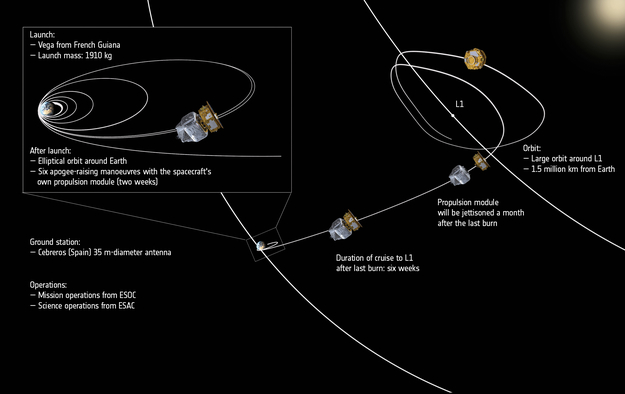
So where did they put this thing?
 

nsaspook

Joined Aug 27, 2009
16,321
From their page.

"Operational orbit is a Lissajous orbit around the first Sun-Earth Lagrange point, L1, after a transfer trajectory from a low-Earth parking orbit"

"The operational orbit for LISA Pathfinder is a 500 000 km × 800 000 km Lissajous orbit around L1. This orbit has been chosen because it is an intrinsically 'quiet' place in space, far away from massive bodies, which induce tidal forces on the spacecraft; has constant illumination from the Sun; and has a quasi-constant distance from Earth for communication. This orbit fulfils the stringent requirements of LISA Pathfinder concerning thermal and gravitational stability.

This Lissajous orbit, with period of 180 days, is unstable and periodic station-keeping manoeuvres will be required - amounting to about 1.8 ms-1 per year - which will be performed using the cold gas thrusters of the spacecraft's micro-propulsion system."


http://sci.esa.int/lisa-pathfinder/56675-lisa-pathfinders-journey-to-l1/

http://www.space.com/30302-lagrange-points.html
 
Last edited:

Thread Starter

cmartinez

Joined Jan 17, 2007
8,759
Thread starter Similar threads Forum Replies Date
M Programming & Languages 0
Similar threads
LISA Programmer.
Top