Likelihood these TA7233P dual amplifier IC's will be the real deal?

Thread Starter

Tp86

Joined Sep 13, 2023
210
Hi everybody. I have been repairing my Toshiba RT-140s boombox in my free time over the past week. I suspect the amplifier IC, TA7233P (Toshiba), may be faulty. I do not know for sure.

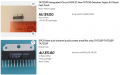
There seem to be very cheap replacement IC's with this model number on eBay. Do you think I can trust them to work?

Link to the IC's: https://www.ebay.com.au/itm/395926698484
 

DickCappels

Joined Aug 21, 2008
10,661
It is a dice throw. Good luck.
I noticed this customer's response:
the ad mentions Condition: New, after placing the order the seller contacted us after 5 days saying they have original and copy, original is used, copy is new. so I choose copy, then after fews days back when I check for the delivery status, seller inform the copy product is not in good condition, so they suggest the original which is 95% ok, so choose original, after several follow up for the shipping, the seller informed the original is faulty and they have check few units, all same.
 

MisterBill2

Joined Jan 23, 2018
27,164
With the right unsoldering tool those ICs are simple to unsolder from scrapped PC boards. And because the TA7233P was used in quite a few automotive stereo receivers , and the audio PCB can be rapidly replaced as an assembly, under warranty, usually, there are/were in some locations a whole lot of scrapped boards available for "recycling". The supply might be drying up by now, and so finding a good dual amplifier IC gets harder.
 

Thread Starter

Tp86

Joined Sep 13, 2023
210
It is a dice throw. Good luck.
I noticed this customer's response:
the ad mentions Condition: New, after placing the order the seller contacted us after 5 days saying they have original and copy, original is used, copy is new. so I choose copy, then after fews days back when I check for the delivery status, seller inform the copy product is not in good condition, so they suggest the original which is 95% ok, so choose original, after several follow up for the shipping, the seller informed the original is faulty and they have check few units, all same.
Yeah that does not make me to confident it will work well!

With the right unsoldering tool those ICs are simple to unsolder from scrapped PC boards. And because the TA7233P was used in quite a few automotive stereo receivers , and the audio PCB can be rapidly replaced as an assembly, under warranty, usually, there are/were in some locations a whole lot of scrapped boards available for "recycling". The supply might be drying up by now, and so finding a good dual amplifier IC gets harder.
I'll keep an eye out for one. I noticed another listing closer to me that claims they have new old stock for this IC. I dont know if its true and its much more expensive (still not that expensive) but at least its more likely to work. https://www.ebay.com.au/itm/325201994074 I think I'll end up getting it but first will double check by feeding in a stronger input to see how it performs (as MrAI suggested). Im not too sure if the attenuation of the signal is before the dual power amp or within the power amp itself
 

Thread Starter

Tp86

Joined Sep 13, 2023
210
It is a dice throw. Good luck.
I noticed this customer's response:
the ad mentions Condition: New, after placing the order the seller contacted us after 5 days saying they have original and copy, original is used, copy is new. so I choose copy, then after fews days back when I check for the delivery status, seller inform the copy product is not in good condition, so they suggest the original which is 95% ok, so choose original, after several follow up for the shipping, the seller informed the original is faulty and they have check few units, all same.
I just had a look at this too and it was actually for another produce the same seller was selling (a VR headset cable). It is confusing how ebay does that. The only review I can find for IC's that seller are selling are 'OK'. So you are right its still very much a gamle
1738026874041.png

1738031039366.png


At the moment I am trying to determine what a safe peak to peak voltage signal would be to pass into this amplifier IC to see if it is capable of amplifying signals. I cannot see from the specs what a safe input voltage peak to peak would be. Does anyone know how to determine this? I'll attach datasheet to this post just in case anyone knows
 

Attachments

Last edited:

DickCappels

Joined Aug 21, 2008
10,661
It looks like you can power it from a 12 volt power supply. As long as your speaker is 4 Ohms or greater, everything should be ok. The chip has thermal shutdown which can be helpful in case you don't have a "powerful" enough heatsink.
 

Thread Starter

Tp86

Joined Sep 13, 2023
210
It looks like you can power it from a 12 volt power supply. As long as your speaker is 4 Ohms or greater, everything should be ok. The chip has thermal shutdown which can be helpful in case you don't have a "powerful" enough heatsink.
Do you recommend I unsolder it to test it on the bench with a DC power supply and signal from a stripped headphone cable (or something similar) or

Leave it in my boombox, allow the PCB to deliver the 9V to the IC, put the ground in on radio ground and signal wire(s) into the input(s) of the amplifier?
 

MisterBill2

Joined Jan 23, 2018
27,164
I just had a look at this too and it was actually for another produce the same seller was selling (a VR headset cable). It is confusing how ebay does that. The only review I can find for IC's that seller are selling are 'OK'. So you are right its still very much a gamle
View attachment 341385

View attachment 341392


At the moment I am trying to determine what a safe peak to peak voltage signal would be to pass into this amplifier IC to see if it is capable of amplifying signals. I cannot see from the specs what a safe input voltage peak to peak would be. Does anyone know how to determine this? I'll attach datasheet to this post just in case anyone knows
Good News!! On page 95 of that data sheet publication it stares that the maximum input voltage is 300 millivolts, and that above that the distortion is extreme.
 

Thread Starter

Tp86

Joined Sep 13, 2023
210
Good News!! On page 95 of that data sheet publication it stares that the maximum input voltage is 300 millivolts, and that above that the distortion is extreme.
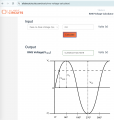
Cool. Thank you mate. I missed that. Using the AAC calculator i calculated 0.8V (pp) out of the pre-amp is under 290mV.
1738036610639.png

So I could technically just short the inputs from the preamp to the power amp. But the pre-amp offsets the signal at 1.3-1.5V DC. How would I remove the DC offset? Put in capacitor with at least 1.5V + 0.4V (max amplitude of varying signal) inline with the signal wire?
 
Last edited:

MisterBill2

Joined Jan 23, 2018
27,164
An adequate series capacitor is indeed the common way to prevent DC offset issues. AND, notice that the result of some small amount of input overdrive is much greater distortion. Certainly at some point damage will result, so it does make sense to avoid over-driving. the input.
One more thing, I would not call it "a short" to the input,but rather a "direct connection", since on most instances "a short" constitutes a fault.

One more thought is that if there is that pre-amplifier DC offset voltage, I suggest also checking for the signal common side DC offset. Just in case, given that we have not seen the circuit.
 

Thread Starter

Tp86

Joined Sep 13, 2023
210
An adequate series capacitor is indeed the common way to prevent DC offset issues. AND, notice that the result of some small amount of input overdrive is much greater distortion. Certainly at some point damage will result, so it does make sense to avoid over-driving. the input.
One more thing, I would not call it "a short" to the input,but rather a "direct connection", since on most instances "a short" constitutes a fault.
Cool. Thanks for explaining that I'll try remember to use "direct connection" in the future.

To be safe I was thinking I could also use a resister inline with the capacitor to attenuate the signal so it doesn't distort.

One more thought is that if there is that pre-amplifier DC offset voltage, I suggest also checking for the signal common side DC offset. Just in case, given that we have not seen the circuit.
Do you mean make sure chassis earth has same potential and signal common? Im pretty sure it does

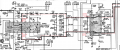
These are some of the DC offset measurements I made on the power amp a few days ago with the AM radio running.

(Pre-amp on left and Power-amp on right) Red line indicates signal wire
1738107392062.png

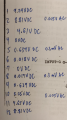
These are the power amp pin voltages I measured DC and AC
1738107855967.png

If your interested, this is a link to schematic of the boombox I'm repairing :)
https://archive.org/download/manual_RT120S_SM_TOSHIBA/RT120S_SM_TOSHIBA.pdf
Edit: Unfortunently this will make things confusing but I have found a scematic that is closer to my actually physical boombox (RT-140S)
https://ia804506.us.archive.org/16/items/manual_RT130S_SM_TOSHIBA_EN/RT130S_SM_TOSHIBA_EN.pdf (it uses the same power amp IC)

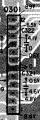
One thing that jumps out at me is that my reading for pin 2 is 8.81V DC (almost full power source) while it should be 4.8V DC. To me this seems like a short. I believe pin 2 has something todo with left channel power amp output (which is getting only static noise). (The right speaker is clear by the way but both are very very low volume). Edit: thinking about this some more its sort of clear why i am getting noise as its trying to impose a signal on a offset that is the power source voltage. It should be imposed on half the power source voltage. Edit again: It is possible I have the pins meausments in reverse order (1 is actually 12, 2 is 11 etc) I thought I did it right, but it would make sense if i did
1738109622904.png
 
Last edited:

Thread Starter

Tp86

Joined Sep 13, 2023
210
The picture shoes a TA7232, but the first post stated TA 7233.
Could that be why you do not find a replacement???
Sorry for making this confusing. I have a Toshiba RT-140S, but for the last 2 weeks I was only able to find a manual for the Toshiba RT-120S. The 120 uses the 'TA7232', but the 140 uses the TA7233.

Only today I found a manual for the Toshiba RT-130S (which is very very similar to mine) and it uses the TA7233

Tonight after work, I'll form the direct connection from preamp to power amp (with cap and resistor) and let you know if I get loud and clear sound to both speakers
 

MisterBill2

Joined Jan 23, 2018
27,164
OK, and now I am wondering if you have checked with an honest supplier of NEW parts. I suggest Digikey so you can at least know what actual new parts cost. There are other less expensive but still honest suppliers but it is not likely you will find them selling on ebay.
 

Thread Starter

Tp86

Joined Sep 13, 2023
210
OK, and now I am wondering if you have checked with an honest supplier of NEW parts. I suggest Digikey so you can at least know what actual new parts cost. There are other less expensive but still honest suppliers but it is not likely you will find them selling on ebay.
Yep I have had a look but no reputable supplier is holding stock. Only websites from middle eastern countries which I would trust less than ebay :)

The first listing claims to be 1 X new old stock from Japan (but sold from Australia).
The second listing claims to be 5 X brand new (from China) Does not say if they are genuine. This is the cheaper option especially so as you get 5pcs but it seems less likely to work. I could be wrong
1738117911795.png

Update: On the first one that claims to be genuine it says (with exclaimation mark followed by fullstop on end)
This listing is for one brand new Intergrated circuit. Sourced from a recently closed retail electronics business this high quality TA7233 IC is in brand new condition and ready for use, it may be ideal for your next electronics repair or design project!.
How does the seller know its genuine and not fake though. Seems sus
 
Last edited:

Thread Starter

Tp86

Joined Sep 13, 2023
210
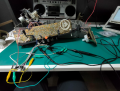
MisterBill2: I just out from my little lab and have some results:

I tested each channel of power-amp IC with direct connection with capacitor and resistor in series (offset removed and attenuated)

Left channel performed very well audibly on the speaker and when the probed the power amp IC output. Looks perfect.

Right channel no loud audible sound on the right speaker and when probed the output of power amp IC nothing at all!

So I think I can conclude the IC is fried. Unless you disagree?

1738151276929.png
 

MisterBill2

Joined Jan 23, 2018
27,164
"Fried"is one possible explanation, BUT there might be an open connection nearby on the non functional channel. So checking voltages on the pins and comparing between channels could show you which portions of the dead channel to check. I am not saying that is the issue, but it could be.
 
Top