Like to make a HV Load

Thread Starter

R!f@@

Joined Apr 2, 2009
10,004
Hey Guys.
I have a termite roaster. I am putting it short
I like to test the HV generator which produces 4KV @ 750mA Max.
The Generator power is adjustable. I guess it adjusts the Voltage and it has a LED bar meter to indicate current.
It drives a 2KW Magnetron.
As far I checked the Magnetron is faulty. I willdive deep into it later.

For now I like to make tester of sort to check the Generator. A resistive load or whatever is needed
Since I have not tackled this kinda voltage except getting electrocuted during my CRT repair days and also, very recently burning my palm at 3 points ( 2 for the fillament and 1 for the HV from Magatron { as apple lobbyist says } ).
Yes... before you ask, it hurt like hell. :eek:I did saw flashes everywhere. o_OStill alive and well though.

So any Ideas on how these kinda load is done.
Throw in what you got and I can try them without getting zapped
 

MrChips

Joined Oct 2, 2009
34,807
I had to do this recently. I needed to measure up to 3kV on a 3.3V MCU.
The HV supply could produce up to 2mA. I did not want to load down the HV so I took a max of 30 microamps on the load.

I happened to have a lot of 10MΩ ½W resistors on hand.
I put 10 resistors in series by just pig-tailing the leads end-to-end to make a very long 100MΩ resistor.
Then I ended the chain with a 100kΩ ½W resistor, terminating to ground. I measured the voltage across the 100kΩ resistor with the MCU.

If you just need to measure the voltage with a DMM, you can omit the 100kΩ resistor and just measure the 1/10 voltage (up to 400V) across the last 10MΩ resistor to ground. In your case the current drawn is 40μA @ 4kV output.

The circuit should be obvious but I can show a circuit when I get to another computer.

edit: I overlooked the fact that you have to take into account the input resistance of the DVM.
 

Thread Starter

R!f@@

Joined Apr 2, 2009
10,004
I had the same thing in mind but due to HV, I was under the impression tht I might need certain kinda insulation.
The problem is tht I need to load it to 750mA too.
In this case a resistor string will just mightbe not enough.
Any Idea on how to accomplish this using salt water and a rod ?
Just guessing here.
 

MrChips

Joined Oct 2, 2009
34,807
If you need to measure this under full load, you are talking about a 5kΩ 4kW load rated to 5kV and some more.
That's outside of my comfort zone. You need to get the HV specialists in here, @nsaspook.
 

MisterBill2

Joined Jan 23, 2018
27,504
You could build a series string of about 32 120 volt 100watt light bulbs in series, which would have a voltage drop close to 4000 volts. There would be a momentary overload as the string initially was connected but that could work fairly well, and handle the power without burning up.
Use ceramic surface mount sockets and mount them in a row on a pair of dry pine boards. Use a well insulated probe on the meter you measure the voltage with, and also measure the voltage across the bulb closest to the "grounded " end of the string of bulbs.
Normal high voltage precautions will be required, but it will be simple and safe.
 

Thread Starter

R!f@@

Joined Apr 2, 2009
10,004
hmmm.
One problem. These days getting filament bulb is rather difficult.
220V 100W bulbs is a good way to go. Increase bulb qty can decrease current. Not a bad idea.
Thanks
 

MisterBill2

Joined Jan 23, 2018
27,504
hmmm.
One problem. These days getting filament bulb is rather difficult.
220V 100W bulbs is a good way to go. Increase bulb qty can decrease current. Not a bad idea.
Thanks
Special purpose bulbs are still available at some locations from some distributors. a company "1000bulbs" is constantly sending me email sale flyers, and they offer all kinds of bulbs and tubes. Of course, what else would you use all of those for after the test?
Of course they do make fair electric heaters with the benefit of light in addition to heat. So there may be some application, depending on where you are.
 

ronsimpson

Joined Oct 7, 2019
4,690
I have used light bulbs for loads. 12V and 24V and 110V
I do not like using 32 bulbs in series. If one bulb burns out then all 4kv will be across the socket and it will spark over.
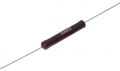
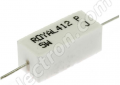
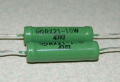
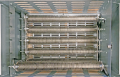
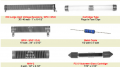
I have purf boards with these resistors lined up in series. Many resistors list the max voltage. Plexi glass, stand off, PCB, resistors. The Plexi Glass is so the 4KV will not spark into the bench. I test 30kv power supplies.
1640019308456.png
1640019586093.png
1640019614162.png
 

MisterBill2

Joined Jan 23, 2018
27,504
INDEED!! There was a good reason that I suggested 100 watt light bulbs. And if one fails then switching off the power fast is the only way to go. And 4000 volts, 3000 watts is a long way from 30KV , as I see it. And a string of ten watt resistors would need 300 of them and that would get rather large. And probably a ten watt resistor costs as much as a hundred watt light bulb.
 

MrChips

Joined Oct 2, 2009
34,807
How about twenty 220VAC space heater elements connected in series on ceramic mounting posts?

Edit: You will need more than 20 to get the right resistance.
 

nsaspook

Joined Aug 27, 2009
16,321
Joking right? It is only 4kV. I have single resistors that will withstand that.
Sure, I've got resistors that can withstand far more than 4kV each but not at KW power levels.
Each of the diagonal resistors have 30kV across them in the 160kV stack arc test. They are lower power because the resistance was designed to balance the voltage across each corona ring, not load the HV power supply.

Boring arc test video.

More interesting arcing video.
 

ronsimpson

Joined Oct 7, 2019
4,690
How about twenty 220VAC space heater elements
Interesting, I used heating elements. At one time I could get a role of that material.
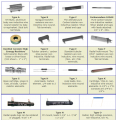
Looking at Digikey I see that many of the large resistors are not available.
I have used smaller resistors and put them in a gallon of transformer oil. It works for about 2 minutes before it is too hot. (see HAM radio load resistors)
I know of a surplus store with 10kw load boxes. Sad they are all low resistance.
1640026621361.png
They have some 30 / 40 watt HV resistors.
1640026780049.png
Another page:
1640026894933.png
 

ronsimpson

Joined Oct 7, 2019
4,690
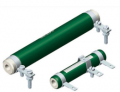
I am looking in the lab and I see GWS500 resistors rated at 500W and GWS500E rated at 300W. (Vishay from Mouser) These resistors are only good to 3kV so you will need to series 2 to hold off 4kV.
I am thinking of two resistors in series. (8k + 8K = 16k ohm) (500W + 500w = 1kw) 4kv=250mA At full power they will need a fan!!
Then do this three times in parallel to get 750mA.
1640030966506.png
I usually add a strong box (computer) fan. Even with a fan they will get hot and burn marks into your hand. Want to see? lol
RonSimpson
 

MisterBill2

Joined Jan 23, 2018
27,504
The goal is to check a 4000 volt supply to verify that it can deliver 4000 volts at 750 milliamps. Tyhat means dissipating 3000 watts for the duration of the test So the big load is needed and I am still thinking that for one test, or possibly 2 or 3 if the supply needs service, the light bulbs are the most cost effective, and can be used elsewhere afterwards. High voltage HI POWER resistors are much more limited as to other uses.
 
Last edited:

ronsimpson

Joined Oct 7, 2019
4,690
High voltage HI POWER resistors are much more limited as to other uses.
Yes I have boxes of them dating back 40 years. Some were 40 old when I got them 40 years ago.

Light bulbs, their resistance changes with temperature. Measure a cold bulb and see what the resistance is. Then calculate what the resistance needs to be to make 60 watts at 120V. That will be the hot resistance. Can you live with not really knowing what the resistance is?
 
Top