Light wavelength sensors

Thread Starter

llEncorell

Joined Nov 11, 2023
3
Hello Folks,
Please bear with me as i try and describe the item im looking for, I have very limited knoledge of electronics and ill probably use some incorrect terminology!

Im trying to offer as much information, whilst being purposfully vague about the product idea, as I can. But im happy to clarify anything via PM if its helpful.

Again I have little to no knoledge about the product im trying to create, or if its even possible!

I have an idea for a handheld device to be used in the industry I have worked in for the past 15 years

What the device would need to do is read(?) the wavelength of light passing through an object and compare it to a known value, then provide the user with a visual readout.

The device would need to be accurate enough to distinguish between very close representations of the same "colour" and quickly compare the reading to a set of known values, and provide a readout with little to no lag...

Im assuming code can be written that compares the results of the sensor to a set of inputted data and provide a response, what i dont know is if such a sensor A; exists or B; would be affordable enough to create a useable product.

Some thing that would make the device unusable in my mind would be:
Not handheld.
Mains powered.
Prohibitively expensive to an average user.

I am hoping such a sensor would be readily available and i could pay someone to make a prototype using off the shelf or easily available parts, but im happy to be told otherwise!

I apologise again if this seems either vague, stupid or unacheivable, I have asked some engineering adjacent friends who havent been much help and i honestly wouldnt know where to start.

The idea for this product has been bothering my brain for ten years and I either need to put it to bed as unachievable or move forward!

I appreciate you taking the time to read

Matt
 

LesJones

Joined Jan 8, 2017
4,511
It sounds like you are trying to build a spectrometer. These normally work by using a prism or difraction grating that bends lthe light beam by an amount that depends on it's wavelenght. fot your purpose you would need to detect where the light beam was after passing through the prism or diffraction grating. You will find designs on the web that use a piece of a CD or DVD as a diffraction grating. This is a link to some information on spectrometers.
Very few light sources give out a single wavelength of light.

Les.
 

k1ng 1337

Joined Sep 11, 2020
1,038
Like LesJones said, you are describing a spectrometer. A rudimentary spectrometer allows one to literally view the spectrum of light hitting the sensor. By comparing a known light source with the light passed through a sample, you can determine a lot about the chemical structure of the sample.

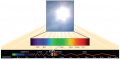
When you look at a rainbow, the atmosphere and the shape of your eye spread out white light into its spectrum which is the same principle. The meter part of the word comes from making this into a device that makes a comparison between a benchmark and an unknown sample. It works like this:

1) Light of all wavelengths hits a diffraction grating which spreads out the light according to each wavelength (a diffraction pattern aka rainbow). This can be achieved by looking around a room using a DVD as a mirror! At certain angles you'll notice rainbows everywhere. But they won't be rainbows like we normally see. Some colours will be brighter and some will be darker which directly correspond to molecular structure.

2) A computer takes a photo of a known light source such as a sodium lamp hitting the diffraction grading. Software then compares the photo of the diffraction pattern produced by the sodium lamp to the diffraction pattern of the sodium lamp AND the sample. The absorption or non-absorption of certain wavelengths by the sample can be used to identify the sample as well many of its physical properties. You can also compare another light source to the known light source which may be handy if you want to match a bunch of LEDs.

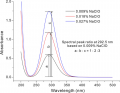
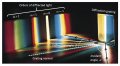
Notice how the waveform for sodium hypochlorite is similar for all three concentrations. University websites have all kinds of benchmarks you can use to help identify chemicals in the home shop. If you really pay attention you'll notice several orders of the same light source like in the photo below. Notice how m=1 and m=-1 are opposite colours relative to m=0. m=2 is more spread out than m=1 but contains the same information at a weaker intensity. This proves white light is a combination of all visible wavelengths. Very cool!

44211_2022_210_Fig1_HTML.png
Figure_79-Photonics_Handbook_800w.jpg
Figure_08_02_03.jpg

Question: In the diffraction grating reflection there is mostly yellow, white and blue but no red. Why is that?
 
Last edited:

Janis59

Joined Aug 21, 2017
1,894
llEncorell: The question is how much You want to witchcraft around optics. And seems not too deep. Therefore take the cheap but well proven thingy, the Ocean Optics spectrometer. It costs slight over 4k$. Small but effective phone size box with input by lightquide (fibre optics) and output by USB. Then in Your computer use their proprietary software to make signal A minus B, where B is memory content and rejoice what got. Or use alrternatively LabWiev what easy can make as distracting A minus B as even is capable to make a one large step higher task - the pattern recognition.
 

Ya’akov

Joined Jan 27, 2019
10,226
Hello Folks,
Please bear with me as i try and describe the item im looking for, I have very limited knoledge of electronics and ill probably use some incorrect terminology!

Im trying to offer as much information, whilst being purposfully vague about the product idea, as I can. But im happy to clarify anything via PM if its helpful.

Again I have little to no knoledge about the product im trying to create, or if its even possible!

I have an idea for a handheld device to be used in the industry I have worked in for the past 15 years

What the device would need to do is read(?) the wavelength of light passing through an object and compare it to a known value, then provide the user with a visual readout.

The device would need to be accurate enough to distinguish between very close representations of the same "colour" and quickly compare the reading to a set of known values, and provide a readout with little to no lag...

Im assuming code can be written that compares the results of the sensor to a set of inputted data and provide a response, what i dont know is if such a sensor A; exists or B; would be affordable enough to create a useable product.

Some thing that would make the device unusable in my mind would be:
Not handheld.
Mains powered.
Prohibitively expensive to an average user.

I am hoping such a sensor would be readily available and i could pay someone to make a prototype using off the shelf or easily available parts, but im happy to be told otherwise!

I apologise again if this seems either vague, stupid or unacheivable, I have asked some engineering adjacent friends who havent been much help and i honestly wouldnt know where to start.

The idea for this product has been bothering my brain for ten years and I either need to put it to bed as unachievable or move forward!

I appreciate you taking the time to read

Matt
Welcome to AAC.

The problem is that any genuinely useful answer to your question necessarily requires a description of the problem your device is intended to solve. By presenting the sensor as the problem, you have removed any context that would make an effective consultation impossible—or at least a matter of guessing and not much more than blind luck.

Given the few tiny clues you dropped, I have a question: have you ever heard of, seen, or used a densitometer?

Other than that, in the absence of genuine requirements (something you are not, at this time, qualified to produce), a description of the problem being solved, or the application, is necessary.
 
Top