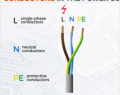
Hello ,an AC light bolp has needs two wires , while AC power in the wall has three wires.
So how am i supposed to connect the lightbolp in the power in the wall?
Thanks.
Connect the Live (L) wire from the wall (brown) to one terminal of the light bulb socket.
Connect the Neutral (N) wire from the wall (blue) to the other terminal of the light bulb socket.
Do not connect the Protective Earth (PE) wire to the light bulb socket, as standard light bulbs do not require it.
Connect the Live (L) wire from the wall (brown) to one terminal of the light bulb socket.
Connect the Neutral (N) wire from the wall (blue) to the other terminal of the light bulb socket.
Do not connect the Protective Earth (PE) wire to the light bulb socket, as standard light bulbs do not require it.
The connections of live and neutral are not arbitrary and reversible them can lead to painful—or worse—shocks. A lamp socket is only safe if the neutral, and not the live, is connected to the terminal with continuity go exposed metal parts of the socket which the user may contact.
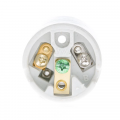
The screws of the socket with be color coded, like this one:
The neutral goes to the silver screw and the live to the gold (brass). And, many—though not all—lamp sockets provide a terminal for the safety ground, and it must be connected if there is one in the line cord. In the case of a two pin plug, the same applies and for the US Edison connector, a polarized type must be used (larger blade is neutral).
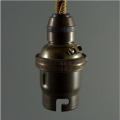
It's true that a typical modern phenolic B22 socket, which is entire insulated has no preferred polarization, but there are older B22 sockets with metal shells, and these must be wired with the correct arrangement. This is an example of of a UK-made B22 socket with brass shell:
You could e right about that, I was under the impression that the neutral appeared on the shell, but It is earthed and the neutral is isolated, that also works.
Of course my original point is you can't just ignore the L and N in many cases, and the ground in others. So many lamps are miswired in the US, but the 120V is somewhat mitigating. The 240V of the UK/EU is probably the reason for the fulliy insulated B22 socket.
What is certified as unsafe is to put one's finger into a light socket. And nobody asked the TS what type of socket. Worse yet, the sample held up was a power cord, not suitable for permanent wiring in a building, at least not in the US. In other parts of the world, rules may differ. AND A QUESTION: what color are the line (hot) and neutral of permanent wires in the UK? That is, not in ortable cords, but in wires hidden inside the walls.
One recent change in enclosure wiring colours by N.A. (NFPA79) to conform to Europe standard, was wiring inside enclosures that remained powered live from a different source when the local enclosure disconnect was OFF, was the N.A. custom of using colour Yellow in place of the now E.U. standard of Orange.
One recent change in enclosure wiring colours by N.A. (NFPA79) to conform to Europe standard, was wiring inside enclosures that remained powered live from a different source when the local enclosure disconnect was OFF, was the N.A. custom of using colour Yellow in place of the now E.U. standard of Orange.
Interesting indeed, Max, since orange may be easy to mistake for faded RED, while any of the shades of Yellow clearly stand out as not at all red or orange. I wonder what explanation was provided as to how the change improves safety.
"Yellow MAY STILL BE HOT" was so very easy to understand.

 Facebook
 Google
 GitHub
 Linkedin