Light automation circuit

Thread Starter

Copey84

Joined Jul 27, 2015
198
Hello, I'm trying to put together a circuit that will turn on a outside light automatically.
The light is over a doorway and can be switched on from inside, however that's not much use when your trying to find keys to get into house in the dark.
Don't want to use a pir as it can be a nuisance with cats and dogs setting it off plus the neighbours door is only a few feet away, so there likely to set it off.
I was thinking since the door opens on to driveway I could use the car headlights as a trigger to operate the light.
If I use two ldrs, one to turn on the other when it gets dark via a transistor, then when the car lights hit the second ldr that will trigger the circuit.
There's probably lots of ways to do this hoping someone could give me some pointers as to the most efficient way, with least amount of components. Had thought about using a latching relay with three separate contacts, the pulse from trigger latches relay, one set of contacts grounds the trigger ldr so that if car lights are on after relay has closed then it can no longer effect circuit. A second contact charges a rc time circuit that will be set to unlatch the relay after 3min. The third contacts turn light on.
I think this circuit will work but would it be better to use a flip flop circuit that will latch instead of multiple relay contacts?
Also if I powered the circuit of a 9v battery how long would it last given that one of the ldrs will be pulling current to ground during daylight hours? Possibly needs a rethink maybe someone could advise?
 

Thread Starter

Copey84

Joined Jul 27, 2015
198
Hello, thought I'd explain the light above the door will only be turned on when a car enters the driveway.
That door is mainly used for access to and from car, so the car headlights seemed a good idea as a trigger for light over door.
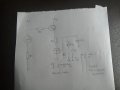
I have included a rough wiring diagram below showing how I think the circuit could work with relay contacts.
Is this a suitable method or is there a better more efficient way of building the circuit?1480002073048-1106355378.jpg
 

Thread Starter

Copey84

Joined Jul 27, 2015
198
Thought I'd try one last time to see if anyone out there could advise on how best to build the light automation circuit I have described in previous post.
I'm an electrician so connecting into mains voltage side is not a problem it's coming up with a low voltage circuit design that will work efficiently with minimal components.
As you can tell I'm no expert when it comes to electronics but I do like to learn a bit by building a few circuits when I get time. So if anyone has any advice please let me know, thanks.
 

Dodgydave

Joined Jun 22, 2012
11,395
You already have mains to the light, why would you want to power it from a battery?? what's wrong with a switch or pir on the front door.

Ldr is no good as it will respond to the sunlight, your best option is infrared or rf.
 

Thread Starter

Copey84

Joined Jul 27, 2015
198
Hi dodgydave the battery is for the control circuit that will operate a relay to switch on the light.
Suitable relay with 230v switch contacts will be used.
I was going to use two ldrs, one at rear of house, this will keep circuit low during the day.
Then at night the ldr at front of house in driveway will go high and be able to trigger relay when car lights hit it.
Plan to use small PCB ldrs, as it's just a case of drilling two holes front and back of house, push them through and make a clear flush cover, they'll never be noticed and I can easily get wires to them.

Only problem is power consumption and the trigger circuit.
If I use a 9v battery how long could I expect to get out of it with one of the ldrs pulling current on a daily basis, then at night the activation of relay three or four times max?
And what would be the best way to latch the circuit on and of. Would a flip flop circuit be best ?
 

Thread Starter

Copey84

Joined Jul 27, 2015
198
Hi r!f@@ don't want to have a switch or pir around the doorway.
My idea means only a small hole to drill to push ldr through, and it will not be visible.
Can you advise on questions on previous post?
 

Thread Starter

Copey84

Joined Jul 27, 2015
198
In wiring diagram on post 4 I showed one ldr pulling current down, then at night when it stops conducting the transistor turns on leaving the second ldr with a voltage that can trigger circuit when car headlights shine on it.
Do you think this will work?
 

Bernard

Joined Aug 7, 2008
5,784
If you have dawn to dusk light control then what is the need for headlight control ?
If just headlight control, I would measure LDR in proposed location during daylight & with headlight; if there is a reasonable difference, say 2:1 then use LDR to trigger a 555 -5 min. one shot driving a 12 V relay. Power from AC adapter.
 

Thread Starter

Copey84

Joined Jul 27, 2015
198
Hi Bernard, I don't want the light on from dusk to dawn. The door is only used when going to and from car, so thought it would be a good idea to use car headlights as a trigger for light over the door.
From what you have said it could be done with one ldr as long as there is a difference between the light levels, is that correct?
If so is it a case of using those two different light levels to arm and trigger the 555timer.
Could you provide more info on how to build the circuit.
Think I have a 12v adaptor lying around somewhere, there's definitely a 5v. Could get a 5v relay, either way 5 or 12 would do I think.
 

Bernard

Joined Aug 7, 2008
5,784
Either 5 V or 12 V will work. Relays need to draw less than 200 ma. or use drivers.
Today is overcast, LDR with 2 in. X 1/2 in. shielding tube, measures 5 K, with headlight @ 15 ft. measures 1-5 k.
If you can have similar results then triggering a 555 should work. I can post a drawing next Monday.
 

Thread Starter

Copey84

Joined Jul 27, 2015
198
Bernard when car comes into drive the lights will be about a metre away from ldr.
Thats probably when the ldr is going to get the strongest light, driveway is facing north east so light levels will be low especially this time of year, but will obviously be higher in summer months.
Had planned to use a small ldr about 5 to 8mm diameter, nothing fancy came in a bag of components i got awhile ago, will it be fit for purpose?
Will try measuring the resistance of ldr tomorrow. Car headlights are likely to reduce the resistance although it will depend on how quickly the ldr reacts. Headlights will only be concentrated for short time might take awhile to reduce the resistance, what do you think?
Also will the circuit work ok if say someone pulls into drive and leaves headlights on for 5 10min. I'm thinking the circuit will latch someway after pluse from ldr triggers it. Just thought I'd point out that the ldr could conduct after it has triggered the circuit if lights are left on.
 

R!f@@

Joined Apr 2, 2009
10,004
Well....built it and find out.

I usually do that when some one differs with me, I tried to find out.
Nothing is better than doing it and understanding it.

LDR drops it's resistance as long as the it has light on it.
 

Sensacell

Joined Jun 19, 2012
3,785
If I understand the design objective correctly- You want the lights to turn on for a few minutes when headlights shine on an LDR, leaving the lights on for a few minutes to get into the house?


The circuit could be made to only respond to rapid increases in illumination, totally ignoring the slow changes of light during the day.
This could be achieved by capacitively coupling the LDR circuit to the input of a simple timer circuit.
If the LDR is placed at the end of a longish black tube, the response could be directional enough to ignore most sources of light - besides the direct illumination from headlights.

Run the system from a mains powered DC power supply - batteries are not going to cut it here.
 

Thread Starter

Copey84

Joined Jul 27, 2015
198
Hi Sensacell, you are correct about how I want circuit to work.
Could you explain further how the capacitive coupling part could work?
And what would timer set up consist of?
I could probably have ldr at end of a tube no more than 3inches. Don't want too much sticking out inside garage. Would this be ok?
 
Top