LED TV backlight tester - Why two DIACs ?

Thread Starter

ranatungawk

Joined Oct 30, 2008
226
T
As expected, the LEDs clamp the output voltage below the DIAC trigger voltage, so the don't conduct anything beyond their leakage current.

ak
To understand, what is the "max current" that will flow across the LED between the probs ? Ex: if one 3V, 15mA LED connected across the probs ?

furthermore :
1779500456224.png
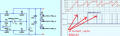
can you explain the above pic pls, when probs are not connected , can there be current spikes through Diacs up to 900mA? (Sorry, im not familiar with this illustration )
 
Last edited:
This is a DIY LED TV backlight tester. I found this on the internet. Could you please tell me the purpose of the two serially connected DIACs placed between the + and − terminals of the bridge rectifier?
View attachment 367521
To me, it looks like they act like a voltage-dependent bypass/protection path. Most probably to suppress voltage spike and protect the LEDs from voltage transient.
 

AnalogKid

Joined Aug 1, 2013
12,143
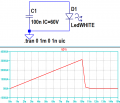
When you connect charged up to 60 V capacitor to LED, through LED passes 300 millions ampere current pulse.
1. No, it doesn't.

2. 300 million amperes for one femtosecond - ??? I want to buy that capacitor. Please post a photo of the capacitor and a link to a vendor.

3. Given the nature of what is being asked, do you really think that that is a rational response?

ak
 
Last edited:

Danko

Joined Nov 22, 2017
2,170
2. 300 million amperes for one femtosecond - ???
Do not worry so much, in post #25 LTspice showed us theoretical scenario.
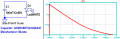
In reality:
1779601299449.png
I guess, TS will happy.

@ranatungawk:
LED failure during capacitor discharge occurs due to thermal and electrical breakdown of the p-n junction.
A capacitor charged to a certain voltage acts as a source of infinite current.
When connected directly, a pulse occurs that exceeds the diode's rated current hundreds of times,
instantly destroying the crystal.

Destruction Mechanism:

Overcurrent:
At the initial moment of discharge, the LED's internal resistance is very low,
so the current is limited only by the capacitance and ESR (equivalent series resistance) of the capacitor.
Instantaneous heating:
The power released in the p-n junction exceeds the crystal's heat capacity.
Temperatures at points in the current cords reach critical levels within microseconds.
Electromigration and degradation:
Micro melting of gold conductors (hairs), destruction of the semiconductor structure,
or detachment of the crystal from the heat-dissipating substrate occur.

Characteristic signs of failure:

Instantaneous open circuit:
The crystal completely breaks, the LED stops glowing and does not conduct current.
Micro short circuit:
The diode begins to glow dimly, flicker, or consume current, but
loses its optical properties due to the destruction of the phosphor.
 

Thread Starter

ranatungawk

Joined Oct 30, 2008
226
Do not worry so much, in post #25 LTspice showed us theoretical scenario.
In reality:
View attachment 367605
I guess, TS will happy.

@ranatungawk:
LED failure during capacitor discharge occurs due to thermal and electrical breakdown of the p-n junction.
A capacitor charged to a certain voltage acts as a source of infinite current.
When connected directly, a pulse occurs that exceeds the diode's rated current hundreds of times,
instantly destroying the crystal.

Destruction Mechanism:

Overcurrent:

At the initial moment of discharge, the LED's internal resistance is very low,
so the current is limited only by the capacitance and ESR (equivalent series resistance) of the capacitor.
Instantaneous heating:
The power released in the p-n junction exceeds the crystal's heat capacity.
Temperatures at points in the current cords reach critical levels within microseconds.
Electromigration and degradation:
Micro melting of gold conductors (hairs), destruction of the semiconductor structure,
or detachment of the crystal from the heat-dissipating substrate occur.

Characteristic signs of failure:

Instantaneous open circuit:
The crystal completely breaks, the LED stops glowing and does not conduct current.
Micro short circuit:
The diode begins to glow dimly, flicker, or consume current, but
loses its optical properties due to the destruction of the phosphor.
Thanks for the update!

Just forget the adding a capacitor now.
What would happen if I replaced the two DB3 DIACs with a 1W / 62V Zener diode such as the 1N4759A?
 

Thread Starter

ranatungawk

Joined Oct 30, 2008
226

schmitt trigger

Joined Jul 12, 2010
2,092
No.
You haven’t yet grasped exactly how a Diac works.
Once a Diac reaches its break over voltage, it triggers and switches to a low impedance, meaning the voltage across its terminals is very much reduced, and will remain in this state until its current falls below the holding current.
 

Thread Starter

ranatungawk

Joined Oct 30, 2008
226
No.
You haven’t yet grasped exactly how a Diac works.
Once a Diac reaches its break over voltage, it triggers and switches to a low impedance, meaning the voltage across its terminals is very much reduced, and will remain in this state until its current falls below the holding current.
But the final result (what we can see) is the same, correct?
Adding a Zener diode or two DIACs keeps the probe voltage at 62V.
 

AnalogKid

Joined Aug 1, 2013
12,143
Adding a Zener diode or two DIACs keeps the probe voltage at 62V.
No, it does not.

A zener diode will clip the voltage waveform at 62 V. During each half-cycle, the voltage will rise up in a sine wave pattern until it reaches 62 V. At that point, the zener will begin to conduct, and will adjust its own impedance such that the voltage across it does not increase above 632 V. After the peak of the half-cycle, the voltage across the zener will stay at 62 V while the mains voltage decreases from its peak, heading down to the zero crossing. When the mains drops below 62 V, the zener will stop conducting and the voltage across it will follos the sine shape down to the zero crossing.

The two DIACS trigger, or break over, at 62 V. They do not conduct any current until the voltage reaches 62 V. At that point, their impedance drops very fast, so that the voltage across them is less than the breakover voltage.

ak
 

AnalogKid

Joined Aug 1, 2013
12,143
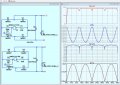
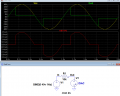
Below is the simulation of one DIAC to help understand its operation:
It's actually a neon bulb model, but its voltage levels were adjusted to act essentially the same as the DIAC,
I knew that if I waited long enough, you would get tired of all of this text borscht and leap into action.

ak
 
Top