THAT is why I suggested buffers AND then diodes, as a "diode OR" arrangement. The buffers would increase the available drive current if you used either 9 or 12 volt power.
Is this project for a model car??
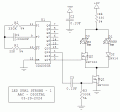
#22 schematic - Connecting the diodes to Q1, 3, 5, and 7 will make a symmetrical blinking pattern, rather than an extra 1-count delay between the end of blue and the start of red.
Ah, but wait - The asymmetrical pattern might be more attention-getting. Hmmm...
Because the 555 is clocking a counter, the clock waveform duty cycle does not affect the output pulse widths. You can eliminate R2 and D3. Connect pins 2 and 6 together, and the other end of R1 to pin 3.
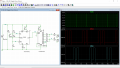
Assuming this circuit is driving generic red and green LEDs, here is a different approach. This is set for 4 blinks left and 4 blinks right. I added R3-C3 to shorten the on time for a more snappy look.
#22 schematic - Connecting the diodes to Q1, 3, 5, and 7 will make a symmetrical blinking pattern, rather than an extra 1-count delay between the end of blue and the start of red.
Ah, but wait - The asymmetrical pattern might be more attention-getting. Hmmm...
Because the 555 is clocking a counter, the clock waveform duty cycle does not affect the output pulse widths. You can eliminate R2 and D3. Connect pins 2 and 6 together, and the other end of R1 to pin 3.
OK, I counted wrong. It was early, before morning coffee. And the pulse generator would be the two inverters not used as buffers, used as an oscillator. and use counts 1, 2, and then 6, 7
To work through things like this, think of the 4017 (or any logic device with a totem-pole output) like this: The output is either dead-shorted to a 10 A power supply (high), or dead-shorted to GND (low). There is nothing in between, and any circuit errors will burst into flames. Since only one output at a time can be high, a direct connection between any two outputs means that there are two opportunities for flames.
Maybe, instead of connecting the LED directly (with one current limiting resistor to ground) the outputs should be connected to the LED via a resistor at each output,
You can connect two outputs together into one LED through resistors. However, when one output is high the other will be low, so you now have a 2-resistor voltage divider driving the LED. Not dangerous, but also not efficient.
or maybe a diode for each output and one resistor from the LED to ground.
Assuming this circuit is driving generic red and green LEDs, here is a different approach. This is set for 4 blinks left and 4 blinks right. I added R3-C3 to shorten the on time for a more snappy look.
Very clever, I like the fact that one can use smaller caps with this circuit.
BTW, what CAD package are you using for your schematics?
They look very sharp.

 Facebook
 Google
 GitHub
 Linkedin