Led light turn on at specific Voltage

Thread Starter

djmixalot

Joined Dec 27, 2023
23
Can you show how the old lights are wired and where you measuring this 10.2V when off? My understanding of your description seems very unlikely to me.
There is a pair of wires connected to a molex plug and the old and new lights have the mating molex plug. I'm measuring the voltage at the molex plug from the vehicle side.
 

Thread Starter

djmixalot

Joined Dec 27, 2023
23
Sounds like my wife's old Hyundai. Daytime Running Lights (DRL). Headlights were lit dimly whenever the car was running. When you switched the headlights on they went on full brightness. This is a safety feature, one insurance companies like to see. The way the Hyundai DRL lights ran dim was via a modulated source. PWM or Pulse Width Modulation would supply power on and off very quickly with a shortened ON time. The overall average voltage was what lit the DRL's. When you turned on the headlights PWM either went to 100% on time or another circuit activated at full voltage.

When you talk about a car's electrical system, a 12 volt system, when the engine is running, runs at about 13.6 volts. After startup it can run as high as 15 volts, though I've never seen one run that high. I HAVE seen 14.5V on occasion. So all this must be factored in. If you're using some sort of comparator circuit to determine the voltage that comparator needs to have a constant regulated reference voltage. Otherwise at 10 volts DRL ON and the engine starts and the voltage runs as high as 14 volts, the 10V can appear to be 12V (approximately without doing any math).

Are you SURE your 10V is a solid 10V? Or is it PWM? PWM engine running or engine off will still see the fluctuation in voltage unless the car's computer monitors the output and modulates the PWM accordingly. You COULD be chasing a rabbit down a hole. No matter how far in you reach the rabbit just goes deeper.

It is not DRL, this is a unique Electric Vehicle, does not have a motor and there is a separate DRL plug just for that.
 

Thread Starter

djmixalot

Joined Dec 27, 2023
23
Yes, that is correct, but the diode will always have the breakdown voltage across it after it breaks down.

It is not a switch that closes at the breakdown voltage.
But that is what I want, i want the zener breakdown to be 12v so when it hits it passes the 12v. This would simulate pressing the brakes it would pass 12v through the zener or when the turn signal is turned on it passes 12v on and off.

I'm still trying to understand why you don't think it will work
 

BobTPH

Joined Jun 5, 2013
11,533
That is not the way a zener works. A 12V zener in series with a voltage will pass no current at <= 12V. After that it passes current, but drops 12V across it. So if your lamp in series with a 12V zener, If the supply is 12V, the lamp will see 0V. If the supply goes to 13V, the lamp would see 1V.

I don’t know what exactly @Ya’akov is talking about, but it certainly is not placing a 12V zener in series. That cannot solve your problem. I hope he will clarify this.
 

Thread Starter

djmixalot

Joined Dec 27, 2023
23
What Bob said.

An 11-volt zener and a transistor might do what you want.
Wow, i was under the wrong impression this whole time. I thought it would work with a 12v zener.

Can you please elaborate on the 11v zener and transistor how that would be wired to make it work? A diagram would be helpful
 

Thread Starter

djmixalot

Joined Dec 27, 2023
23
That is not the way a zener works. A 12V zener in series with a voltage will pass no current at <= 12V. After that it passes current, but drops 12V across it. So if your lamp in series with a 12V zener, If the supply is 12V, the lamp will see 0V. If the supply goes to 13V, the lamp would see 1V.

I don’t know what exactly @Ya’akov is talking about, but it certainly is not placing a 12V zener in series. That cannot solve your problem. I hope he will clarify this.
I'm confused Bob, i thought that is how it worked thanks for bringing this up, i just cancelled the order for the 12v zener diode. I wonder why @Ya'akov thought it would work too?
 

ElectricSpidey

Joined Dec 2, 2017
3,335
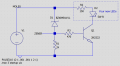
Here ya go.

The zener is just the first one in the list in the sim, you will have to find a suitable one.

Inside the dotted box represents your new LEDs, as the exact contents are unknown.


1703792991361.png

1703793111850.png
 

Thread Starter

djmixalot

Joined Dec 27, 2023
23
Here ya go.

The zener is just the first one in the list in the sim, you will have to find a suitable one.

Inside the dotted box represents your new LEDs, as the exact contents are unknown.


View attachment 311147

View attachment 311148
Sorry for the late response it's been a long day.

I just looked at what you put together and I just have a question or two for clarification before I start ordering the parts.

When you state the zener is one I will have to find a suitable one what do you mean exactly?

The resistors I can order the transistor part number I believe you've got listed I can order that as well it's just the zener I need clarification on.

In terms of reliability and longevity since I'm going to have to make this for each light do you foresee this being a problem?

Thanks again
 

Janis59

Joined Aug 21, 2017
1,894
One of ways to make it is 555 tablet. One may serve as two level indicator, no light when voltage is too small, other LED when level is between two levels and second diode when level is over that interval. Exactness is not ideal like with comparator, but +/- 0.1 V is easy to get. Have worked with that in plethora of cases.
 

ElectricSpidey

Joined Dec 2, 2017
3,335
Standard Disclaimer:

The circuit provided is essentially a proof of concept based on the information provided, and it is entirely up to you to determine the suitability for your needs. You can't just take a circuit provided by some total stranger online and assume it will work for you.

The very first thing you must do is to determine if that 10-volt signal is a true DC source. The circuit provided will not work with PWM. You can determine this with a scope or perhaps a meter with a frequency mode. Another way to get a pretty good idea would be with a simple circuit consisting of a standard diode and a capacitor. (connect the diode and cap in series with the positive and negative output from the connector and measure the voltage across the cap, it should be close to the source voltage)

You must be in a position to breadboard the circuit and test the operation in actual conditions. Making tweaks to a circuit is very common after a proof of concept is established. In other words, you may need a different voltage Zener and or make adjustments to the component values such as the resistors.

You also mentioned the current in one of the lamps, is this value consistent across all of them? (or at least close)

As far as component choices...you need to acquire them based on the environment they will be used in, in this case automotive.

As far as reliability, I don't see any problems with the circuit as shown, but it will be very important to use the proper construction techniques to insure long life and durability. (heat, vibrations etc)

So don't just run out and buy a bunch of components based on the concept, you need to plan how to do the testing phase first. That should include some breadboard, MOLEX connectors, a resistor assortment...etc.
 

Thread Starter

djmixalot

Joined Dec 27, 2023
23
Standard Disclaimer:

The circuit provided is essentially a proof of concept based on the information provided, and it is entirely up to you to determine the suitability for your needs. You can't just take a circuit provided by some total stranger online and assume it will work for you.

The very first thing you must do is to determine if that 10-volt signal is a true DC source. The circuit provided will not work with PWM. You can determine this with a scope or perhaps a meter with a frequency mode. Another way to get a pretty good idea would be with a simple circuit consisting of a standard diode and a capacitor. (connect the diode and cap in series with the positive and negative output from the connector and measure the voltage across the cap, it should be close to the source voltage)

You must be in a position to breadboard the circuit and test the operation in actual conditions. Making tweaks to a circuit is very common after a proof of concept is established. In other words, you may need a different voltage Zener and or make adjustments to the component values such as the resistors.

You also mentioned the current in one of the lamps, is this value consistent across all of them? (or at least close)

As far as component choices...you need to acquire them based on the environment they will be used in, in this case automotive.

As far as reliability, I don't see any problems with the circuit as shown, but it will be very important to use the proper construction techniques to insure long life and durability. (heat, vibrations etc)

So don't just run out and buy a bunch of components based on the concept, you need to plan how to do the testing phase first. That should include some breadboard, MOLEX connectors, a resistor assortment...etc.
I understand some level of testing is going to be required but I was not expecting to have to try a dozen different resister and diode values. Was hoping your schematic was it.

I know the source is not PWM so that is easy.

Is there an off the shelf solution that has adjustment that I could use. A comparator would not work b/c the source voltage is 10v so the relative voltage would be 0-10v and once it receives 12V at that point it is not considered the source the comparator initially knew of.
 

Thread Starter

djmixalot

Joined Dec 27, 2023
23
One of ways to make it is 555 tablet. One may serve as two level indicator, no light when voltage is too small, other LED when level is between two levels and second diode when level is over that interval. Exactness is not ideal like with comparator, but +/- 0.1 V is easy to get. Have worked with that in plethora of cases.
Can you make a simple schematic and give more context on how it is setup. thanks

I'm looking for a solution i don't have to buy a dozen resistors and diodes to test. Was hoping the solution wlectricspidey provided would be it but it sounds like that is just a concept
 

MisterBill2

Joined Jan 23, 2018
27,587
One question unasked is at what voltage do the new LED light first show illumination, and then at what voltage do they show full brightness?
My second question is what is so very wrong with lighting up just a bit? Is it possible to open the new light assemblies and access the connections, without causing damage.
A possible option will be a series SCR to totally cut off power to the array until the voltage was 12 volts. Latching on will not be an issue, hopefully, but it might be.
 

Thread Starter

djmixalot

Joined Dec 27, 2023
23
not possible to open the new led without causing damage.
what is wrong is that those 4 led are stuck on, with turn signals you don't want them stuck on all the time.
What matters is the condition i'm trying to sovle, which is with 10v part of the leds are lit all the time.

If you have an off the shelf or simple solution that doesn't require having to buy a ton of components to test I would love to hear it. thanks
 

Thread Starter

djmixalot

Joined Dec 27, 2023
23
You didn't waste my time, I was just under the assumption your circuit would work without having to buy a bunch of different components
 
Top