LED light bulb circuitry

Thread Starter

chrischrischris

Joined Feb 18, 2012
317
Hi.
I thought I'd order some LED light bulbs via ebay from China to see how fair up. And yes, before you say it, I know you get what you pay for.

So in Australia, a normal quality phillips LED 9W light would cost me around $7AU. From China, these "no name brands" cost me $2.18AU each delivered (I bought 10). Well, they were delivered in bubble wrap only and so of course one had it's head knocked off! What surprised me is the weight difference between the phillips brand and this no name.

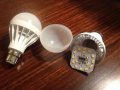
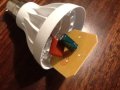
Given the head was off one of them, I took a peek inside and found there were:
  • 15 off SMD LEDs
  • 4 diodes labelled M7 (which I see is an SMA rectifier diode 1N4007)
  • 2 off 470 ohm resistors
  • 2 off 470K resistors
  • 1 off 47uF 100V electrolytic cap
  • 1 off film capacitor 145J, 400V
  • and that's it!
    (see photos)


Any comments from anyone? Is this sufficient circuitry? There's a heap more in a phillips bulb, so what are they missing out on?
 

Attachments

JUNELER

Joined Jul 13, 2015
183
Hi,
Is there any ratings label such as wattage and ac voltage.
The parts listed its look like a 220vac input and the circuit is a half wave rectified (1N4007).
2 470k dropping resistor and filtered by 47uf/400v to be a dc supply for 15 smd leds in series.
2 470 ohm resistor for led dropping on one of the rails. Either connected to positive or negative rail.
1 of 145J/400V for shunt across the diode act as a noise filter.
No missing at all its a cheapest designed of the circuit,thats why low price.
The problem is the life in hours consumption.
 

ErnieM

Joined Apr 24, 2011
8,415
I would bet that big red cap is in series with the AC line and is used as an AC capacitive divider. It's a cheap and dirty way to fairly efficiently drop an AC voltage.

However, further discussion of this violates this sites TOS as it is an off the line to LED circuit. It's a safety issue if you start building these things.
 

DickCappels

Joined Aug 21, 2008
10,661
The lamp you described is not regulated and is not (very) dimmable. Those features might be present in the Philips lamps you mentioned.

A Japanese company and an American company own patents covering lamps with the phosphor film that converts the bluish LED light to white. This seems to be the only practical method of getting a good white (the conversion film is the yellow thing you see when you look at an unlit white LED). The bad news for people living in markets covered by those patents is that the right to make and sell LEDs with that technology one has to pay rather stiff royalties. Three years ago one of the patent-holding companies quoted me $1 per square inch. When buying white LEDs from some Chinese LED manufacturers you can opt to buy LED with the license or without. It is very likely that the cheapo no-name LED lamps are using the unlicensed LEDs.

LEDs dim as they age. The hotter the LED the faster the degradation. Philips would likely have gone to some trouble and expense to conduct the heat away from the LED(s) and couple that heat to the ambient air.

I don't think Philips can make things truly on the cheap because they have to worry about the experience of the customer. Sadly, as it is in China these days companies that get into trouble merely change their names and pick up where they left off.
 

GopherT

Joined Nov 23, 2012
8,009
The lamp you described is not regulated and is not (very) dimmable. Those features might be present in the Philips lamps you mentioned.

A Japanese company and an American company own patents covering lamps with the phosphor film that converts the bluish LED light to white. This seems to be the only practical method of getting a good white (the conversion film is the yellow thing you see when you look at an unlit white LED). The bad news for people living in markets covered by those patents is that the right to make and sell LEDs with that technology one has to pay rather stiff royalties. Three years ago one of the patent-holding companies quoted me $1 per square inch. When buying white LEDs from some Chinese LED manufacturers you can opt to buy LED with the license or without. It is very likely that the cheapo no-name LED lamps are using the unlicensed LEDs.

LEDs dim as they age. The hotter the LED the faster the degradation. Philips would likely have gone to some trouble and expense to conduct the heat away from the LED(s) and couple that heat to the ambient air.

I don't think Philips can make things truly on the cheap because they have to worry about the experience of the customer. Sadly, as it is in China these days companies that get into trouble merely change their names and pick up where they left off.

So-called "remote organic phosphors" are coming soon. They are sprayed inside the lens rather than on the LED. Much higher efficiency and cheaper. Inorganic phosphors actually attenuate a lot of the incoming light.
 

Dodgydave

Joined Jun 22, 2012
11,395
What you have there is a transformerless psu, very cheapest way to drop voltage at low current..And DANGEROUS TOO.

(Moderator's note: Schematic of a circuit that we are not permitted to discuss on the forum was removed -dc)
 
Last edited by a moderator:

dl324

Joined Mar 30, 2015
18,326
Any comments from anyone?
Those bulbs are going to have terrible down light in base down applications. That was problematic in most of the early designs and some still haven't addressed it.

I replaced 6 candelabra bulbs in a fixture with LEDs and had to put back two of the incandescent bulbs to get rid of the shadow...

Better quality bulbs will have a more effective method for dissipating heat. Looks like those bulbs are relying on convection; which would work better if they had vent holes in the other part of the bulb. Probably won't be long before they copy Cree's latest design.
 

wayneh

Joined Sep 9, 2010
18,104
What you have there is a transformerless psu, very cheapest way to drop voltage at low current..And DANGEROUS TOO.
I agree it CAN be dangerous, hence the ban here on projects using it, but it doesn't have to be. Many, many commercial products use this type of power conversion.

BTW, this is called a "wattless dropper", right? Where does that name come from? Is it really more power efficient than a wall wart?
 

Bernard

Joined Aug 7, 2008
5,784
That circuit looks almost like my line operated, 9 year old LED night light. It's down to just a bright glow now.
Not posted on AAC.
 

Thread Starter

chrischrischris

Joined Feb 18, 2012
317
Thanks everyone for your comments. In answer to some questions:
Juneler - these are so cheap that there isn't any markings on them at all. They are 7W, 240V rated. However, you mention life in hour consumption. Could you explain further.

ErnieM - yes, that big cap does go directly across the active and neutral. I don't see how it drops the voltage though.

DickCappels - I checked the Phillips light and it's not dimmable. I do however see what you say about led royalties. I'm sure that probably accounts to the price difference. As for heat, these are actually quite well designed. They have quite a bit of venting going on in the plastic bulb surround.

Doggydave - yes, another bulb I once opened did have a transformer. This has none. I assume that means this is less efficient (costs more to run?). Why do you say however that it is dangerous?

dl324 - I've tried this globe in a night stand and it seems to light up well - no extra shadowing. I'll have to see how it goes in a down light application - you could be right. As for venting, as mentioned above, it does have stack - check out the original photo. Also it seems to not heat up at all as compared to the Phillips one. Not sure why. Does this mean it's running more efficiently?
 

#12

Joined Nov 30, 2010
18,224
Is it really more power efficient than a wall wart?
If the film cap is the current limiter, then it's a "wattless" situation where the only power used is in the LEDs and the rectifiers. I have some 4W equivalent LED bulbs with capacitor limiting and they are completely dimmable.

1.4 uf @ 50Hz is 2.27k for 106 ma at 240 volts. That would be 25 watts to the LEDs but they are labeled 9 watts, so the resistors must be involved in the current limiting.
that big cap does go directly across the active and neutral. I don't see how it drops the voltage though.
Must be a spike limiter because it's not a current limiter.
 

Dodgydave

Joined Jun 22, 2012
11,395
Thanks everyone for your comments. In answer to some questions:
Juneler - these are so cheap that there isn't any markings on them at all. They are 7W, 240V rated. However, you mention life in hour consumption. Could you explain further.

ErnieM - yes, that big cap does go directly across the active and neutral. I don't see how it drops the voltage though.

DickCappels - I checked the Phillips light and it's not dimmable. I do however see what you say about led royalties. I'm sure that probably accounts to the price difference. As for heat, these are actually quite well designed. They have quite a bit of venting going on in the plastic bulb surround.

Doggydave - yes, another bulb I once opened did have a transformer. This has none. I assume that means this is less efficient (costs more to run?). Why do you say however that it is dangerous?

dl324 - I've tried this globe in a night stand and it seems to light up well - no extra shadowing. I'll have to see how it goes in a down light application - you could be right. As for venting, as mentioned above, it does have stack - check out the original photo. Also it seems to not heat up at all as compared to the Phillips one. Not sure why. Does this mean it's running more efficiently?
It's dangerous to work on for testing, as it is Not Isolated from the mains supply, where a transformer would be safer, as for Efficient, yes it's more efficient than a transformer as there is less power wasting, and cheaper to make.
 

DickCappels

Joined Aug 21, 2008
10,661
Thank goodness that chrischrischris (The Thread Starter...by the way, your name isn't "Chris" is it? :rolleyes:) is converting his lamps to 12V, so he doesn't have to worry about electric shock.
 

Thread Starter

chrischrischris

Joined Feb 18, 2012
317
Thanks dodgydave, this is just a bought light globe, so won't be working on it. Good to hear it's more efficient. Only downfall I can see then is that the LEDs are half way up the light, so the light only radiates up. My wife hates them!

DickCappels - yes it's Chris. I would have used plain old Chris in this forum, but someone already did. And they used chrischris too! Not sure however what you mean about the 12V. That red film capacitor is connected across the 240V supply, which pokes thru the board to were the LEDs are. Touch that part of the board with the semi hemisphere dome off and and I'd turn into toast.
 

ErnieM

Joined Apr 24, 2011
8,415
A bulb using a capacitor for a voltage drop is no more dangerous that any other standard incandescent bulb.

The danger comes about when people start using this technique to light LEDs and things on their own, especially people new to electronics. It is very easy to poke your eye out and get huge lethal shocks from doing this.

If you have the experience to do this safely you do not need instructions here. If you need the instruction then you should not be doing this. Period.

Thus I am in complete agreement with the ban on this topic.

One may note I have successfully built a few of these things, and reversed engineered some products that use this. I live to tell the tail because I can do it safely.
 

Thread Starter

chrischrischris

Joined Feb 18, 2012
317
A bulb using a capacitor for a voltage drop is no more dangerous that any other standard incandescent bulb....The danger comes about when people start using this technique to light LEDs and things on their own, especially people new to electronics. Thus I am in complete agreement with the ban on this topic.
Ernie, I understand what you mean about the ban on this topic. However I would assume this would be the case if I was to modify the circuitry that connected directly to mains power. If however I was to pull it to pieces to use with DC voltage then the topic should be fine.

In my case, I pulled this bulb to pieces simply to satisfy my curiousity to see what made it tick. I had a Phillips bulb that weighed much more and it had about 25 components in it including a small transformer. So I asked the question in this forum to simply learn how this could work and whether it was energy efficient (I.e. why pay $8 where I could pay $2).
 

RichardO

Joined May 4, 2013
2,270
I am guessing that some of the extra weight is a better (beefier) heat sink in the Philips lamp compared to the no-brand version. Using a cap for a current limiter is only practical for up to a few watts. More than that and the cap gets really huge.
 
Top