LED flash circuit doesn't work.

Thread Starter

quique123

Joined May 15, 2015
405
OK this is my confusion:

"The voltage across the transistor decreases because the LED discharges the capacitor."

If you say the voltage across the transistor decreases it's because at some point it was high. Does the V across the T get high when power is applied and since one terminal of the T is to GND and the other to 12V, then as current flows from the Cap discharging the cap, the + side of the T goes down?
 

dendad

Joined Feb 20, 2016
4,637
45+ years ago I made a Do Nothing Box and gave it to a pretty young exchange student. Well, it did not "Do Nothing"!
We have been married for 45 years :)

The circuit is 3 cross connected NE2 neon oscillators. They flash one after another.
I wonder if the transistor circuit will work the same?
DoNothingBox.jpg
 

rsjsouza

Joined Apr 21, 2014
425
Pretty cool story that made me recall doing "never ending" blinking circuits by taking advantage of the "avalanche" behaviour of Neon lightbulbs. That and the countless times I replaced the elusive newfangled "DIAC" with NE-2s on my dimmers... (my hometown was 220Vac, thus it still allowed a good voltage control range after the NE-2 triggered).
 

Thread Starter

quique123

Joined May 15, 2015
405
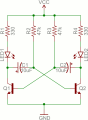
Ok so Im trying this astable multivibrator. The differences are that instead of a 330Ω for each LED, i only have 220Ω R and that instead of 47kΩ resistors I have 30kΩ resistors. Could that be the reason the circuit doesnt work?:

astable.png

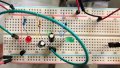
My wiring came up like this:

IMG_8719.JPG
 

DickCappels

Joined Aug 21, 2008
10,661
Your resistor substitutions, though the 220 ohms made me wince a little.

Are you sure the capacitors are in the correct direction? (Can't tell from photo)
What are you using for VCC?
What are the transistors?
And is VCC + or - with respect to the emitters.
 

MisterBill2

Joined Jan 23, 2018
27,513
I would say, that in the circuit the capacitors are backward. With one transistor conducting it's collector is low, and in order to charge thwe cap so that the other transistor can switch on the cap has to have low enough leakage so that the base voltage for the other transistor can turn on.If the caps leak. At least that is what I can see could be the problem.
 

Thread Starter

quique123

Joined May 15, 2015
405
Thanks,

1. Ok, the caps have the negative side facing the 30kΩ. According to the schematic above, they are in the right direction. The white stripe is the (-) side.

2. Vcc is two 9V in series for a total of 18V.

3. Transistors are 2n2222.
 

MisterBill2

Joined Jan 23, 2018
27,513
For a test, if you take the caps out of circuit, do both LEDs light?
If not, have a look at that first.
Like I just mentioned, if the cap leakage is excessive then the thing would not work. AND capacitor leakage current in the reverse direction is generally much higher.
 

Thread Starter

quique123

Joined May 15, 2015
405
I removed the calls and the Leds don't light up...but I tested the Leds and they are fine. The caps and resistors are new. The T are from an old project but they were fine after I used them.
 

dendad

Joined Feb 20, 2016
4,637
I removed the calls and the Leds don't light up...but I tested the Leds and they are fine. The caps and resistors are new. The T are from an old project but they were fine after I used them.
There is a problem.
Check the transistor connections. They are not all the same.
Without the caps, the current via the base resistors should turn the transistors on and light the LEDs.
Do you have a multimeter?
If so, measure the volts on the transistors.
 

ebp

Joined Feb 8, 2018
2,332
18 V supply with 220 ohms for the LEDs is rather cruel. I'd use just one 9 V battery.

Both pins of the LEDs are plugged into the same strip, so they are shorted.
 

DickCappels

Joined Aug 21, 2008
10,661
At 18 volts you are likely to be avalanching the emitter-base junction of your 2N2222 when the other transistor turns on. Not only will that affect timing, it could lead to eventual failure of your transistor to have enough gain to oscillate.
 

panic mode

Joined Oct 10, 2011
4,978
looks correct if using 2N2222
i seriously question wiring methods though, connections of all components are stretched widely and probably don't make good connections. when breadboarding, avoid stress on connections, try to make the fit more or less straight into the breadboard holes, without too much fanning out. and don't place more than one wire to same hole. don't see negative power or mention of supply voltage. this circuit only needs couple of volts (5V for example). connecting too high voltage will fry it.
 

dl324

Joined Mar 30, 2015
18,326
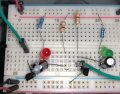
My wiring came up like this:
The green LED is shorted, and it looks like the red one is too.

upload_2018-9-12_7-16-39.png

As mentioned previously, you shouldn't insert more than one wire in a hole. If you abuse the spring loaded clips, you could get bad/intermittent connections.

Your lead forming skills need improvement. When you bend leads, you need to avoid putting stress on them where they exit the component body. You can use smooth jaw needlenose pliers to take the wiggles out of the leads. You can also use the pliers to form some 90 degree bends.
 
Top