LED flash circuit doesn't work.

dl324

Joined Mar 30, 2015
18,326
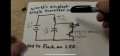
Make sure you wired things correctly. Measure voltages and post results. The voltage on the cap will be increasing. When it gets to around 8V (LED forward voltage + BE breakdown voltage + CB forward voltage), BE junction of the transistor should break down and turn the LED on.

Be sure to mark that transistor because breaking down the BE junction will kill the beta; so it will be useless as a transistor.

Have to think about that circuit a bit. I don't see how it can make an LED blink/flash...

EDIT: I get it now...
 
Last edited:

Thread Starter

quique123

Joined May 15, 2015
405
Thanks, I tried the circuit by paulktreg but with a 100uF, i dont have a 3300uF cap. It still doesnt work. Does it need to be 3300uF?
 

AnalogKid

Joined Aug 1, 2013
12,127
For a very round number approximation of the oscillation frequency, use one time constant as the output period. 1K and 100 uF yields 100 mS, or 10 Hz. Fast, but you should see some flicker. 470 uF will give much more pleasing results.

Get a 2nd 9 V battery. Your schematic says 12 to 18 V. That is correct.

ak
 

ebp

Joined Feb 8, 2018
2,332
The second video explains the circuit quite well. Note what he says about the sensitivity of the circuit to supply voltage and the value of the resistor.

This circuit requires the transistor to behave in a way it is not designed to operate. There is likely to be substantial difference from one device to another of the same type number.

It is hard to tell from the video, but I suspect there is a thermal effect involved. It appears that the LED turns on for a time, then flashes more brightly before turning off. If that is the case, it is quite different from what one would expect with a device such as a diac. I'll leave it up to someone else to watch the video frame by frame, if that is even possible, to try to confirm this.
 

ebp

Joined Feb 8, 2018
2,332
At the very least, the LED should light and stay on if there is sufficient voltage to cause reverse breakdown of the base-emitter junction. It that isn't happening it means the supply voltage is definitely too low. If a white LED were used, the minimum voltage would be in excess of 10 V. The absolute maximum Veb for a 3904 is 6 V, so the breakdown must be higher than that. The LED forward voltage will be around 3. The base-collector junction, barring the desired effect, will just appear as a PN junction diode for about 0.7 V.
 

Thread Starter

quique123

Joined May 15, 2015
405
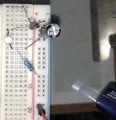
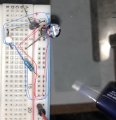
OK I just reset my wiring as in Post #3 and powered it with 2 nine volt batteries and the led lights up but stays on. Maybe the cap is too small?
 

MisterBill2

Joined Jan 23, 2018
27,508
The circuit is known as a relaxation oscillator. The concept is that the capacitor charges through the resistor until the reverse breakdown of the resistor happens, at which time current flows and the LED illuminates, until the voltage across the transistor drops far enough below the reverse breakdown voltage so that conduction stops. So the oscillation depends on a large number of variables, including both the reverse breakdown voltage of the transistor AND the breakdown current. Then the value of the resistor also controls the current flowing in the transistor once the breakdown begins. So it depends on a large number of variables that usually are only controlled to be on one side of some limit value.
We used to do this with a small neon lamp bulb, and they worked very well, because the breakdown voltage and the conduction voltages were fairly stable for all bulbs of a given type. For transistors they typically specify some minimum reverse breakdown voltage, and it may be any value above that number and be within specification. Likewise, the reverse breakdown current must be below some value, and anything down to zero is usually OK. So usually this circuit will not work.
 

Sensacell

Joined Jun 19, 2012
3,784
I would call this an example of a typical "beginners trap" circuit"

It's attractive because it looks so simple, but it uses the transistor in a mode that it's not specified for.
Some transistors might work, others not - even though they are all the same part number.

I remember being frustrated by similar "simple" circuits when I was starting out.
Once you get over the fear of complexity, you realize that these finicky little circuits are actually far more difficult to troubleshoot than complex ones.

Nobody would design a mass produced product with this circuit, where only 20 % of the units work.
 

MisterBill2

Joined Jan 23, 2018
27,508
I would call this an example of a typical "beginners trap" circuit"

It's attractive because it looks so simple, but it uses the transistor in a mode that it's not specified for.
Some transistors might work, others not - even though they are all the same part number.

I remember being frustrated by similar "simple" circuits when I was starting out.
Once you get over the fear of complexity, you realize that these finicky little circuits are actually far more difficult to troubleshoot than complex ones.

Nobody would design a mass produced product with this circuit, where only 20 % of the units work.
You are certainly correct about not using it for a production product, where production yield is the most important parameter. Bitter experience verifies your statement, BIG TIME.
 

Bordodynov

Joined May 20, 2015
3,431
Such an electronic circuit has been discussed more than once.
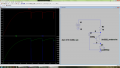
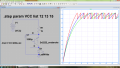
A special model is needed. Such properties of the transistor (not documented) are not advisable to introduce into the standard model, because this increases the simulation time in the normal mode. The parameters of such a scheme have a wide spread. In addition, some transistors may not work. I made two models of 2N2222, which work at different currents. This type of transistor was done at many factories and I think they work differently.
LedPulse1.png
 

Thread Starter

quique123

Joined May 15, 2015
405
OK so I'll try

1. A larger resistor just out of curiosity. Ok, a 10k and a 30k worked just fine!

2. I realized the transistor is being used in a weird way the minute I saw its base isn't plugged into anything.

3.a So as the cap charges, current doesn't flow thru the led. Where does that current go, lost as heat in the R? Is that what you refer to

3.b Once the cap is charged, current can then pass thru the led as the cap is discharged.

3.c Current flows thru the transistor until the voltage across it is low enough that the reverse-breakdown of the T is reached at which point it stops conducting. Why does voltage across the T drop?

4. Ok Ill try the oscillator circuit again. It may have failed because of resistor and cap values. This is the one I was trying to make in order to keep a battery pack alive and failed at it. Then I found astable multivibrator online and was trying to understand it and make it but it also failed. I just found this awesome animation of it which will help me understand it and Ill build it again and post back...

http://www.falstad.com/circuit/e-multivib-a.html

Thanks guys!
 

AnalogKid

Joined Aug 1, 2013
12,127
The resistor charges up the capacitor until the capacitor voltage equals the transistor avalanche voltage.

The transistor "turns on", discharging the capacitor into the LED. Current from the resistor also goes through the LED.

There is hysteresis in the avalanche voltage, so the transistor turns off at a slightly lower voltage than when it turns on. This voltage difference is what lets current flow through the LED long enough to be visible.

The voltage across the transistor decreases because the LED discharges the capacitor.

When the capacitor has discharged so much that it no longer can keep the transistor conducting, the transistor turns off and the cycle repeats.

The capacitor acts as a rechargeable battery. The charge that is pumped into the capacitor during the off part of the cycle is the same charge that lights the LED during the on part of the cycle. This is very different from a typical 555 circuit, where the timing current and the load current are separate.

ak
 
Top