LED Dimming

MrSalts

Joined Apr 2, 2020
2,767
Use a 40 to 100k PWM frequency to avoid (minimize) any audible feedthrough from the switching of the LED. Wither or not an emitter follower is used, the on/off load of the LED on the power supply can be (will likely be) audible on a vacuum tube amplifier. A solid state amplifier with an op amp pre-amp will have a -100db power supply rejection ratio whereas a tube amp will not (I’ve never seen one).


Another “trick” wold be to turn one hidden LED on when the visible LED turns off on the PWM circuit. You can do this by connecting one LED across the 555 output and ground (visible LED) and the other connected across Vcc and 555 output. Make sure each LED is the same and the same size current limiting resistors are used on each.
 

wayneh

Joined Sep 9, 2010
18,104
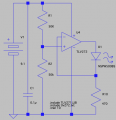
Yes, I was thinking of posting a circuit I've used: a variable, constant current op-amp circuit. No timer, linear, and pretty good control. I'll post the schematic if there's any interest. The discrete emitter-follower may be nearly as good and far simpler though.

update - here it is
Screen Shot 2021-04-13 at 11.00.00 AM.png
 
Last edited:

ElectricSpidey

Joined Dec 2, 2017
3,334
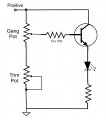
Here ya go.

The trim pot is used to match the divider to the LEDs turn on voltage.

I don't include most of the component values because for one...I like to leave some of the work to the OP and these things normally have to be worked out in a sim and or a breadboard and are determined by the other variables such as LED forward voltage and supply voltage...etc.

AAC_Simple_Follower.jpg
 

Thread Starter

dlad87

Joined Nov 9, 2020
36
1618330209148.png
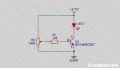
I breadboarded this earlier, used a 50kB pot and changed R1 to work with a 9V supply. Had pretty decent control.

I’ll try one of these others and see how it compares
 

wayneh

Joined Sep 9, 2010
18,104
If you build the op-amp one I posted, recognize that the 100K pot should sit below a fixed resistor chosen so that the full travel of the pot affects the LED current. The control voltage on the op-amp pin need never be more than the supply voltage less the LED Vf.
 
Last edited:

Thread Starter

dlad87

Joined Nov 9, 2020
36
If you build the op-amp one I posted, recognize that the 100K pot should sit below a fixed resistor chosen so that the full travel of the pot affects the LED current. The control voltage on the op-amp pin need never be more than the supply voltage less the LED Vf.
Thanks
With some testing I’ve settled on a 50kB pot, for the audio. The led will be tethered to this control via a 2 gang pot.
Will I have to change any of the other values to use a 50k pot? And as you mentioned earlier, the fixed limiting resistor would go between the upper side of the pot and the positive rail, correct?
 

Thread Starter

dlad87

Joined Nov 9, 2020
36
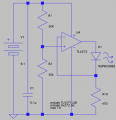
I ended up trying this circuit from post #23 with a 50kB pot:
1621007990701.png

It did appear to be a little "smoother" controlling the brightness of the led over the other circuit I tried shown in post #25 and worked well overall.

I will roll with this if there isn't a suitable alternative but is there anything else to try or tweak maybe on this circuit to make perceived brightness more linear? BTW I need to a 50kB pot to control this. I'd like to stay away from PWM since its near an audio circuit.

Thanks
 

Ian0

Joined Aug 7, 2020
13,131
but an audio taper will not be as satisfying as a linear taper.
An audio (logarithmic) taper is EXACTLY what you need. Your eyes' response to light is logarithmic, just like your ears' response to sound. All professional LED dimmers should have a logarithmic response.
 

Audioguru again

Joined Oct 21, 2019
6,826
A 50kB pot is linear and is not used as a volume control, but works fairly well to dim the LED with an emitter-follower transistor.

A 50kA pot is logarithmic and is used as a volume control. But if it is in the emitter-follower circuit and is turned down only a little from maximum, the LED dims so much it turns off.
 

Ian0

Joined Aug 7, 2020
13,131
A 50kB pot is linear and is not used as a volume control, but works fairly well to dim the LED with an emitter-follower transistor.

A 50kA pot is logarithmic and is used as a volume control. But if it is in the emitter-follower circuit and is turned down only a little from maximum, the LED dims so much it turns off.
That depends if it is European or Japanese. Europe used A for linear and B for log, Japan was the opposite. I don't know which America used, and I think China followed Japan.
 

k1ng 1337

Joined Sep 11, 2020
1,038
If the driving signal is a square wave then the emitter follower signal will be a square wave. And square waves have been known to not filter out of power supply circuits very well. Thus switching an LED with a square wave will produce square wave current variations on the supply line. Hence my remark.
What if there is a massive capacitor at the supply rails? If the "pool" of stored energy is large enough.. shouldn't the effect of the square wave back into the line be reduced in proportion? Or is it a case that some of the wave always gets injected into coupled components regardless?
 

MisterBill2

Joined Jan 23, 2018
27,510
With high frequency varying loads the inductance of the wiring can provide enough impedance to have a voltage drop between the ends and so the a bit of the wave is present . This can be a source of glitches in digital circuits, and noise coupling in analog circuits.
 
Last edited:

Danko

Joined Nov 22, 2017
2,168
How about this variant?
One PWM'ed LED.
Volume:

0%0%.gif 5%5%.gif 25%25%.gif 50%50%.gif 75%75%.gif 95%95%.gif 100%100%.gif

ADDED:
I'd like to stay away from PWM since its near an audio circuit.
This miniature sound card has high sensitive microphone input, but continuously flashing LED does not add any noise to output signal.
See video in zip file.
 

Attachments

Last edited:
Top