LED circuit design powered by a USB power bank

Thread Starter

sjwomersley

Joined Oct 4, 2023
8
Hi There,

I studied electronics a long time ago and unfortunately have forgotten a lot of what I knew so I'm looking for a bit of help and guidance please!

I want to make an LED circuit that is powered by a USB power bank. I have stripped a USB cable so I just have the + and - cables, connected this to a breadboard and got some LEDs working, but they were on the point of burning out so I need to add some resistors into the circuit.

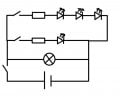
My power bank has a capacity of 19200mAh and has a rated output of 5.4A from a 5V USB socket - will the power bank always provide 5.4A output or does it only provide what the circuit draws? I've attached a very crude circuit diagram (incomplete but enough to show what I'm doing) and the total current needed is probably going to be somewhere in the region of 500mA once all my LEDs are connected.

I know I could use a 9V battery or even an AC - DC transformer but I don't want to have to plug this into the wall and I like the idea of being able to just recharge the power bank when needed instead of going through batteries, as well as the large capacity meaning it should last a long time before needing to be recharged.

Thanks,

Sam
 

Attachments

BobTPH

Joined Jun 5, 2013
11,463
The power bank will provide whatever current your LEDs need, up to the 5.5A limit. Some will automatically shut off if the current drawn is too low.

Yes, you need a resistor for the LED(s).

You cannot drive 3 visible light LEDs in series from a 5V source. Maybe, you can drive 3 IR LEDs.
 

Thread Starter

sjwomersley

Joined Oct 4, 2023
8
The power bank will provide whatever current your LEDs need, up to the 5.5A limit. Some will automatically shut off if the current drawn is too low.

Yes, you need a resistor for the LED(s).

You cannot drive 3 visible light LEDs in series from a 5V source. Maybe, you can drive 3 IR LEDs.
So as long as the current drawn is enough to trigger the power bank output it's just whatever my circuit is?

I forgot about the voltage for LEDs, that's a bit problematic as I will need to power ~9 LEDs from one switch. I suppose I could do it in parallel again. Am I right in thinking I can power as many LEDs as I want from 5V as long as they are wired in parallel and there is enough current?
 

KeithWalker

Joined Jul 10, 2017
3,603
So as long as the current drawn is enough to trigger the power bank output it's just whatever my circuit is?

I forgot about the voltage for LEDs, that's a bit problematic as I will need to power ~9 LEDs from one switch. I suppose I could do it in parallel again. Am I right in thinking I can power as many LEDs as I want from 5V as long as they are wired in parallel and there is enough current?
You can connect LEDs in parallel and use a single series resistor but LEDs don't all have identical characteristics. You may notice a difference between the brightness of them. If this is an issue, you should use a separate series resistor for each one.
 

BobTPH

Joined Jun 5, 2013
11,463
Put each LED in series with its own resistor, then put all of those pairs in parallel.
 
Last edited:

AnalogKid

Joined Aug 1, 2013
12,045
1. 500 mA is a lot of power for simple LEDs. What is the max number you want to power at one time?

2. What does the circle with the X represent?

ak
 

Thread Starter

sjwomersley

Joined Oct 4, 2023
8
1. 500 mA is a lot of power for simple LEDs. What is the max number you want to power at one time?

2. What does the circle with the X represent?

ak
Probably about 20 LEDs in total, and a separate circuit which records and plays back 10s of sound.

I now remember X is the symbol for a DC motor, I actually meant it to be a bulb.
 

MisterBill2

Joined Jan 23, 2018
27,186
Certainly you CAN power two red LEDs from a 5 volt source, you may need to add a resistor to limit the current. White LEDs require a higher voltage to illuminate, but two of some brands of white LEDs will indeed give a bit of glimmer with 5 volts across two in series. Not all LEDs are the same, and mostly they will start to glow at less that the specified voltage. Not everybody knows that.
So the first things that we need to know is how many LEDs to be controlled by one switch from the one power pack, and second we need to know what color they will be. Also let us know if they all need to display the same brightness, or if some difference is OK.
 

ThePanMan

Joined Mar 13, 2020
862
You can connect LEDs in parallel and use a single series resistor but LEDs don't all have identical characteristics. You may notice a difference between the brightness of them. If this is an issue, you should use a separate series resistor for each one.
This is true. Cousin Tony (TonyR1084) did a video on this.
Put each LED in series with its own resistor, then put all of those pairs in parallel.
However, this is the right way to manage LED's using only resistors.

The BEST approach is to have a Constant Current (CC) regulator manage the current for your LED's; depending on how you wire them together.

Finally, yes, sufficient voltage with head room is required. If you have three LED's in series with a common 3Vf drop, a 9V source is insufficient. For that I'd opt for a 12 volt source. However, two LED's in series with a 9V source leaves sufficient head room without overdoing it. But 9V batteries don't have a long life when powering LED's in the manor you're requesting. 20 LED's wired in 10 parallel sets of two series LED's plus a single resistor running at 20mA (for example) would have a draw of 200mA. Your 9V battery will die a quick death. Not "Sudden" death, just will go out in short order.

Got this from the internet:
(9v battery amp hour rating)
How many amps does a 9v battery have?
  • 9V batteries have 0.4 to 1.2 Amps. 9V batteries provide 500 milliamps for an hour. A ‘milliampere-hour’ rating shows you the volume of electricity the battery will generate in an hour before it dies. You can also present this information using the ‘Ampere-hour’ unit, which reveals the battery capacity. {end cut-n-paste}

So you can see that a 9V battery under the circumstances above would work for 2 1/2 hours with diminishing illumination as time goes on.
 
Top