Led christmas lights failing

Thread Starter

u156531

Joined Dec 4, 2023
2
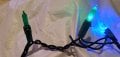
I have three separate strands of led christmas lights that have stopped working in the same place. It's where the socks have 3 wires going into the base. Only the side toward the plug is working. I've checked the fuses and they are good. I dont find a broken or loose wire. Can someone tell me why these two bulb sockets have three wires and why they would fail.
 

Attachments

KeithWalker

Joined Jul 10, 2017
3,603
Are you sure that they are LED lights? They look like incandescent Christmas lights. If they are, they are low voltage lamps and are connected in series. If one lamp in a string goes open circuit, the whole string will not light. The only way to trouble shoot them is by testing each lamp with a continuity or Ohm meter or by substituting each lamp in turn with a known good one. The substitution method will only work if no more than one lamp in a string has failed.
It's a long and frustrating task. I know because I did it every year for very many years. I would recommend scrapping them and replacing them with modern LED Christmas lights. They are inexpensive and last much longer than the incandescent ones.
 

MisterBill2

Joined Jan 23, 2018
27,159
Are you sure that they are LED lights? They look like incandescent Christmas lights. If they are, they are low voltage lamps and are connected in series. If one lamp in a string goes open circuit, the whole string will not light. The only way to trouble shoot them is by testing each lamp with a continuity or Ohm meter or by substituting each lamp in turn with a known good one. The substitution method will only work if no more than one lamp in a string has failed.
It's a long and frustrating task. I know because I did it every year for very many years. I would recommend scrapping them and replacing them with modern LED Christmas lights. They are inexpensive and last much longer than the incandescent ones.
Some LED strings utilize unique arrangements, for lack of a more polite term. At the socket with two wires on one side, the wire continuing away from the plug end is one side of the mains power, the wire passing by is the other side of the mains voltage. The way that I have found that is faster than checking every LED device has been to use a voltmeter with one lead connected to the feed wire at one end. With my DMM, I can then probe the pair , without connecting, just seeing what voltage is capacitively picked up. When I probe on the other side of the open LED or light, the voltage will be much greater. Capacitive coupling that way saves a whole lot of effort, and time.
I also had one LED decoration item that developed the mode of only lighting in the rain. I could switch it on and it would not light, but a gentle spray of water would make it start to glow, and the more I sprayed the brighter it would get, until it reached full brightness. Then I could stop spraying and it would be lighted for quite a while, then get dimmer and go out as it dried.
I replaced that string and put it into the recycling bin.
 

Ya’akov

Joined Jan 27, 2019
10,226
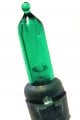
Although it is barely possible to see into the bulb of the lamp that is not lit, it does appear they could be filament lamps. But, the location of the light source in the lit lamps suggests they are not since the filament would not be so low in the bulb.

In any case, if they are LEDs they might still be wired in a series to deal with the mains voltage. Totally pulling numbers from... non-authoritative places: if the mains is 120V, there could be as many as 60 lamps in a series to handle the voltage (~2V for \( \mathsf{V}_f \)).

If there is a bad lamp in the string that is out, it would make all of those out. Normally, the strings are interleaved to avoid having a while section going dark. But without more information, this is all surmise and barely a SWAG.
 

wayneh

Joined Sep 9, 2010
18,085
Those don’t look like LED lights. This thing actually works and I recommend it if you have a lot of strings to maintain.
https://www.amazon.com/LightKeeper-Incandescent-Light-Repair-Tool/dp/B000R8KBOK
It doesn’t always work, and I have a procedure using a multimeter to check for full voltage (against ground) along the string. Anytime you see a drop of more than a couple volts, you know the previous bulb is a problem.

But I recommend switching to LEDs even more strongly. They’re even harder to diagnose - a multimeter is useless - but on average last a lot longer. Their primary failure mode is corrosion of their leads, which is easy to see once you pull the failed LED.
 

MisterBill2

Joined Jan 23, 2018
27,159
My suggestion for probing the electrostatic field next to the wire between devices should detect an open LED or bulb. so it is much simpler because it only requires a single connection at one point.
 

MisterBill2

Joined Jan 23, 2018
27,159
It is easy to tell without eve a close look because of the tab to only allow one way insertion. But if doubts remain, measure the resistance, in each direction. AN LED will read like a diode, a incandescent will be the same both ways.
 

wayneh

Joined Sep 9, 2010
18,085
I now agree these are LEDs designed to look like the old bulbs. I was fooled by the form.

The only way I know to fix LED strings is to pull one lamp at a time and test it in another working string. Only rarely is the problem anything other than corroded (gone) leads. But since you’re opening it up anyway, look in the socket for potential problems such as one side missing.
 

MisterBill2

Joined Jan 23, 2018
27,159
I now agree these are LEDs designed to look like the old bulbs. I was fooled by the form.

The only way I know to fix LED strings is to pull one lamp at a time and test it in another working string. Only rarely is the problem anything other than corroded (gone) leads. But since you’re opening it up anyway, look in the socket for potential problems such as one side missing.
I suggested a search scheme in post #4 that can usually locate an open socket. Detailed inspection will need to follow that.
 

Thread Starter

u156531

Joined Dec 4, 2023
2
Thanks to everyone that replied. I should have mentioned in my original post that I had pulled and tested every bulb on the unlight side. I used the incandescent version of the light keeper pro to test each bulb after I pulled it. I also used the audible voltage tester on the tool to try and find a spot where the current stopped running through the set. It never indicated that there was a break in the current. Every time I held it near an unlight buld the audible signal sounded. Maybe I need a different tool. I've got 3 sets that have all stopped working in the same place on the string. Hate to throw them out without determine why this is happening.
 

wayneh

Joined Sep 9, 2010
18,085
Sometimes it just becomes impractical to keep a string going. If you get to the point of throwing them out, at least keep the bulbs for spares.
 

LesJones

Joined Jan 8, 2017
4,511
Are the light strings fed direcly with mains voltage or are they supplied from a transformer or DC power supply ? What is the total number of lights in the string and starting from the supply end how many lights are working ? Do they have a control box that controls the flashing or are all the lights on all the time ? If you remove one bulb in the section that is working how many bulbs go out ?

Les.
 
Last edited:
Top