Unknown Chip on Chinese Solar Christmas Lights

Thread Starter

gootonew

Joined Dec 29, 2025
1
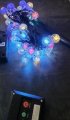
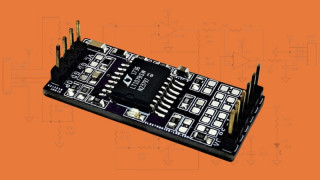
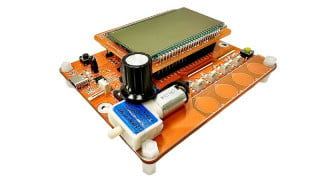
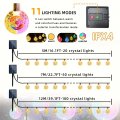
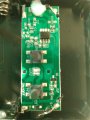
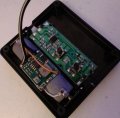
Has anyone seen this unmarked chip in Chinese solar Christmas lights? It seems to have a timer/memory, but I can't tell if it's for a fixed runtime or intervals. Even on constant DC power, they shut off after a few hours until manually reset. I've disconnected the solar panels on each board to prevent any conflict with the step-down module. Any idea what chip this is?
The colored ones operate with a 3.7 V lithium battery. The light curtains operate with 1.2 V NiMH batteries.
In both models, the output repeats the input voltage, without reducing or increasing it.
note: I have not yet photographed the curtain circuit board, as it has a different circuit board.
33d26774-3dc1-45c7-a2a0-d9af6a03753d.jpg
IMG_20251215_103218.jpgIMG_20251225_233158.jpg5cafa6c3-958c-41e0-be47-5a6ef81cb484.jpegIMG_20251226_211033_1.jpg
 

Ya’akov

Joined Jan 27, 2019
10,226
Welcome to AAC.

That will be a mystery MCU. These generic microcontrollers are standard practice for this kind of product. It will be practically impossible to determine what it is.

If you map out the functions, and the I/O, you could replace it with your own so you can write custom firmware for it.

One other possibility would be to build your own circuit that turned the device back on after it turned itself off.

But as it stands, you can't influence the behavior (for if you can, it will be in some mysterious way that defies guessing.)
 

schmitt trigger

Joined Jul 12, 2010
2,027
Exactly.
A dime-a-dozen microcontroller, programmed in a low-level programming language one step removed from assembly, with a Chinese language datasheet consisting of a pair of pages with some maximum ratings and a typical circuit.
 

wayneh

Joined Sep 9, 2010
18,085
...the output repeats the input voltage, without reducing or increasing it.
That's the way boost circuits appear, as if battery voltage is fed straight to the LEDs. But that's your meter showing you the time-averaged voltage. If you look with an oscilloscope, you'll see bursts. That's when the LEDs are actually producing light. They're off during a good portion of each cycle.

You can up the output by driving a MOSFET with the signal and using the MOSFET to switch a separate power supply to feed your load. I've used that approach to leverage one of those little fake candle tea lights to provide the signal to drive a larger light.

I don't think there's much else useful you can do.
 
Top