LED analog circuit help

panic mode

Joined Oct 10, 2011
4,983
apples to apples is using everything else being equal - just compare parallel vs series connections.
that means same LEDs (no change in spec), and then build series and parallel circuits. parallel always loses due losses being per LED. and that is the one of main reasons for DCDC converter type of LED drivers.

as for series resistor, use R=Vr/Ir = (Vbatt-Vf)/If
so if your LED has Vf of 2.2V when current is 2mA, and battery is 3V you get
(3V-2.2V)/0.002A = 0.8V/0.002A=400 Ohm. nearest common value is 390 Ohm.

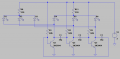
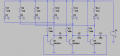
you mentioned 5 LEDs before but 6 makes it work with 3 channels. by switching the LEDs current consumption is reduced.
1753283979951.png
and this can be reduced to
1753284206507.png
 
Last edited:

ElectricSpidey

Joined Dec 2, 2017
3,335
You seem to be arguing for the sake of arguing.

Look one configuration has an output power of something like 1.5 watts and the other is more like .3 watts...how is that an "efficiency" situation?
 

panic mode

Joined Oct 10, 2011
4,983
You seem to be arguing for the sake of arguing.

Look one configuration has an output power of something like 1.5 watts and the other is more like .3 watts...how is that an "efficiency" situation?
those are not the same things.
you are looking at efficiency in terms of picking LED with different spec. and that is fine but that does not have anything with "parallel vs series connection" efficiency.

if one LED consumes N watts, then 5 of THOSE LEDs will consume 5N watts regardless if you wire them in parallel or in series.
but the overhead losses will always be higher for the parallel connection since LEDs are current controlled devices and in parallel circuit you will have 5 current limiting devices..

am just pointing out that there is more to it that picking different product. when someone designs LED lamp there is a reason that LEDs are connected in strings - series connections are essential for higher efficiency. this is why chips exist like one i mentioned earlier. they will boost supply voltage just to be able to drive series connection of LEDs - because of efficiency. when operating on battery power, efficiency is everything and 1h is really not much, specially for closed book sitting on the bookshelf.
 
Last edited:

Thread Starter

chaibunny

Joined Jul 11, 2025
14
I’ve found LEDS w a current of 2ma which would have a total of 10mA when in parallel thanks to the suggestions above…still using the same 500mAh battery and the correct resistors I’m guessing this will be a much better solution than a blinking circuit
Please stop arguing and help me with this question
 

Thread Starter

chaibunny

Joined Jul 11, 2025
14
I was sponsored by a company to make this flex pcb so I would like to keep it on topic and take suggestions in regards to my questions.
 

Thread Starter

chaibunny

Joined Jul 11, 2025
14
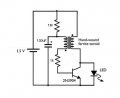
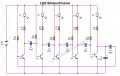
Hello, I am working on an LED analog circuit that has a comparator and pressure sensor to signal the LEDS to turn on....to reduce current draw from the coin battery i am using i would like to make the leds blink... i am using 1206/0805 SMD LEDs and would like to use this circuit as inspiration for the blinking...i am just unsure how to get the right resistor/capacitor values because i would like this circuit to work with a 3v coin battery if that is even possible...i am open to any suggestions or equations to solve this problem12v-led-flasher-blinking-led-circuit-diagram.jpg
 

panic mode

Joined Oct 10, 2011
4,983
for minimal part count (and compact size) one could use single inverter like SN74LVC1G14.

advantages:
tiny size, low pin count
very low current consumption
flexible voltage
low parts count needed since it it is an inverter with Schmidt trigger - just add single RC element to make an oscillator
single IC can drive all LEDs (16ma) or you can use separate one for each LED.
adding diode and resistor (optional) can alter duty cycle and optimize battery life and introduce randomness to the flickers
 

Bordodynov

Joined May 20, 2015
3,431
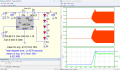
I did the calculation for a slightly discharged battery Vbatt=2.7V. The current through the high-efficiency LEDs is 2 mA. The current consumption is less than 12 mA.
See:

1753362309096.png
 
Last edited:

MisterBill2

Joined Jan 23, 2018
27,522
IF there are actually FIVE LEDs IN SERIES, drawing any current, powered by: " I want to power the circuit with a slim 3v coin battery "
I have a difficulty with the math, because most bright LEDs require at least 2 volts to produce much light.
OR did I miss the part about multiple batteries??
 

MisterBill2

Joined Jan 23, 2018
27,522
Looking back at post #1, the TS is trying to create a THIN BOOKMARK device., that is powered from a THIN battery. So the string of LEDs will need to be on the edge that does not get covered when the book is closed on it.
 
Top