L.E.D protection resistor value

MrChips

Joined Oct 2, 2009
34,831
I experimented with resistor values untill i got to 17.7mA as measured with my multimeter, at that current if i looked directly into the LED then looked around the room, i had a red dot in my eyesight so i didn't go any brighter , that was with the red LED.:p
Well, that’s not right. If you stared at a red LED, you should be seeing the complementary colour, bluish-green or cyan, as the after image.
 

Thread Starter

Homebrew1964

Joined Nov 22, 2024
217
Well, that’s not right. If you stared at a red LED, you should be seeing the complementary colour, bluish-green or cyan, as the after image.
Maybe it was a bluish colour, i can't remember, i do know i couldn't see properly for a full minute.
 

ThePanMan

Joined Mar 13, 2020
922
Shouldn't stare into a non-defused LED. The brighter the more harm they can cause to your eyesight. It probably won't be instantaneous but the harm can be cumulative.
 

dl324

Joined Mar 30, 2015
18,341
i was just curious as to how bright the thing was...it's BRIGHT!!!
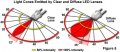
The 4 LEDs with brightness information in your original post indicate that they're all what's considered ultrabright or high output. Anything in the 1000+ mcd range is in that category. LEDs from the 1970's were typically in the less than 20mcd range.
 

Thread Starter

Homebrew1964

Joined Nov 22, 2024
217
As has been said, I think the diffused variety make better indicators, I bought a box of ultra bright clear ones with the intention of building a colour organ at some point.
 

dl324

Joined Mar 30, 2015
18,341
As has been said, I think the diffused variety make better indicators, I bought a box of ultra bright clear ones with the intention of building a colour organ at some point.
You can sand the lenses with fine grit sandpaper to make them more like diffused. That'll be a pain-in-the-ass, but at least you can use what you already have.
 

Thread Starter

Homebrew1964

Joined Nov 22, 2024
217
You can sand the lenses with fine grit sandpaper to make them more like diffused. That'll be a pain-in-the-ass, but at least you can use what you already have.
No I want the bright ones for my project, at the $10 or so for a box, I can buy more.
 

skstrobel

Joined Nov 29, 2023
28
You probably won't find this to be an issue using only 5V and less than 20mA, but it is worth checking how much heat will be dissipated in the resistor (watts of heat = V * V / R). In your example, 5V supply minus maybe 3V for the LED leaves 2V across the resistor. To get 20mA, your resistor would be 2V/20mA = 100 ohms. So the heat dissipated by the resistor is 2V * 2V / 100Ω = 40mW. That isn't very much; any through-hole (leaded) resistor and even a tiny 0402 SMT resistor would probably be fine, especially if you connect it with sizeable PCB traces (they serve as a heat sink for the resistor).

Now consider running the same LED from 12V. Now the resistor needs to drop 9V (12-3). To get 20mA, you need a 450Ω resistor. It will dissipate 9V*9V/450Ω = 180mW. A through-hole 1/8W resistor isn't going to be happy about that; you need a 1/4W part. Similarly, some 0603 SMT parts are rated for only 100mW, so you need to be careful about the part selection or move up to an 0805 package.
 

MrChips

Joined Oct 2, 2009
34,831
You probably won't find this to be an issue using only 5V and less than 20mA, but it is worth checking how much heat will be dissipated in the resistor (watts of heat = V * V / R). In your example, 5V supply minus maybe 3V for the LED leaves 2V across the resistor. To get 20mA, your resistor would be 2V/20mA = 100 ohms. So the heat dissipated by the resistor is 2V * 2V / 100Ω = 40mW. That isn't very much; any through-hole (leaded) resistor and even a tiny 0402 SMT resistor would probably be fine, especially if you connect it with sizeable PCB traces (they serve as a heat sink for the resistor).

Now consider running the same LED from 12V. Now the resistor needs to drop 9V (12-3). To get 20mA, you need a 450Ω resistor. It will dissipate 9V*9V/450Ω = 180mW. A through-hole 1/8W resistor isn't going to be happy about that; you need a 1/4W part. Similarly, some 0603 SMT parts are rated for only 100mW, so you need to be careful about the part selection or move up to an 0805 package.
You don’t need to calculate the value of the resistor to find the wattage.

P = I x V

20 mA x 2 V = 40 mW

20 mA x 9 V = 180 mW
 
Top