Kirchhoff's law

Thread Starter

zorro_phu

Joined Jun 14, 2018
20
I was looking for questions to practise and found this one which i'm puzzled by current ls as in the picture below.can i say that ls=Vx/4 and if i assume left of Vx to be V1 and right of Vx as V2, then can i say Vx=V1-V2.Or if i'm wrong how should i go about sloving this problem because there is no value for ls. Any help is very appreciated.
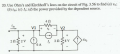
Capture.PNG
 

MrAl

Joined Jun 17, 2014
13,702
I was looking for questions to practise and found this one which i'm puzzled by current ls as in the picture below.can i say that ls=Vx/4 and if i assume left of Vx to be V1 and right of Vx as V2, then can i say Vx=V1-V2.Or if i'm wrong how should i go about sloving this problem because there is no value for ls. Any help is very appreciated.
View attachment 154724
Hello there,

Without actually analyzing this myself, i can tell you that a general method would be to write the equations as you normally would, but keeping whatever variables you have as variables (such as Is and vx). You then see if you can reduce the equation set down to as few variables as possible, and you may or may not be able to deduce something that comes out of it being constant or you may have to leave it in the form of a function of one or more variables.
For example, say you came out with two equations:
Is=f(vx,Iin)
vx=g(Is,Iin)
where f() and g() are both functions. You may or may not be able to solve for Is such that you get it down to a function of just one variable such as:
Is=h(Iin)
If you cant then that's all you can do is show the functions.

See what happens once you write your equations, which you can show here.
I did not yet check for what we can and can not do here, but i'll do that after you have a try at it first.

V1 and V2 as they appear in that drawing can be taken to be node voltages.

[A few minutes later]
A hint would be that Vin and Vout are GIVEN (V1 and V2) as constant, so that means that there will be only a few unknown variables, probably just two which would be Iin and Is, and that means you can solve for them as constants most likely. See what you can do with this information first.
 
Last edited:

WBahn

Joined Mar 31, 2012
32,823
I was looking for questions to practise and found this one which i'm puzzled by current ls as in the picture below.can i say that ls=Vx/4 and if i assume left of Vx to be V1 and right of Vx as V2, then can i say Vx=V1-V2.Or if i'm wrong how should i go about sloving this problem because there is no value for ls. Any help is very appreciated.
View attachment 154724
No, you have no basis by which to claim that Is is Vx/4Ω.

You do have a basis by which to assert that Vx = V1 - V2 since, by definition, that's exactly what it is.

Your circuit has two unknowns beyond the "normal" ones (the node voltages and branch currents due to fully specific circuit elements) that a typical circuit problem would have. You have an unknown Iin and you have an unknown Is -- essentially two current sources with unspecified outputs. Note that Vx is not an unknown, it is a control signal. Since you have two additional unknowns, you need to know two of the values for the "normal" unknowns. You have been given those, namely the voltages across each of the 2 Ω resistors.

So start with that and figure out as much as you can. Show your work and we will help you get past where you get stuck.
 

MrAl

Joined Jun 17, 2014
13,702
Hello again,

I have been able to verify that we can solve explicitly for Iin and Is and they resolve down to two constants even though we dont know what vx is at first. It works out because we know so much else about this circuit like the two node voltages for example which tells us right away what vx is.
I used nodal analysis however to reach this conclusion.
 

The Electrician

Joined Oct 9, 2007
2,986
WBahn already told you in post #3 that you have no basis by which to claim that Is is Vx/4Ω. If you make the very bottom node your reference node, can you write nodal equations for the v1 and v2 nodes?
 

WBahn

Joined Mar 31, 2012
32,823
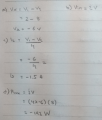
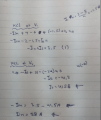
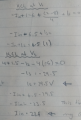
It's hard to tell where the magic numbers are coming from in your equations. For instance, in your first KCL equation your second term is "4". Assuming you mean 4 A, where is that coming from?

If you got it by multiplying the 2 V across the leftmost resistor by the 2 Ω resistance, then you might think about tracking your units properly since 4 V⋅Ω is NOT the same as 4 A.

Have you tried to check your results?
 

Thread Starter

zorro_phu

Joined Jun 14, 2018
20
Very silly mistake from me, my intention was to write current flowing outward from resistors. Instead of doing v/r i did v*r. I've made same mistake when applying kcl to V2 node. After this correction the answers are coming same as the solution. thanks for the help
 
Very silly mistake from me, my intention was to write current flowing outward from resistors. Instead of doing v/r i did v*r. I've made same mistake when applying kcl to V2 node. After this correction the answers are coming same as the solution. thanks for the help
What did you get for the answers?
 

WBahn

Joined Mar 31, 2012
32,823
Very silly mistake from me, my intention was to write current flowing outward from resistors. Instead of doing v/r i did v*r. I've made same mistake when applying kcl to V2 node. After this correction the answers are coming same as the solution. thanks for the help
Yep. And if you had tracked your units properly, you would have caught the fact that you used v*r when you should have used v/r because the units would have gotten messed up.

But, instead, you neglect the units and then tack on the units you want the answer to have onto the end and then need others to point out your mistakes because you've chosen to throw away what is perhaps the single most effective error detection tool available to the engineer, namely properly tracking units.

Well, I'd give you 25% since you only got one of the two answers shown correct and you didn't properly track units in your work to arrive at either answer.

Is is NOT 29.5 volts, so that's wrong.

That kind of thing happens when you neglect units and then just tack on the units you think you want the answer to have onto the end instead of the units the work shows that it should have. Had you tracked your units they would have come out to be amps and, if you had made this same mistake and thought it should be volts, the discrepancy would have been staring you right in the face forcing you to think and go, "Oh, duh, of course the answer is in amps and not volts."
 

Thread Starter

zorro_phu

Joined Jun 14, 2018
20
yeah i agree.i'll have to be more careful.thanks for pointing out, i would neva thought of going back and checking the answers.thx
 
Top