@KeepItSimpleStupid; have read all your posts. I didn't see mention of a switch. Did see mention of latching relays, but not a switch. If I missed it - sorry. See post #19
See post #19 and #33. It's highly recommended you read all posts before you post. You could be repeating something someone already suggested and the topic may have been explored.
But yes, in my honest opinion a switch is the easiest and most reliable way to accomplish the task. And as @AnalogKid suggested, use an old wallwart. Easier than snagging a transformer and building a BR and filter. After all, it's just an LED you want to light. Hell, you could use a couple of C or D cell batteries too.
@KeepItSimpleStupid; have read all your posts. I didn't see mention of a switch. Did see mention of latching relays, but not a switch. If I missed it - sorry. See post #19
You could have a light loaded board that has the switch and the switch activates the solenoid closing the door. There may or not be the problem of the solenoid continuously being on. In this case you can reduce the problem to "pulseing the solenoid" and "detect door position". In this case, no latching relay is required.
It may be that the mechanism of the trap will not adapt to adding a switch on the closure. It may also be that the TS is no longer able to add to the construction of the trap assembly. Now I recall that there are also a variety of magnetic driven magneticly held indicators in existence. It seems that they were used for call signaling butlers and maids in the past. I have no clue as to what company made them, but they might still be found in some of those old electrical shops. Or in some old handy-mans storage area. They were also part of some much older security systems.
OK, so a switch has been mentioned before. I don't understand why everyone is still trying to build a better mouse trap. Door open, light off. Door closed, light on. Timers, relays, sensors, proximity switches - it's overkill.
OK, so a switch has been mentioned before. I don't understand why everyone is still trying to build a better mouse trap. Door open, light off. Door closed, light on. Timers, relays, sensors, proximity switches - it's overkill.
The event to be trapped is door open and close. If the door is closed and the light is off, that doesn’t accomplish what is needed. Re-read the initial posts, particularly post #13
THAT is the reason for my suggestion of a latching relay. The original post did not mention a door or gate, only a solenoid being operated for some short time, and needing to light an LED and latch it on after the solenoid was operated. We found out about the gate quite a bit later.
But now I have another idea that does include a switch that is moved to the on position when the gate is opened, and then does not return to the off position when it is closed. Sort of a latching switch. That might be a good way to do it.
I am "Planning" to put them on a freezer and a refrigerator/freezer that are in the cellar and fit them with a door-prop alarm.
One might turn on a lamp nearby as well.
I have used one without the switch for a vacuum cleaner bag door latch, It's working well along with a smaller catch.
The simplest will be a latching relay triggered with a small reed switch glued to the coil of the solenoid. Good isolation, meaning no interference, cheap to do, and easy for anyone to understand the circuit.
Whatever the means of springing the trap - whether it's a door actuated by a solenoid or a tip trap - or whatever, something changes in the geometry of the trap. With the trap in the set position a microswitch can easily sense the position. When the trap is sprung by whatever means, the microswitch changes state. In the set state the light is off. In the sprung state the light is on. When the trap is reset the light goes off again. No need for latching anything. Just like the car door, only when the door is open the light is off. Door - or whatever.
But I'm not going to argue the point any further. Said what I have to say.
Good day and good luck.
Looking back I think I saw the last entry by the TS was November 17. Here, it's 8 days later and no further response. So he may have his solution and we're still arguing the point.
Whatever the means of springing the trap - whether it's a door actuated by a solenoid or a tip trap - or whatever, something changes in the geometry of the trap. With the trap in the set position a microswitch can easily sense the position. When the trap is sprung by whatever means, the microswitch changes state. In the set state the light is off. In the sprung state the light is on. When the trap is reset the light goes off again. No need for latching anything. Just like the car door, only when the door is open the light is off. Door - or whatever.
But I'm not going to argue the point any further. Said what I have to say.
Good day and good luck.
Looking back I think I saw the last entry by the TS was November 17. Here, it's 8 days later and no further response. So he may have his solution and we're still arguing the point.
The post that explained the application described a momentary opening of the door. That is why a switch monitoring the position will not work. No need to argue at all. And a Happy and Wonderful Thankgiving Day Celebration to all!!
Well, from the description I assumed when the trap was sprung it was sprung by a switch that actuated the solenoid, thus closing the trap. The idea of an LED indicator to indicate the sprung trap - to me - seemed like some sort of closure device actuated by a solenoid. The LED was only supposed to be triggered when the solenoid activated. Then after the solenoid dropped out the LED was to stay on. Which is why I assume the trap has a door. If the door is open - no light. Door closed - LED lit.
The TS had a notion of how to go about his indicator. He approached it by some sort of latching system that can be reset by a push button. He may have overthought the solution. But since he hasn't responded in days perhaps he's found a solution. After all, he did seem to like the idea of the microswitch on the door.
Oh well. I've given it my best shot, my 2¢. If my approach is not wanted then the TS can go about it any way he/she wants.
Y'all have some good turkey. I'm smoking mine tomorrow.
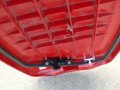
Aside: Those latches with a switch application. This one has does not use the switch. This is a fax fix for a Dirt Devel vaccum whose lungs have given out. The door fatiqued to the point it eould not latch and would not hold vacuum.
The vaccum part can be fixed with tape, but the catches are another story. here are some enclosed pics of that fix:
This is the main latch.
The white latch is basically a guidance latch. It has very little gripping power. The black latch grips. These were mounted on the removable door.
The white latch acts as a guide pin and the black latch grabs, hence "grabber latch", pulls it in place.
I need to so the same sort of thing to a Hoover vacuum. So far, the Hoover has had the plastic pins replaced with pins made of metal at the bottom. it's not an easy retrofit.
I have an upright freezer where something falls and the door ends up open for days. That can't happen anymore.
So, plan is these latches which are available in 3. 5 and 15 lb strengths to keep the door shut, That one will also turn on a light, I hope.
Unfortunately, I have hand tools only, so building the parts isn't easy.
Then there is a refrigerator/freezer with an old style latch and a plastic inner freezer door. Ice builds up because of a damaged plastic freezer door and the ice will eventually open the door. It's like 70 Years old. I'm hoping it's vinyl and it will twist back into place when heated like vinyl windows do.
Both of these will get fitted with door prop alarms.
A common rat trap design uses a platform that swings down from a rat’s weight and returns to the up position for the next rat. Unlike bears, trapping just one rat will be a long time before you affect the population. These rat traps commit mass murder! There’s many posts on Facebook. If you have FB, search for the user named Mensajes. Not only is she rather clever, she’s cute, too.
OK, so a switch has been mentioned before. I don't understand why everyone is still trying to build a better mouse trap. Door open, light off. Door closed, light on. Timers, relays, sensors, proximity switches - it's overkill.
The event to be trapped is door open and close. If the door is closed and the light is off, that doesn’t accomplish what is needed. Re-read the initial posts, particularly post #13
I said "Door closed - light ON.
You said "Door closed - light OFF - is not what's needed.
I think the TS wants to know when the trap is sprung - i.e. trap door closed - with an indicator light indicating the trap has been sprung. Door closed - trap sprung - light ON. All this is one event, a sprung trap.

 Facebook
 Google
 GitHub
 Linkedin