kCube - LED cube design revisited

Thread Starter

tatus1969

Joined Apr 2, 2018
11
Long time ago, I wanted to make my own LED cube - mainly because I had an interesting idea of what to show on them. Sadly, I never started building it because of the huge amount of work that comes with soldering hundreds of LEDs together, bending each leg such that it can connect with the next, then adding even more wires to be able to create a multiplexing grid. Plus tons of logic, power switches and current sources to drive them all. And I wasn't even daring to dream of full color RGB...

Then came Worldsemi and made LED's smart.

I just started experimenting with some NeoPixel rings, when suddenly my old idea came back into my mind. But I didn't want to design yet another LED cube. My goals are:
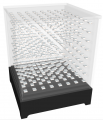
- (almost) invisible power and signal wiring of 8x8x8 full RGB dimmable WS2812B LED's mounted on PET based transparent flex PCBs
- easy to assemble (I estimate 2-4 hours - no soldering needed)
- lowest possible cost (full kit will proably around 150 .. 200€)
- open source hardware and software for your cool ideas (STM32 based, USB, Bluetooth?, WLAN?, accelerometer, speaker, microphone), battery and power plug options, ability to connect to Fadecandy
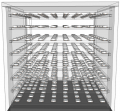
- ability to immerse the LED arrangement in propylene glycol (image showing glycerine, but that is too conductive) to reduce refractions of inner transparent structures

That was a week ago, and the first parts already arrived. I am curious of how that will work together

IMG_20180402_112538.jpg kCube1.png kCube2.png kCube3.png kCube4.png
 

dl324

Joined Mar 30, 2015
18,326
Welcome to AAC!

Have you considered viewing angle? As I recall, these cubes use LEDs with diffused lenses so light is visible from more angles.
 

Thread Starter

tatus1969

Joined Apr 2, 2018
11
Welcome to AAC!
Thanks :)

Have you considered viewing angle? As I recall, these cubes use LEDs with diffused lenses so light is visible from more angles.
They are actually better than they seem, because quite some light gets reflected from the inner surface of the white body. They are usable at almost a half circle. This is also the reason why I arranged them horizontally, this will allow to walk around the cube.

A second (final?) version of it will use APA102-2020 LEDs, these are super small and have a transparent body. I just didn't know them yet, a user at eevblog pointed me to them.
 

Sensacell

Joined Jun 19, 2012
3,784
It's going to require a lot of current- and a power distribution scheme that can deliver it without undue voltage drops.
R-G-B @ 20 mA each = 60 mA X 512 parts = 30 AMPS! Of course you can use the GLOBAL CURRENT SET register to reduce this a lot.

This wiring is your biggest problem.

A small ceramic bypass capacitor installed across the Vcc can go a long way to help keep things stable.
You can see these installed on many types of addressable LED strips, evenly distributed along the strip.

You might say "but I am never going to turn them all on at once" - yes, maybe, but that's a really bad design, you don't want to design a display that can be crashed by the content you send to it.

Consider the frame update rate, you might need to use multiple output ports to keep the frame rate up.

Consider a micro with DMA functionality, this can drive your display update with very little MCU intervention.
 

Thread Starter

tatus1969

Joined Apr 2, 2018
11
@Sensacell, thanks for your thoughts.

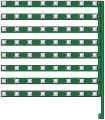
I will be software-limiting the current to 10A total, and to 2A per plane. I think, that way the cube will be still bright enough to use it in daylight. The supply distribution concept is three-fold: there are branches of 8 LEDs with 0.2mm copper traces, and no individual MLCCs (you can see them in the last picture). 8 of these are bundled into a plane at the back side to 0.8mm copper traces, with the flex PCB running down and out of the cube. This also means that each plane has an individual controller. This is how each plane looks like (except the green solder mask):
kCube5.png
 

Thread Starter

tatus1969

Joined Apr 2, 2018
11
I paid USD150 for 10 copies, plus USD25 for shipping. I used wonderfulpcb.com, which is, you guessed it, in Shenzhen.
 

Thread Starter

tatus1969

Joined Apr 2, 2018
11
thanks for the suggestion, I am not familiar with them but it sounds that it would definitely make sense to make a kCube shield for it.
 

Thread Starter

tatus1969

Joined Apr 2, 2018
11
I know, but I'm a native C / C++ guy who had started with 6502 / assembly a long time ago, and I am used to have clear and "visible" control of the underlying hardware. In other words, I have never used Arduino, nor the programming style that is built around them. That's not particularly my world...
 

Thread Starter

tatus1969

Joined Apr 2, 2018
11
Got caught by Chinese counterfeit fraud, even though I took a sample from the reel and made a genuine check (the window must be made from silicone, fakes are mostly glass). What the seller did was taking 150 genuine parts from one reel, and then adding another 450 counterfeit parts attached with tape. If someone would have feeded that into a pick&place machine, then he would'nt probably even notice.

The most facepalming moment tough was the reply from the vendor (Shenzhen Shijibaike Electronics Co., Ltd.), after my feedback that I had received partly counterfeit parts in a clear act of fraud, and telling them that they do not work (they do electrically, but they do not match in color, nor brightness, nor appearance):
[...] We understand but how does it not work? there is no reaction at all? We have sent those parts to many different clients last month mostly the same time as per your order. But the other feedback is good. We agree to send you another new 450pcs original part [...]
They don't even seem to realize that they are admitting having done this kind of fraud many times, nor that this is a fraud anyway.

I'm not complaining because I was expecting this in one or the other way anyway, just what astonishes me is the inventiveness that they develop in winding up their customers.

Anyway, I will have to wait for more parts now before I can continue. The genuine parts were good to populate two boards, and this is how it looks like. When being submersed in clycerine (board is covered with Plastik 70 spray), the effect is even better than I had expected. There fluid creates a glow around each light, which looks great. The last picture cannot fully reproduce this. The flex PCB and copper traces are visible when the light is turned off, but that disappears almost completely as soon as they turn on.

The signal and power supply integrities are spot on. With good stabilization at the connector, the voltage ripple is less than 200mV (peak) at full brightness. I can definitely recommend this topology. The board's continuous current limit is 1.2A in free air (hottest spot is the main power trace at 60°C). The indivdual legs can be made even thinner, 0.1mm will work equally well (now 0.2mm). This corresponds to an intensity level of 200/200/200 (R/G/B).


Thread Starter

tatus1969

Joined Apr 2, 2018
11
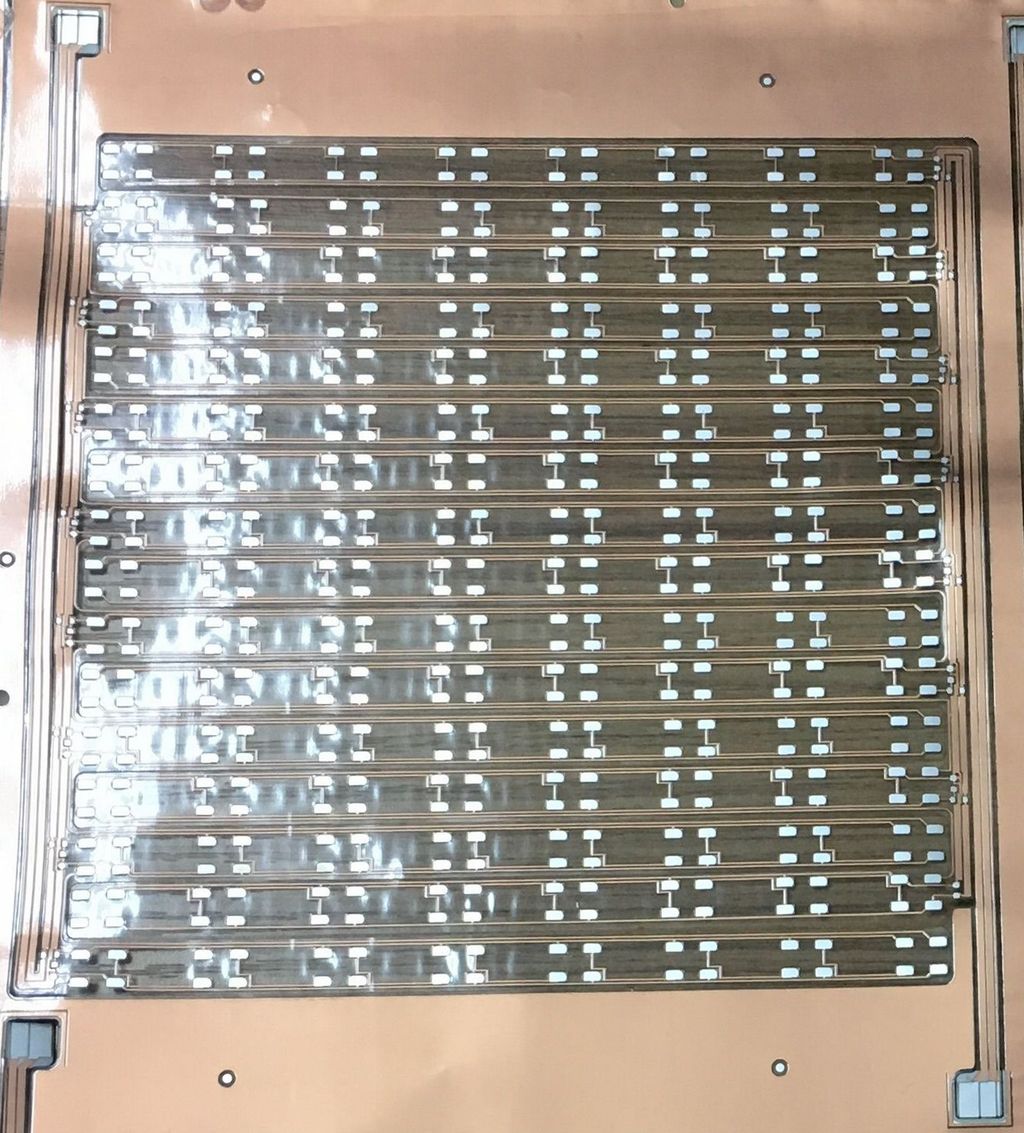
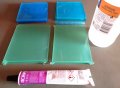
I haven't found much time to work on this recently, but I managed to make a few steps nevertheless. One of them was deciding to change the transparent flex PCB construction. The first design required to glue all flex PCBs onto acrylic base plates. It is almost impossible to do that without having bubbles inbetween. The next design will use a completely different approach. You can see this in the below picture.

I also used this opportunity to change to APA102-2020 LEDs, because they are much smaller and will drastically reduce the amount of obsticles in the light paths. Populated sample flex PCBs are ordered and should arrive in a few weeks.
 

dl324

Joined Mar 30, 2015
18,326
I just got this picture from my PCB assembly service
Thanks for the update.

I've been planning to make some of these cubes and assembly has always been a showstopper. Interested in seeing how the finished product performs. I still don't see how an interconnect scheme that isn't close to 100% transparent can work.
 

Thread Starter

tatus1969

Joined Apr 2, 2018
11
it took me quite a few redesigns of the mechanical support framework for the flex PCBs in place, but it finally works now. A lot of thought had to go into finding a solution that would be as easy to assemble as possible, without the need of glue. This is how that looks like at the moment. I haven't lit up the new boards yet, but MultiCB is already making adapter boards. I'll be able to show the completed cube soon :)

 
Top