K-Type Thermocouple not reading correct temperature

Thread Starter

Robert_Kabuski

Joined Jan 9, 2023
19
Different heaters or different power source.

Generally, heaters are massive power hogs in any system, you want them matched to the power source to allow for simple and efficient driving.
In your system, the heaters are very poorly matched to the power source.
so a higher voltage DC power source would work? i assume this would increase efficiency. would this also decrease the noise in the system?
 

MisterBill2

Joined Jan 23, 2018
27,621
Are there replies to this thread which I can't see? The only people in the discussion since you showed up (that I can see) other than the TS and yourself is me and Ron. Which of us are you insinuating is an idiot?
I am not calling anybody an idiot. I am familiar with my advice being ignored, mostly by those who are not paying for it. It is likely that I was not clear enough in my comment.
And I really do try to avoid insulting anybody in these forums.
 

Reloadron

Joined Jan 15, 2015
7,891
why wouldnt you use DC power or a step up converter? I have seen plenty of nichrome wite heaters powered with DC? what is the advantage of AC? Off the shelf components arent really available where I live, but im also trying to learn about things rather than just having them work. in the case of the heater, I couldnt find any options in my country that were under $100 USD, and my one cost $5 USD.
Why wouldn't I use DC? Mainly because I have AC and going DC would just mean more parts. Not to mention on large systems I would need really large rectifiers. Most of my work with heaters has been on a large scale and mostly 3 phase 480 VAC. Using AC verse DC really matters not since the AC RMS value and DC value are the same.

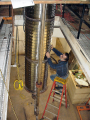
Me Clave.png

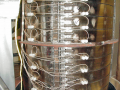
Each band half is 3.0 KW so 6.0 KW per band. Top to bottom there are 72 bands. When calling for full heat 100% heaters on that is 450 KW. Each band half is 240 volts so the halves are put in series for 480 volts per full band.

They look like this.
Clave3.png

What we are looking at is an autoclave less the outer covers. Now can we imagine trying to power this with DC? :)

The original controllers used what we called a "Hocky Puck SCR". Current per phase was measured using a current transformer per phase.

Anyway all this aside yes, I am good using AC as it saves me rectification. Actually for this project and the light load current rather than a DC boost converter I would have supplied my element using a Variac Transformer which I did not suggest since the power supply was already chosen and since I have no idea as to any budgetary restraints. I would use a 10 amp Variac but even a 5 amp version would likely work.

Ron
 

strantor

Joined Oct 3, 2010
6,875
that explains my 10A fuse blowing. do you have any other solutions?
Different heaters or different power source.

Generally, heaters are massive power hogs in any system, you want them matched to the power source to allow for simple and efficient driving.
In your system, the heaters are very poorly matched to the power source.
I would suggest different heaters AND different power source. And since the heater is DIY, it can just be rewound with longer and/or thinner resistance wire. I would suggest using 120Vac if that is available in your country. If not, the math is the same, just use your mains voltage value. I'm going to arbitrarily pick 500W as the target heat output; if you want more, substitute your numbers.

500W / 120V = 4.17A
120V / 4.17A = 28.8Ω

If you want one continuous element to carry the full 4.17A from one end to the other then according to this, the smallest nichrome you can use is 26awg and according to this, the resistivity of 26awg nichrome80 is 2.56Ω/ft.

28.8Ω / 2.56Ω/ft = 11.25ft

That seems like a pretty reasonable length of wire to fashion into an element to fit a heater of that size (if I am interpreting the scale from the images accurately).

If you did that, then you would have a heater that can run directly from mains, no inverter required. You can switch it on/off with a solid state relay as is typically done with AC heating applications. There will still be some EMI but it will be insignificant compared to what you are probably dealing with now; inverters are extremely noisy (electrically speaking) and a thermocouple is a very low voltage signal that can't stand against such electromagnetic bombardment. But a thermocouple can definitely play nice with 60Hz sinusoidal current, it is happening right now in thousands of factories world wide.

As I'm sure you are aware, mains voltages represent a higher risk than 12VDC or even 60VDC. Your heater looks very well built (I'm curious how you constructed it actually, if you wouldn't mind sharing) so I will give you the benefit of the doubt that you can make this safely. Just make sure to eliminate any possibility of the element contacting anything conductive and please (please) use a GFCI protected outlet.
 

strantor

Joined Oct 3, 2010
6,875
Why wouldn't I use DC? Mainly because I have AC and going DC would just mean more parts. Not to mention on large systems I would need really large rectifiers.
Another reason for using AC is that the interference on the thermocouple signal will be symmetrical. DC from an inverter will cause spikes all in one direction that could lead to offset error like TS describes. With AC there should be positive and negative influence that more or less cancel each other out.

P.s. that autoclave is an impressive beast!
 

Wendy

Joined Mar 24, 2008
23,798
It is possible that your thermocouple is bad. If you have a separate meter to plug it into and see what it does? Almost all DVM's have a type K thermocouple by all I mean newer.
 

MisterBill2

Joined Jan 23, 2018
27,621
OK, now you have opinions from a bunch of folks with a lot more resistance heating experience than I have.
But if you change to AC heat and if you use an electronic temperature controller, I suggest getting the ON/OFF control type, not the traic variable heat type. The reason is electrical noise!! phase control triacs produce a whole lot of electrical noise.
 

Reloadron

Joined Jan 15, 2015
7,891
P.s. that autoclave is an impressive beast!
I think that clave was one of the 24" ID ones, we had 24" and 18" ID claves. The material was all 316 stainless and top to bottom about 40'. The wall thickness was 3.0" and as can be seen in the images the elements have torque specs on the springs which allow for the expansion of the mass. We ran deionized grade A water through the claves heated to 600F and under a 3,000 PSI nitrogen blanket. I guess since I retired they have added two more of the big claves. The large claves could also be tilted and I forget, but think maybe 30 degrees. Hard to believe it's been over 10 years now since I retired.

They have new stuff on the burners. New project is BWXT to Build First Advanced Microreactor in United States almost enough to get me to go back... Naw. :)

Ron
 
Top