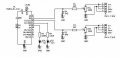
Something like this should work. The component values may need to be adjusted depending on voltage levels across the speaker outputs.I would like to try some optoisolators that I have to hand, but unsure how best to drive the opto's LEDs. They will have to deal with quite a wide range of voltage, depending on the volume of the jukebox. I'll be measuring what sort of voltages I'll need to work with later today.

Having spoken to the jukebox tech team, we have unused speaker outputs, and we can use one of them as a detector. Once we have it commissioned, they can "lock" any volume changes on that channel, so the detection circuit won't be affected by volume changes of the channels connected to speakers.Is it likely that at any time only one of the outputs would be active?? If not, then monitoring only one of them will be all that is required. In addition, unless you are certain that one side of the output is indeed "commoned" with other circuitry that might include some "ground", I suggest having a small value capacitor in series with each side of the external speaker connection.
A different option would be to monitor the mains current, if the juke-box has the audio amplifiers switched off when it is not playing.
That may be a simple scheme, there are modules available for that sort of functions.

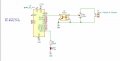
This could work, BUT you need to break thenconnection between terminals 2 and 3 of the opto-isolator. The reasons are: First, there is no reason to tie the two susyems together, and second, tying one side of the amplifier output to a random ground connection can not possibly provide any benefit. There is no reason to prevent the isolation that an optoisolator provides.Having spoken to the jukebox tech team, we have unused speaker outputs, and we can use one of them as a detector. Once we have it commissioned, they can "lock" any volume changes on that channel, so the detection circuit won't be affected by volume changes of the channels connected to speakers.
It could be just as simple as this ...
View attachment 297810
I don't know why I connected it in the first place... lol. It has been removed.This could work, BUT you need to break thenconnection between terminals 2 and 3 of the opto-isolator. The reasons are: First, there is no reason to tie the two susyems together, and second, tying one side of the amplifier output to a random ground connection can not possibly provide any benefit. There is no reason to prevent the isolation that an optoisolator provides.
Thanks for the info.....Mostly over voltage protection is not needed, but because the audio signal is an unknown, the first step will be careful reading of the data sheet for the optos. The simple scheme is shunt diodes in series, connected across the LED, so that they go into conduction before the applied voltage exceeds the specified maximum. Also a series resistor to limit the current into the shunt diodes.
But it might happen that the opto-isolator is already protected and only needs a series resistor. That is why reading the data sheets is important.


Set the audio voltage at 10 volts and use a 1K resistor on the PC814. No other protection required.can set anywhere we want, and that level can be locked at that.
I find the circuit operating the opto from 250 volts AC rather hard to accept for any device without a great deal more input circuitry. Consider that the reverse voltage applied to the device LED is over 250 volts, and most LEDs are not rated for a revers voltage of even ten volts. So YOU need to examine the data sheet for that opto-isolator and find what reverse voltage it can withstand. Also what forward voltage it can withstand.Thanks for the info.....
Doesn't look to me that the EL814 opto-isolator has any protection, it's just 2 diodes in parallel. Data sheet says typ. Vf is 1.2, max is 1.4V, so I assume that applies to both diodes.
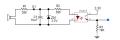
Did your description mean something like this? And help with the values for R2, ZD1 & ZD2 would be appreciated.
View attachment 297865
I do know that the jukebox output we will be connected to can deliver 475W into a 4ohm load if that helps, but it has it's own independent volume control we can set anywhere we want, and that level can be locked at that.
To be honest I'm thinking we may not even need the trim pot I've drawn, which if not needed simplifies things even further.
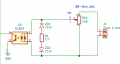
A circuit I've found on Google Search shows the opto diodes connected via a 100K series resistor to 230V AC mains....
View attachment 297866
TIA
The PC814 is made for AC voltages as it has two back to back IR diodes.Also what forward voltage it can withstand.
OK, I can scope the channel, get the volume set and locked, no problem.Set the audio voltage at 10 volts and use a 1K resistor on the PC814. No other protection required.
The opto isolator I will use is designed for an AC input, having two diodes on the input. Reverse voltages don't apply, it is bidirectional. Please see the schematic I posted in post #10, the footprint is a published one in Kicad. Perhaps if you had looked at the datasheet for the EL814 you wouldn't be wasting our time.I find the circuit operating the opto from 250 volts AC rather hard to accept for any device without a great deal more input circuitry. Consider that the reverse voltage applied to the device LED is over 250 volts, and most LEDs are not rated for a revers voltage of even ten volts. So YOU need to examine the data sheet for that opto-isolator and find what reverse voltage it can withstand. Also what forward voltage it can withstand.
And please understand that I do not read data sheets for thread posters.
And what I suggested looks nothing at all like the circuit with the zener diodes. I said two diodes in series connected with the opposite polarity of the opto LED, the concept being to clamp the reverse voltage applied.
Might be a good idea to place a load resistor across the amp output for that unused zone.OK, I can scope the channel, get the volume set and locked, no problem
It can deliver 475W into a 4 ohm reactive load, any idea what to suggest for a load resistor ?Might be a good idea to place a load resistor across the amp output for that unused zone.
I don't know why we need to "load" the amplifier output. Yes the amplifier might go non-linear without an expected load, but we only want to detect an output, not use it for audio purposes. And we'd be wasting energy dissipating it into heat, which we have to get rid of somehow....16 ohm 5 watt should suffice. A 20 volt peak to peak output would dissipate only appx 3 watts.