Sure, those would be the natural choice. I was just wondering if it could be done with op amps.
Also just crossed my mind that a simple relaxation oscillator could possibly be modified to do the job, but still a little hazy in my mind's eye as to how that might work...
Well all the others seem to be most easily adapted from the JK-type, so preferably that one. I did think about using a transistor multivibrator as a building block, but control circuits based on transistors are just such a hassle; more complex circuit interactions, instabilities due to transistor mismatches and temperature variations, higher component counts, etc, etc.
What I'm aiming for here is a single op amp configuration, which is most likely going to be based on some very different principles of operation. That said, the transistor versions still may come in handy for comparison so I will definitely keep them in mind.
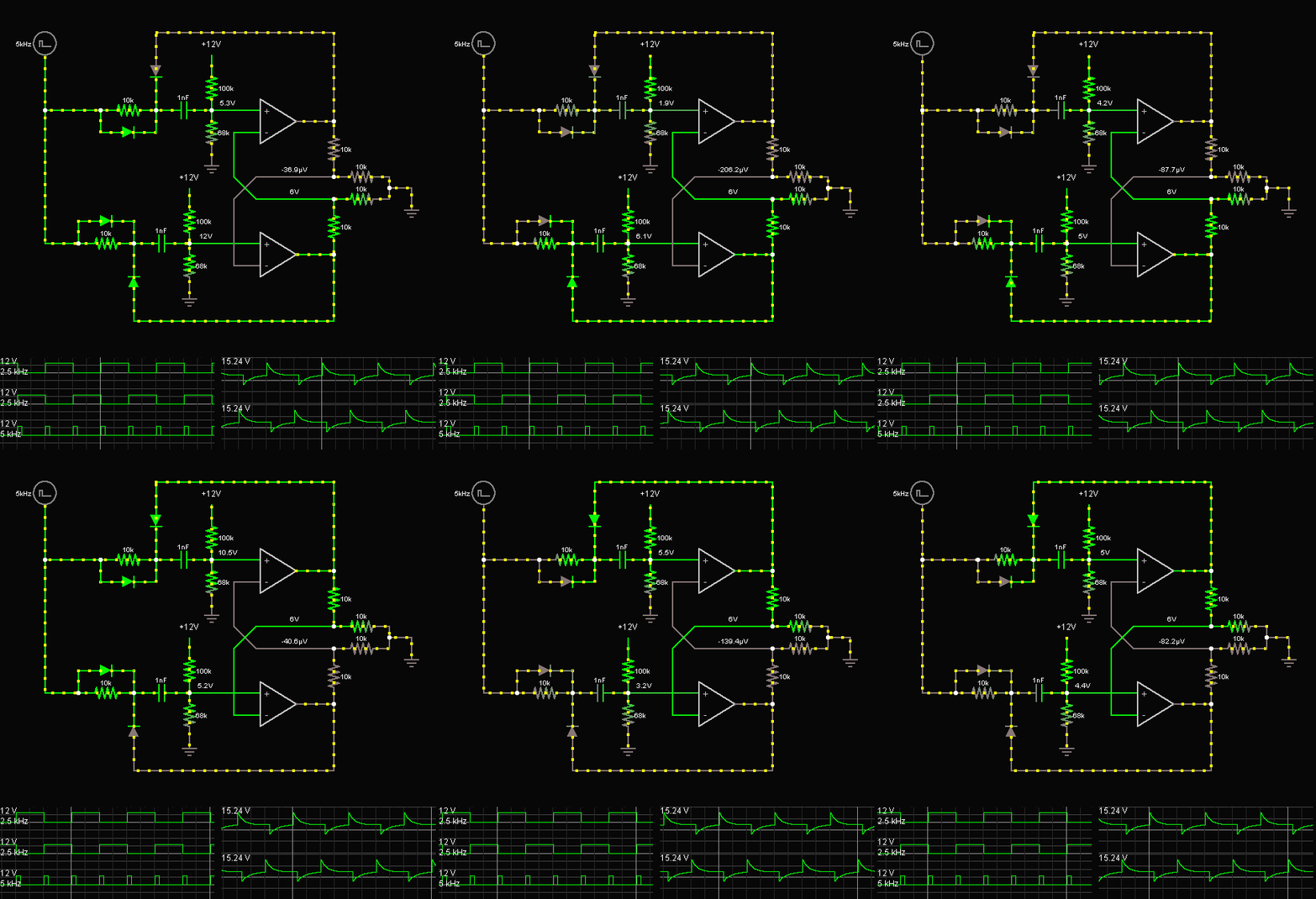
A J-K flipflop has three inputs, so right there an exact version of one cannot be made from a single opamp. Beyond that, a J-K is a clocked flipflop, so an opamp version would need several amps plus diodes or open-collector outputs for the combinatorial functions.
It can be done if you are dedicated enough. There are projects on the innergoogle where an LED clock is made from all opamps.
Your question title reads, "op amps", which is the plural form of "op amp", meaning more than one op amp.
With that in mind, you can make any logic circuit you like with op amps as long as it does not have to work at super high speed like regular logic gates and flip flops. The fastest op amp will never create a flip flop as fast as the fastest logic will because the fastest logic is designed to take advantage of certain features of the sub components so as to get maximum speed without regard for linearity.
The transformation is somewhat easy to visualize.
We start with an op amp that is wired as a comparator. Using resistors and a comparator we can make any type of gate we want:
OR, AND, NOR, NAND, INVERT
using more than one comparator we can also make an XOR gate.
Given that we can make any gate with comparators and we can wire an op amp as a comparator, that means we can make any gate with op amps.
Also, any type of flip flop can be made with logic gates because flip flops are just gated cross coupled logic gate arrangements.
Given that a flip flop of any kind can be made with logic gates and given that we can make any logic gate with op amps, with enough op amps we can thereby make any type of flip flop with op amps. As addressed above, the usable speed will always come into question however.
An op amp flip flop might still be useful. You can get op amps at a few cents per op amp, but buying different logic stuff can get expensive. Sometimes you need a flip flop but only have op amps and other stuff.
An op amp flip flop might still be useful. You can get op amps at a few cents per op amp, but buying different logic stuff can get expensive. Sometimes you need a flip flop but only have op amps and other stuff.
An op amp flip flop might still be useful. You can get op amps at a few cents per op amp, but buying different logic stuff can get expensive. Sometimes you need a flip flop but only have op amps and other stuff.
Yeah I missed that. I haven't done much dabbling in recent months but still be interesting to see how that would be done. I was able to figure out a very simple, stable SR flip-flop circuit using op-amps. May be able to use that as a building block for a JK.

 Facebook
 Google
 GitHub
 Linkedin