Facebook
 Google
 GitHub
 Linkedin

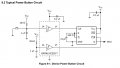
Take a look at the datasheet for this flip-flop.
There is an example in Figure 9-1 which, if I understand correctly, sends Vcc to Q (by switching on MCU) when the button is pressed... is that right?
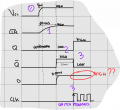
As you can see in the photo, let's assume these cases:
1) I do not press the button (which remains "OFF") so CLK=Vcc (logical 1) --> Q depends on D, but on D there is simply an RC that sets the delay and it's always to 0... so I do not understand how it can work...
2) I press the button (i.e. 'ON') so CLK=0 and since D=X Q=Q0... is this Q0 the previous state? Or the initial state? (that I don't know what it is..)
3) I release the button (which goes back to "OFF") so again CLK=Vcc (logical 1) -->repeat 1)
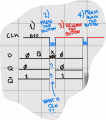
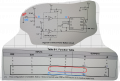
I can't understand the meaning and what happens in the step 2)
Where am I going wrong?
Thanks
There is an example in Figure 9-1 which, if I understand correctly, sends Vcc to Q (by switching on MCU) when the button is pressed... is that right?
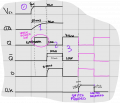
As you can see in the photo, let's assume these cases:
1) I do not press the button (which remains "OFF") so CLK=Vcc (logical 1) --> Q depends on D, but on D there is simply an RC that sets the delay and it's always to 0... so I do not understand how it can work...
2) I press the button (i.e. 'ON') so CLK=0 and since D=X Q=Q0... is this Q0 the previous state? Or the initial state? (that I don't know what it is..)
3) I release the button (which goes back to "OFF") so again CLK=Vcc (logical 1) -->repeat 1)
I can't understand the meaning and what happens in the step 2)
Where am I going wrong?
Thanks