Facebook
 Google
 GitHub
 Linkedin

I am wondering what equation governs the operation of an n-channel JFET when V_ds is negative. All the resources I have found explain how it operates when V_ds is positive and V_gs is negative.
Id = k[2Vds*(Vgs-Vp)^2 - Vds^2] describes the current in the ohmic region.
The gate potential would still be less than the drain potential so the PN junction will still be reverse biased, drawing 0 steady-state current into the gate. Since the JFET is essentially a symmetrical device, I would guess that the equation would be the same as above but with Vsd instead of Vds and Vgd instead of Vgs:
Id = k[2Vsd*(Vgd-Vp)^2 - Vsd^2]
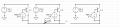
For anyone who is wondering, my intention is to create a circuit that will output an adjustable weighted average of several input voltages. My thought was to connect each input to the drain of a JFET. Then the sources would all be connected together as the output. The weights would be controlled by Vgs. However, since the sources will be a weighted average of the drains, some drain potentials will be below the source.
Thank you in advance for any help I can get. I appreciate it!
Id = k[2Vds*(Vgs-Vp)^2 - Vds^2] describes the current in the ohmic region.
The gate potential would still be less than the drain potential so the PN junction will still be reverse biased, drawing 0 steady-state current into the gate. Since the JFET is essentially a symmetrical device, I would guess that the equation would be the same as above but with Vsd instead of Vds and Vgd instead of Vgs:
Id = k[2Vsd*(Vgd-Vp)^2 - Vsd^2]
For anyone who is wondering, my intention is to create a circuit that will output an adjustable weighted average of several input voltages. My thought was to connect each input to the drain of a JFET. Then the sources would all be connected together as the output. The weights would be controlled by Vgs. However, since the sources will be a weighted average of the drains, some drain potentials will be below the source.
Thank you in advance for any help I can get. I appreciate it!