Isolation Transformer Question for Signal Tracing with Oscilloscope

Thread Starter

Jsprite7660

Joined Jan 9, 2024
75
Hey all,

I have a Tripp-Lite IS-500 isolation transformer I was going to use to float devices under test, when tracing with my Hantek DSO2D15 oscilloscope.

However, isn't there supposed to be isolation between the ground terminals of the input and output of the iso transformer? On my Tripp Lite IS-500 I am seeing continuity between the ground terminal of it's power chord and the ground terminals of it's output terminals.

This would essentially be just like plugging the device under test into a wall outlet as far as I can tell and not "Floating" it. Correct?

Thanks
 

MaxHeadRoom

Joined Jul 18, 2013
30,881
Leaving the original question up, but I think I answered my own question. The isolation transformer is isolating the neutral from it's relation to ground that it has at the breaker box.
Sounds right, the secondary neutral should not be referenced to Earth-Ground! ;)
 
Last edited:

ronsimpson

Joined Oct 7, 2019
4,878
Some isolation transformers have a switch to cut the ground connection. Some do not. Some are open all the time and some shorted all the time.

The isolation transformer isolates the (Line & Neutral)in from (Line & Neutral)out. It may or may-not isolate the grounds. You have a meter test it.
 

dl324

Joined Mar 30, 2015
18,505
I was going to use to float devices under test, when tracing with my Hantek DSO2D15 oscilloscope.
What's the point of floating devices under test if you're using a line powered scope which will have its ground terminal connected to earth ground?

I'd just connect scope ground to circuit ground (assuming that circuit ground is either floating or also earth ground) and probe whatever you want to probe.
 

Thread Starter

Jsprite7660

Joined Jan 9, 2024
75
Thanks for all of this. After opening my isolation transformer and doing some continuity tests I have some new problems and questions.

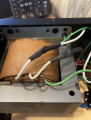
-One wire from the secondary winding is split; one to the neutral terminals on the output, and one to chassis ground (Photo attached)

-there is an additional third ground wire from the secondary, which connects to chassis ground, the input ground is also connected to this point on the chassis

-BOTH OF THE ABOVE POINTS, mean that the isolation transformer's output neutral terminals are directly connected to the input ground terminal.

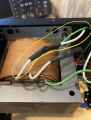
So I will need to disconnect the secondary wire which splits. Eliminating it's connection to the chassis and leaving just it's connection to neutral. I circled this in yellow in the second photo. By doing this, it will break the bond between the neutral and ground. Correct me if I'm wrong please and thank you!
 

Attachments

Last edited:

ronsimpson

Joined Oct 7, 2019
4,878
What's the point of floating devices under test if you're using a line powered scope which will have its ground terminal connected to earth ground?
There are two ways to "float" your project.
1) Cut the ground wire on the scope cord. (or us an isolation transformer) This lets the scope be at any voltage. Back when I was doing this, I noticed I could get shocked from touching the scope. I found the scope knobs at 180Vdc.

2) The better way is to float what you are looking at. Keep the scope at earth ground and let your work be at any voltage.

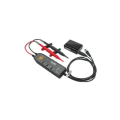
3) If money was no option use a differential probe. It allows you to see the difference between two voltages. I made some isolation scope probes for this purpose. I never sold them as a product.

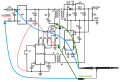
Here is a schematic of an offline power supply. The "GROUND" with red lines is not ground. It will pop the breaker if the scope "ground" is connected to it.
I often look at the voltage across Q1. As shown in green. This requires the supply to be floated.
I often look at the filter (not shown) that is on the power line. As shown in Blue.

1794172168140.png
 
You're reading it right — the IS-500 bonds the output ground straight to chassis, so as it sits the DUT isn't floated at all. Lifting that split secondary wire is the fix, but leave the input-side chassis earth alone, that's your fault path if something shorts to the case. Meter it after: secondary neutral to chassis should read open. And remember dl324's point — your Hantek is mains-powered, so the second its ground clip touches the DUT, the DUT is earthed again through the scope. For mains-side tracing a differential probe is the safer way.
 

dl324

Joined Mar 30, 2015
18,505
There are two ways to "float" your project.
1) Cut the ground wire on the scope cord. (or us an isolation transformer) This lets the scope be at any voltage. Back when I was doing this, I noticed I could get shocked from touching the scope. I found the scope knobs at 180Vdc.

2) The better way is to float what you are looking at. Keep the scope at earth ground and let your work be at any voltage.
I assumed the OP wanted to probe willy-nilly with up to two scope probes. Since they have a common ground (whether it's floating or not), that could short things from the scope grounds.
 

ronsimpson

Joined Oct 7, 2019
4,878
OP wanted to probe willy-nilly with up to two scope probes.
Most battery scopes have all the probe grounds connected together.
Most scopes have all the grounds connected together.
I have used a totally isolated scope. Each input was isolated. I have never owned such a machine. Never will.

I have used diff probes like this.
1794178790180.png
 

Thread Starter

Jsprite7660

Joined Jan 9, 2024
75
I will be probing "willy nilly" but am only using one probe while feeding in a sine wave to signal trace through the audio path in the circuit.

So overall;

-I will modify the iso transformer so I can float the DUT
-Only will be using one probe
-ground clip of probe to DUT's chassis ground

I don't need two probes for what I'm doing so I'll save that for when I'm more experienced.
 

dl324

Joined Mar 30, 2015
18,505
I will be probing "willy nilly" but am only using one probe while feeding in a sine wave to signal trace through the audio path in the circuit.
If the sine wave source is line powered, it's ground may be connected to earth ground. In that case, probing willy-nilly with your scope can create a short through earth ground.
ground clip of probe to DUT's chassis ground
If circuit ground of the DUT isn't connected to the chassis, you won't have a ground connection to the circuit. If it is, what did you gain by floating it? More importantly, what did you lose by floating it?
I don't need two probes for what I'm doing so I'll save that for when I'm more experienced.
Floating things is usually a mistake. It should only be done by people who know what they're doing and are willing to accept the inherent risks associated with doing it.
 

ronsimpson

Joined Oct 7, 2019
4,878
If the sine wave source is line powered, it's ground may be connected to earth ground. In that case, probing willy-nilly with your scope can create a short through earth ground.
The purpose of the isolation transformer is to disconnect the power from earth. Both wires are not connected to earth.
Floating things is usually a mistake.
Not floating is a mistake. At school all the ground leads have burn marks on them. I can say 100 times don't connect the ground clip to the power line and bang someone does it.
 

Thread Starter

Jsprite7660

Joined Jan 9, 2024
75
If the sine wave source is line powered, it's ground may be connected to earth ground. In that case, probing willy-nilly with your scope can create a short through earth ground.
If circuit ground of the DUT isn't connected to the chassis, you won't have a ground connection to the circuit. If it is, what did you gain by floating it? More importantly, what did you lose by floating it?
Floating things is usually a mistake. It should only be done by people who know what they're doing and are willing to accept the inherent risks associated with doing it.
Ok so what is your set up when using a scope to probe?
 

panic mode

Joined Oct 10, 2011
5,439
differential probes are nice but they cost as much as oscilloscope. i don't have isolation transformer for my scope. last time i needed isolation i simply turned it into battery powered one - using Jackary
 

Thread Starter

Jsprite7660

Joined Jan 9, 2024
75
So it seems some people float the device under test where others say "don't float the device under test."

Thats cool regarding the battery powered scopes and using a Jackathy. I don't have either tho, but that sounds swell.
 
Top