Isolating Forced and Natural Responses of a Cicuit LTspice

Thread Starter

bgm298

Joined Oct 18, 2024
22
Hello,

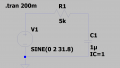
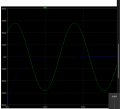
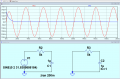
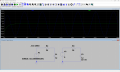
I have been given a cicuit which I modeled in LTspice. The assignment is to modify the simulation deck so that the currents passing through an R2 and R3 show the natural and forced responses' graphs seperately. I have tried this by dividing it into two circuits: One with the sinusoidal voltage source and C1's C set as 0 and the other with only the capacitor with the initial voltage set as 1V. However, the initial currents magnitudes are not right and the forced response model still has a transient face at the start. What am I missing? The graph that I am supposed to arrive at is also attached.
Ekran görüntüsü 2024-11-13 004105.png
 

Attachments

MrAl

Joined Jun 17, 2014
13,667
Hello,

I have been given a cicuit which I modeled in LTspice. The assignment is to modify the simulation deck so that the currents passing through an R2 and R3 show the natural and forced responses' graphs seperately. I have tried this by dividing it into two circuits: One with the sinusoidal voltage source and C1's C set as 0 and the other with only the capacitor with the initial voltage set as 1V. However, the initial currents magnitudes are not right and the forced response model still has a transient face at the start. What am I missing? The graph that I am supposed to arrive at is also attached.
View attachment 335641
Hi,

Do you have to use a sine wave as input?
If so, are you given the time that the source is turned off in order to calculate or show the natural response?

The complete response will have an indication of an exponential in the sine wave shape near the beginning.
 
Last edited:

Thread Starter

bgm298

Joined Oct 18, 2024
22
It was actually given in a previous question.
Sorry didnt answer the whole thing. The thing is this was an already given circuit. And I have to model it in a way that shows the natural and force responses seperately. The problem with my approach is that the initial value of the natural response is supposed to be -400uA by hand calculations but here it is -200.
 

MrAl

Joined Jun 17, 2014
13,667
I see why that works but I do not understand why?
Hi,

Pure and simple coincidence.

You stated that the initial current is -400ua, and that just happens to coincide with 2v divided by 5k resistance. Therefore, if you assume a 2v constant input, the current could be said to be -400ua. However, not only is the input not a constant 2v, but the capacitor voltage will never reach the required 2v needed to provide the spec of -400ua with a sine wave that has a 2v peak. In fact, it looks like the max voltage across the cap would be 1.5124 (around 1.5v max) which means it could never supply the right current for this problem solution. That means the initial current was given artificially, which is usually not the case, but since it was given, it was given.

Now if we had a cosine wave, we could say that at t=0 the voltage would be 2v, so 2v/5k=400ua. But even then it's still not a given because we were not given any time spec where we stop the input function and calculate the conditions at that time.

So in the end, if you are given -400ua then you are given -400ua, and because it is an artificial spec (an outside source not shown must have induced this current) we cannot correlate it to the input voltage without changing a couple more things. The author of this problem must have just decided to specify it at something that seemed reasonable at the time, or it could be a trick question to see if you would catch it.

I do not think this problem would be too unreasonable if the secondary source was indicated. The idea then would have been to switch to the new source at t=t1 where t1 would be the given switch time point, or just declare it to be at t=0 which is not unreasonable. Since the initial current was a given though, it's not that unreasonable as is either, we just don't know why the author chose to use that current. Normally, you would have to calculate this current yourself, but then you need to see the entire circuit as well as it's complete operation.
 

Thread Starter

bgm298

Joined Oct 18, 2024
22
Hi,

Pure and simple coincidence.

You stated that the initial current is -400ua, and that just happens to coincide with 2v divided by 5k resistance. Therefore, if you assume a 2v constant input, the current could be said to be -400ua. However, not only is the input not a constant 2v, but the capacitor voltage will never reach the required 2v needed to provide the spec of -400ua with a sine wave that has a 2v peak. In fact, it looks like the max voltage across the cap would be 1.5124 (around 1.5v max) which means it could never supply the right current for this problem solution. That means the initial current was given artificially, which is usually not the case, but since it was given, it was given.

Now if we had a cosine wave, we could say that at t=0 the voltage would be 2v, so 2v/5k=400ua. But even then it's still not a given because we were not given any time spec where we stop the input function and calculate the conditions at that time.

So in the end, if you are given -400ua then you are given -400ua, and because it is an artificial spec (an outside source not shown must have induced this current) we cannot correlate it to the input voltage without changing a couple more things. The author of this problem must have just decided to specify it at something that seemed reasonable at the time, or it could be a trick question to see if you would catch it.

I do not think this problem would be too unreasonable if the secondary source was indicated. The idea then would have been to switch to the new source at t=t1 where t1 would be the given switch time point, or just declare it to be at t=0 which is not unreasonable. Since the initial current was a given though, it's not that unreasonable as is either, we just don't know why the author chose to use that current. Normally, you would have to calculate this current yourself, but then you need to see the entire circuit as well as it's complete operation.
The original circuit is also attached. The combined response had the initial current value -200ua. The forced response had the initial value 200ua so maybe that is where the -400 is coming from. The forced response can be graphed when I swap the terminals of C1 but I cannot fond a way to graph the natural response. The question askes to graph the responses seperately after t=0. Could we get somewhere from this?
 

MrAl

Joined Jun 17, 2014
13,667
The original circuit is also attached. The combined response had the initial current value -200ua. The forced response had the initial value 200ua so maybe that is where the -400 is coming from. The forced response can be graphed when I swap the terminals of C1 but I cannot fond a way to graph the natural response. The question askes to graph the responses seperately after t=0. Could we get somewhere from this?
Hi,

I should think so. Start by doing the natural response by first recognizing what the natural response is or where it comes from.
The natural response comes from the circuit when there is no forcing function just any residual energy left in the storage elements.

Thus, if you had 1v across the cap with no input source, the natural response would be what the circuit does with that 1v across the cap starting at t=0. I think you can figure out how to do that, but if you had any trouble figuring out how to do that you can use an initial current generator (a source inserted such that it mimics the initial condition of the cap voltage) which would be a DC source.
However, your initial condition is a current source (whichever you decide is right, 200ua, -200ua, -400ua, etc. That simply means the capacitor has that current flowing through it at t=0, and the input source, being a voltage source, is short circuited. So you would set up your Spice circuit with an initial current of say -400ua through the cap (1uf IC=-400ua for example) and then allow that to run while you plot the response. You can visualize this because it's just an RC circuit with no input source and just some initial current in the capacitor. You probably know already what kind of response to expect from that.

See if you can get that going first.

BTW, where is the original circuit I don't see that yet?
 

MrAl

Joined Jun 17, 2014
13,667
hi bgm,
I am not sure what you are asking?
Why have you chosen that frequency for the Sine vave V1

E
View attachment 335705
Hi Eric,

I am guessing because the author wanted a simpler solution for the math with regard to the sine source. That frequency times 2 times pi comes out to a whole number, "200", for what it is worth :)
Thus the sine source mathematically is 2*sin(200*t). That might seem 'simpler'.
It's interesting that the cap voltage can never reach a voltage level of 2 volts (low pass filter action). The max is around 1.5 and settles to a lower peak somewhat close to 1.4 volts as time progresses and the exponential dies out.
 

Thread Starter

bgm298

Joined Oct 18, 2024
22
Hi,

I should think so. Start by doing the natural response by first recognizing what the natural response is or where it comes from.
The natural response comes from the circuit when there is no forcing function just any residual energy left in the storage elements.

Thus, if you had 1v across the cap with no input source, the natural response would be what the circuit does with that 1v across the cap starting at t=0. I think you can figure out how to do that, but if you had any trouble figuring out how to do that you can use an initial current generator (a source inserted such that it mimics the initial condition of the cap voltage) which would be a DC source.
However, your initial condition is a current source (whichever you decide is right, 200ua, -200ua, -400ua, etc. That simply means the capacitor has that current flowing through it at t=0, and the input source, being a voltage source, is short circuited. So you would set up your Spice circuit with an initial current of say -400ua through the cap (1uf IC=-400ua for example) and then allow that to run while you plot the response. You can visualize this because it's just an RC circuit with no input source and just some initial current in the capacitor. You probably know already what kind of response to expect from that.

See if you can get that going first.

BTW, where is the original circuit I don't see that yet?
Since natural response is coming from the behavior of the capacitor, I made a circuit with just the capacitor with its initial value at 1V and the resistor. The graph of this starts from -200uA. But even looking at the formula I found by hand, I can see that the initial current was supposed to come out as -400uA. Initializing the current of the capacitor loses the ramping part of the natural response.
Here is the original circuit:
 

Attachments

ericgibbs

Joined Jan 29, 2010
21,390
hi bgm,
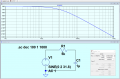
This is the Bode plot for the circuit, note the response at 31Hz.
E

Note:
Z= 7074R @ 400uA
I= 2V/7074R= 282uA
282uA/400uA =-3dB

EG57_ 2297.png
 
Last edited:

MrAl

Joined Jun 17, 2014
13,667
Since natural response is coming from the behavior of the capacitor, I made a circuit with just the capacitor with its initial value at 1V and the resistor. The graph of this starts from -200uA. But even looking at the formula I found by hand, I can see that the initial current was supposed to come out as -400uA. Initializing the current of the capacitor loses the ramping part of the natural response.
Here is the original circuit:
Hi,

I am not sure why you are showing the exact same thing again.

If the capacitor has -400ua initial current, then the capacitor has -400ua initial current, that's the end of the story except for the fact that the voltage source for the input is now to be shorted out. That leaves you with only the following:
1. Capacitor.
2. Resistor.
3. Initial current through the capacitor of -400ua.

There was never any 1v or any 2v or any -1v or any -2v. There was only -400ua (if that is really the initial value of the current through the cap which you seem to have indicated that was the value given).
Without the part of the circuit that caused this -400ua we can never tell what actually caused it, so we can't assume 1v or 2v or anything else, we can only assume -400ua. If we can see that part of the circuit this may change, but until then there is nothing else we can assume.

Note this equation:
E=2*e^(200*t)

There are two variables in this equation and that means we can choose many values for E and t in order to solve it.
If we choose t=0 then E=2 (volts), but if we choose t=0.001 then E=2.4428, if t=0.01 then E=14.7781 (approximately).
However, once we are given one of the values like t=0.01, we then know that E is about 14.8 volts.
In this problem we are given -400ua, so we use that as the initial condition. If we were given -800ua we would use that, or -200ua or 200ua or just about anything else :)
I do not see any other way to handle this because we can't see the part of the circuit that caused this -400ua.

Do you see how to set this up now? If not that's ok, we'll just look at it a little more.

One thing I should add here though.
If you read part of Eric Gibbs' sig line, it reads like so:
"In order to help another effectively, you must understand what he understands. ..."
This also applies to the instructor. We do not yet know for sure what the total intent of the instructor was. He could have something very specific in mind which might even violate some circuit principles. He could be wrong about something, either on purpose or not, or just have something very different in mind. The only way to know that is to communicate with the instructor and only you can do that unless you give us his email or something, and you would have to get his permission to do this.
It's unfortunate that this comes up from time to time, but that is because when we talk about circuit here, we talk somewhat briefly about the workings of the circuit, and that sometimes leads to misunderstandings about the intent of the lesson. There's not much we can do about that unless you ask the instructor some additional questions sometimes. I can say that we are successful most of the time though, there are just those little questionable circuit problems that come up now and then.
Unfortunately, there's also the possibility that we make a mistake ourselves in trying to help, but between all of us here on this forum we have the collective experience of probably 1000 years, so it's not very often that happens :)
You might read that above as a sort of disclaimer, but if we can get to communicate with the author of the circuit exercises there's almost nothing we can't, collectively, do here on this forum even when the most questionable exercises come up.
 

Thread Starter

bgm298

Joined Oct 18, 2024
22
Hi,

I am not sure why you are showing the exact same thing again.

If the capacitor has -400ua initial current, then the capacitor has -400ua initial current, that's the end of the story except for the fact that the voltage source for the input is now to be shorted out. That leaves you with only the following:
1. Capacitor.
2. Resistor.
3. Initial current through the capacitor of -400ua.

There was never any 1v or any 2v or any -1v or any -2v. There was only -400ua (if that is really the initial value of the current through the cap which you seem to have indicated that was the value given).
Without the part of the circuit that caused this -400ua we can never tell what actually caused it, so we can't assume 1v or 2v or anything else, we can only assume -400ua. If we can see that part of the circuit this may change, but until then there is nothing else we can assume.

Note this equation:
E=2*e^(200*t)

There are two variables in this equation and that means we can choose many values for E and t in order to solve it.
If we choose t=0 then E=2 (volts), but if we choose t=0.001 then E=2.4428, if t=0.01 then E=14.7781 (approximately).
However, once we are given one of the values like t=0.01, we then know that E is about 14.8 volts.
In this problem we are given -400ua, so we use that as the initial condition. If we were given -800ua we would use that, or -200ua or 200ua or just about anything else :)
I do not see any other way to handle this because we can't see the part of the circuit that caused this -400ua.

Do you see how to set this up now? If not that's ok, we'll just look at it a little more.

One thing I should add here though.
If you read part of Eric Gibbs' sig line, it reads like so:
"In order to help another effectively, you must understand what he understands. ..."
This also applies to the instructor. We do not yet know for sure what the total intent of the instructor was. He could have something very specific in mind which might even violate some circuit principles. He could be wrong about something, either on purpose or not, or just have something very different in mind. The only way to know that is to communicate with the instructor and only you can do that unless you give us his email or something, and you would have to get his permission to do this.
It's unfortunate that this comes up from time to time, but that is because when we talk about circuit here, we talk somewhat briefly about the workings of the circuit, and that sometimes leads to misunderstandings about the intent of the lesson. There's not much we can do about that unless you ask the instructor some additional questions sometimes. I can say that we are successful most of the time though, there are just those little questionable circuit problems that come up now and then.
Unfortunately, there's also the possibility that we make a mistake ourselves in trying to help, but between all of us here on this forum we have the collective experience of probably 1000 years, so it's not very often that happens :)
You might read that above as a sort of disclaimer, but if we can get to communicate with the author of the circuit exercises there's almost nothing we can't, collectively, do here on this forum even when the most questionable exercises come up.
Thank you so much for your help. I will try to reach out to my instructor again too. :)
 
Top