Is triac a better choice for switching water pumps?

Thread Starter

SM Farjad

Joined Mar 26, 2018
1
Hello!

I am thinking to deploy triac as a switching circuitry for water pump. Triac was recommended by the experts but on one forum I came to know that triac cannot be used for high power load. I want to know whether I can use triac as a switch for my water pump or not. Please guide me how to use triac as a switch.

PS I am avoiding relay switch for its vulnerability and cost.
 

Dodgydave

Joined Jun 22, 2012
11,395
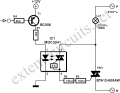
Yes a Triac will do the job , you need to know what Voltage and Current your pump needs in order to select a Triac, most common Triacs are,, BT08-600, BTA12-600, BT139-600-16, these are 600V working and 8, 12, or 16Amp , ideally the triac is fired using an zero crossing opto-coupler.


dc_control_for_triacs_circuit_diagram-2.png
 
Last edited:

ebeowulf17

Joined Aug 12, 2014
3,307
Yes a Triac will do the job , you need to know what Voltage and Current your pump needs in order to select a Triac, most common Triacs are,, BT08-600, BTA12-600, BT139-600-16, these are 600V working and 8, 12, or 16Amp , ideally the triac is fired using an zero crossing opto-coupler.


View attachment 149122
I've read (and been told by an FAE) that zero crossing is only preferred for loads that are primarily resistive. More inductive loads are better switched with random firing.

I've never completely understood it, and I don't know how inductive a load has to be before it becomes a deciding factor, but here's the basic concept as I remember it:

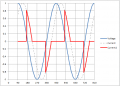
With inductive loads, there's a phase difference where current lags behind voltage. Since TRIACS stop conducting at zero current, but zero crossing optos fire at zero voltage, you can potentially get into a weird situation where you're unintentionally cycling on and off, chopping the wave up kind of like an SCR dimmer.

This would happen if the phase difference was great enough that when the TRIAC stopped conducting at zero current, the voltage had already climbed enough to be above the zero crossing threshold. In this case the TRIAC wouldn't re-trigger until the next voltage zero crossing, missing a significant portion of one half cycle.

I've probably explained this badly, and maybe it's not relevant in this thread anyway. Food for thought though. Honestly, if anyone here can set me straight or explain this better than I just did, I'd love to have a better understanding of it all!
 

ebeowulf17

Joined Aug 12, 2014
3,307
Here's a graph I made in Excel a while back when I was trying to wrap my head around the phase delay and zero-crossing-triggering concepts:
zero-crossing_phase-delay.png

Aside from my zero-crossing questions, getting back to the thread starter's original question, I agree with the others: Assuming it's an AC motor, a TRIAC should be a good solution. If it's a DC motor, then the TRIAC won't work right.
 

MaxHeadRoom

Joined Jul 18, 2013
30,559
I am thinking to deploy triac as a switching circuitry for water pump. I want to know whether I can use triac as a switch for my water pump or not. Please guide me how to use triac as a switch.
.
This is assuming you just want stop/start control, not variable rpm, then a off the shelf (Triac) SSR controller would do it.
Max.
 
Top