Is this TL431 based low battery cutoff circuit practical

Thread Starter

sribasu

Joined May 10, 2017
41
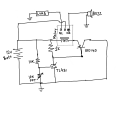
I made a low battery cutoff circuit to monitor my 12v lead acid battery using TL431. I followed the circuit diagram shown below. Sorry for the hand-drawn schematic. I am however not satisfied with the outcome, since I understood with my little knowledge of TL431 that it would work better than a regular OpAmp based comparator. When I built the cutoff circuit using comparator, the relay vigorously oscillated between NO and NC around the cutoff voltage. I thought it will be different when using a shunt regulator like TL431. But unfortunately it is behaving the same.

First of all I am finding it really difficult to set the cutoff voltage at around 12.3v using the pot, I could set it to around 11.5v only. But then too, the relay starts turning on and off rapidly after 11.7v and finally cuts off below 11.5v. Can someone please suggest if I am doing something wrong in this circuit? I am not an electronics expert, so don’t have the knowledge if this behaviour is expected. I am aware of the better alternatives like a special purpose IC made just for this purpose or microcontroller based solutions. But I am just trying to learn the reality here. Are all those websites flooded with similar TL431 based cutoff circuits referring basically this end result? Most of them shows a MOSFET based load driver, but I slightly modified it to drive a relay, so that I get a buzzer based sound alert as well, when the battery voltage is lower than cutoff.

PS: I am using a 14Ah battery and a 10 watt led panel as load. I thought using a reasonable load will help the battery voltage to drop significantly under load that matches my practical use case.
Untitled.png
 

crutschow

Joined Mar 14, 2008
38,316
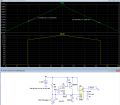
See the circuit below:
It has the relay in the transistor collector so full voltage is applied to the relay coil, and R4 adds a small amount of positive feedback (here about 0.2V of hysteresis) to prevent relay chatter around the trip-point.
So the relay closes at about 12.5V and opens at about 12.3V (you can reduce the value of R4 if that's not sufficient).

D1 is needed here to suppress the inductive spike from the relay coil, which could otherwise zap the transistor.

1728584550922.png
 
Last edited:

Thread Starter

sribasu

Joined May 10, 2017
41
See the circuit below:
It has the relay in the transistor collector so full voltage is applied to the relay coil, and R4 adds a small amount of positive feedback (here about 0.2V of hysteresis) to prevent relay chatter around the trip-point.
So the relay closes at about 12.5V and opens at about 12.3V (you can reduce the value of R4 if that's not sufficient).

D1 is needed here to suppress the inductive spike from the relay coil, which could otherwise zap the transistor.

View attachment 333472
I've built the circuit and tested it just now. It doesn't help me get rid of the chattering either. It still chatters around the threshold. I used 560K and 470K resistors in series, instead of a 1M for R4, 470 for R1 and 1K for R5. But hope these are not making the difference.
 

Thread Starter

sribasu

Joined May 10, 2017
41
I am also worried to not make the solution dependent on the load. So a little extra headroom won't heart. Will it be possible to keep the threshold to approx 0.7v? So when the voltage doesn't rise above 12.3+0.7 = 13v the buzzer will be on. I am ok with that.
 

crutschow

Joined Mar 14, 2008
38,316
Please help me understand the relation between R4 and the voltage drop. I am seeing a drop of approx 0.5v.
The value of R4 determines the hysteresis (the difference between the two trigger points).
R4 slightly changes the Vref voltage from the 12V change at the transistor collector, which generates a hysteresis at the output of about ΔVref * 12/2.5
It has to be greater than the change in supply voltage (here 0.5V) to avoid the relay chatter.

So for a hysteresis of 0.7V, R4 should be about 332kΩ.
 
Last edited:

Thread Starter

sribasu

Joined May 10, 2017
41
The value of R4 determines the hysteresis (the difference between the two trigger points).
R4 slightly changes the Vref voltage from the 12V change at the transistor collector, which generates a hysteresis at the output of about ΔVref * 12/2.5
It has to be greater than the change in supply voltage (here 0.5V) to avoid the relay chatter.

So for a hysteresis of 0.7V, R4 should be about 332kΩ.
Ok I will try this value. Just asking, Thanks for the values, I'll try these and let you know. Just asking - if I simply change "my circuit" a bit to connect the voltage divider for TL431's reference to a stable voltage source (resistor+8V zener in series), instead of connecting it directly to the battery source, does it help to get rid of the problem?
 

crutschow

Joined Mar 14, 2008
38,316
if I simply change "my circuit" a bit to connect the voltage divider for TL431's reference to a stable voltage source (resistor+8V zener in series), instead of connecting it directly to the battery source, does it help to get rid of the problem?
How could it?
The TL431 is being used as a comparator with an accurate trip point.
It's the voltage at the TL431's reference input that determines when it switches.
A volage above 2.5V cause the TL431 to conduct between it's cathode and anode.
Below 2.5V it turns off.
Connecting it to a stable voltage means it will never switch.

Here's why the relay chatters:
When the voltage gets below its trip-point, the TL431 turns off the relay.
But since the load is now disconnected the voltage rises.
Now the TL431 sees the voltage is above the trip-point, so it turns the relay back on.
This on and off rapidly repeats, causing the chatter (frequency period likely close to the twice the relay operate time).

Thus hysteresis is added to the voltage trip points so that when the voltage rises, its not enough to turn the relay back on.
 
Last edited:
Top