Is this feasible ? And I apologize for the vagueness.

Thread Starter

Hextejas

Joined Sep 29, 2017
187
I am a raw beginner to the electronics world and am studying anything that looks to be worthwhile.
In my closet is a Nad 402 am-fm tuner. Well it dont work and I want to make it work. I thought that it would be a good beginners project.
I checked the minimal stuff that I know how to do. Checked for an open circuit by putting my vom leads on the end of the power cord. Yep, shows as open. The tuner is fused so I tested the 2 fuses and one was burned. If memory serves me, they were 415ma, 250v. They were odd in that they had a small resistor in the fuse. A ham buddy of mine said that they were slow blow. That was the replacement that bought. One capacitor looked odd, kinda swollen so I replaced it. Another site, somewhat kiddingly said that it would be a diode. So I replaced 2 of them. 1N4001 with 1N4007 cause that's all I had.
The tuner was acting very strange. After I replaced the fuse the 1st time, the control panel lit up and I tried to select a station. Poof, lights out and another burned fuse. Replaced the fuse and now it won't even light up.
Its beyond my skills to repair this thing so I want to hire a knowledgeable person to repair it as part of a teaching session with me as the student.

How do I go about doing this ? I am willing to pay $nn per hour to do this, whatever the market deems fair. I have the Nad service manual and it has a schematic so thats a help.

Is this anyway possible.
I live in Houston TX if anybody wants to try it. :=)

thanks
 
Yes, it is feasible and no, it is probably not easy. Sounds to me like something shorted (first and second blown fuse) and then burned out (third fuse doesn't blow and nothing lights up).

Where to go from here?

1. Take some really good clear detailed pictures.
2. Note that the service manual with a schematic is available here as a pdf (which you already mentioned).
3. Hope somebody that really knows this area comes by and makes a recommendation.

It's not much but I hope it helps.
 
Last edited:

AnalogKid

Joined Aug 1, 2013
12,043
It would help immensely if you found a schematic and posted an image or a link. Separate from that, it sounds like something in the power supply section survived whatever blew the first fuse, but failed before the 2nd fuse blew.

ak
 

dendad

Joined Feb 20, 2016
4,634
As a good safety (of the electronics) measure, make up a power lead that has a 40 to 100W lamp in series. That helps to prevent fuses blowing and parts incinerating a bit. I have a power socket box with a lamp socket on it so the lamp can be changed if required.
This setup will allow your tuner to operate, at least partially, and is a great servicing tool. Once you have the tuner running with out the lamp lighting brightly, you can then try plugging the tuner into the mains directly.
It is even better if you add the lamp to the secondary of an isolation transformer.
 

dendad

Joined Feb 20, 2016
4,634
Add the series lamp as above.
With T1 unplugged, measure the ACV on the T1 connector to make sure the transformer is still working.
With the power switch off, is the +5V supply there?
If so, the fault will be in the other part of the power supply.
You could check the power switch board for damage to make sure it is not shorting out the low volts AC now.
Measure the bridge rectifier "D10" for shorts.
And the inputs of Q18 and Q19.
Let us know those results.
 

Thread Starter

Hextejas

Joined Sep 29, 2017
187
Add the series lamp as above.
With T1 unplugged, measure the ACV on the T1 connector to make sure the transformer is still working.
With the power switch off, is the +5V supply there?
If so, the fault will be in the other part of the power supply.
You could check the power switch board for damage to make sure it is not shorting out the low volts AC now.
Measure the bridge rectifier "D10" for shorts.
And the inputs of Q18 and Q19.
Let us know those results.
The voltage at input of q18 and q19 is zero.
Quick newbie question, when measuring these voltages one probe is to the chassis for ground. Is that correct ?
What confounds me is that the voltage across the 2 fuses is 19.7. So what stops the 19.7v from getting to the pcb ?
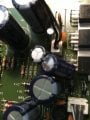
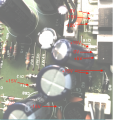
The picture shows the capacitor that i replaced. It is C65, I think. I propped up the faulty cap next to it. I saw it as having a bulged top.
I cant find D10 yet.9E18BE24-229D-40EC-8015-0899647193F3.jpeg
 

dendad

Joined Feb 20, 2016
4,634
The chassis probably is at the 0V level.
That round black thing near the white connector below D8 and D9 is D10.
Try measuring the DC volts from chassis to the cathodes of D8 or D9. Is it around 15VDC?

There should be DC volts on the cathode of D11 too, as well as on the regulator inputs.
(note, the pinouts of Q18an Q19 are not the same!!
If there is no volts there, check to see if the power switch is working. There may be broken tracks under the connectors.
NAD402.png
Note! the "15V" is probably 18V or so.
When you say 19.7V across the fuses, do you mean from one fuse to the other or from one end of the fuse to the other end of the same fuse?
If the latter, the fuse is blown.
I'm off to bed now as it is very late here in Oz ;)
Good luck.
 
Last edited:

danadak

Joined Mar 10, 2018
4,057
Post # 6 is a cap with top bulging up, outward, thats probably a shorted cap you
should replace.

If you fix stuff like this on a regular basis an invaluable tool is a C ESR tester. Pretty
cheap on ebay, banggood.

Regards, Dana.
 

MisterBill2

Joined Jan 23, 2018
27,164
The first thing that I would suspect is a diode or capacitor being installed in reverse, by a beginner. But failed filter caps are also a source of overloads. Much cheaper than replacing fuses is to use a 12 or 24 volt light bulb in place of the fuse, to limit the current until you can find the problem. That is a cheap trick that has worked for me while chasing short circuits.. The equipment won't work with the bulbs in, usually, but first fixing the shorts needs to be done.
 

Thread Starter

Hextejas

Joined Sep 29, 2017
187
I am thinking that this voltage regulator is bad. It's a LM7805, the 5 volt rail. I desoldered it and wired it up in a breadboard and it lets a lot more than 5V through. it seems like it passes the input voltage straight through.
Would that cause the fuse to blow ?
Anyway I am going to replace it.
 

MisterBill2

Joined Jan 23, 2018
27,164
A failed voltage regulator that passes excessive voltage will often cause a fuse to pop because of tge excessive current that the loads draw. Also, as the regulator fails it may short-circuit the supply connection, also likely to pop a fuse, if you are fortunate.
 
Top