is this a good charger ?????

Lestraveled

Joined May 19, 2014
1,946
It is not just auto shut-off, it is powering the supervisory circuit from the battery you are charging. It monitors the battery and when it needs to charge, it turns the charging circuit back on. Zero current draw from the mains until it actually is charging.
 

Thread Starter

green90

Joined Sep 3, 2015
29

cornishlad

Joined Jul 31, 2013
242
Apart from any of the circuit design issues I wonder if it would actually charge batteries properly. It's a complicated subject and I don't pretend to understand it well....but...I'm sure Ive read that if you charge a LA battery from a fixed voltage of 13.8 volts, it will take a VERY long time to get fully charged, So, in this design, if power is removed immediately the voltage rises to 13.8 volts it will be only partially charged. Perhaps less than 70%....In car chargers - alternators - charge with 14.2> 14.4 v I believe. Thoughts ?
 

MikeML

Joined Oct 2, 2009
5,444
Apart from any of the circuit design issues I wonder if it would actually charge batteries properly. It's a complicated subject and I don't pretend to understand it well....but...I'm sure Ive read that if you charge a LA battery from a fixed voltage of 13.8 volts, it will take a VERY long time to get fully charged, So, in this design, if power is removed immediately the voltage rises to 13.8 volts it will be only partially charged. Perhaps less than 70%....In car chargers - alternators - charge with 14.2> 14.4 v I believe. Thoughts ?
Yes, the proper recharging algorithm for lead-acid chemistry batteries (sealed or flooded) is a three step process:

Step 1. Feed the battery a constant-current of about 0.1C (10A for a 100Ah battery) until the voltage reaches ~14.5V.
Step 2. Switch to constant-voltage mode, hold the voltage at 14.5V while measuring the current that flows into the battery.
Step3. When the battery current drops below ~0.001C (100mA for the 100Ah battery), switch to a constant-voltage of ~13.6V and hold that forever. At this point the battery is 97% to 100% fully charged.

Switching off the charger as the circuit being discussed in this thread is the wrong thing to do.

If you connect a separately current-limited, constant-voltage power supply (like a lab power supply, separate knobs for setting current limit and voltage-limit) set to 13.6V to a discharged lead-acid battery, it will eventually recharge it to the same 97% point as the three step algorithm, above. However, it will take days, while the three-step method will get it there in a few hours.


This type of charger implements the three step algorithm, above, but because its peak current is limited to only ~1A, it takes several days to recharge a large battery, but it will eventually get it there, and then it will maintain the battery by compensating for parasitic draw or self-discharge. I have several of these on little-used vehicles, boats, and airplanes. They get left on 24/7.
 
Last edited:
It is not just auto shut-off, it is powering the supervisory circuit from the battery you are charging. It monitors the battery and when it needs to charge, it turns the charging circuit back on. Zero current draw from the mains until it actually is charging.
Perhaps, but it drains your battery (to whatever limited extent) instead of float-charging it. Not a good way to maintain a lead-acid battery, by constant charging/discharging. You're supposed to leave it on a float charge or nothing at all. See Mike's post about the recommended 3-phase charging.
 

Lestraveled

Joined May 19, 2014
1,946
Perhaps, but it drains your battery (to whatever limited extent) instead of float-charging it. Not a good way to maintain a lead-acid battery, by constant charging/discharging. You're supposed to leave it on a float charge or nothing at all. See Mike's post about the recommended 3-phase charging.
The circuits operating from the battery can easily be designed to run on micro-amps of current. Micro Chip makes a line of PIC chips with the NanoWatt feature. When they go to sleep they only draw in the tens of nano-amps.
 
The circuits operating from the battery can easily be designed to run on micro-amps of current. Micro Chip makes a line of PIC chips with the NanoWatt feature. When they go to sleep they only draw in the tens of nano-amps.
Yeah, so you're progressing to what I was talking about: a simple LM317 circuit plus an MCU that can implement proper 3-phase charging and can shut the power off at an appropriate time.
 

Lestraveled

Joined May 19, 2014
1,946
The self discharge are of a typical lead acid battery is 5% per month. Assume a 100 AH battery and that equals 5 amp hours over thirty days. There are 720 hours in a month so 5 AH divided by 720 equals .007 AH. So the self discharge is equivalent to drawing 7 ma continually for 720 hours (1 month). It would be easy to design a battery monitoring circuit that ran off of one tenth of that current.
 

Lestraveled

Joined May 19, 2014
1,946
When the supervisory circuit is powered from the mains, there is more power lost in the conversion than what is used by the circuit. Also, since it draws power all the time it would be classified as a energy vampire. When the supervisory circuit is powered from the battery, there is very little overhead loss, drawing less current than the self discharge rate of the battery. Plus, it would not be classified as a energy vampire.
 
Last edited:

Lestraveled

Joined May 19, 2014
1,946
There is more than one method to "float" a battery.
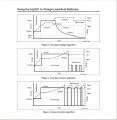
- The classic method is for the charger to hold the battery at 13.2 volts. (Constant voltage, charger never turns off). (figure 3 below) This would not be consistent with the "power off" concept.

- Another method is once the bulk charge is completed, (reaches 14.7 volts), the charger pulses the battery at 13.2 volts (constant voltage) to keep the average battery voltage at 13.2 volts. (Figure 4 below)

- Another method is once the bulk charge is completed, (reaches 14.7 volts), the charger turns off until the battery voltage drops to the float voltage. Then the charger charges at the bulk constant current rate until 14.7 volts is reached. (Figure 5 below)

Below is a page from the app note for the BQ2031 lead acid battery controller chip from TI. It shows graphically the charging profiles talked about above.


Attachments

Top