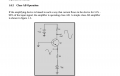
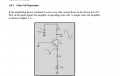
Is there any way for this circuit to work?

Thread Starter

tsmspace

Joined Mar 16, 2026
94
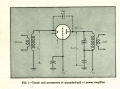
I snipped this from the NEETS module 8 , for amplifiers. (navy electronics education and training series).

This image is the books basic concept schematic for a class AB amplifier, but what I'm talking about is the input for the signal being on the emitter, and the base being grounded.

Is this a possible circuit? I see it nowhere else, the logic doesn't seem to work out, but then, the navy has signed and dotted this module so perhaps it's a conspiracy to promote closed-culture and exclusive behavior, or perhaps it's just someone who thinks they don't get paid enough so maliciously wrote the texts, either way to me, with my untrained eye, it does look inaccurate.
 

Attachments

nsaspook

Joined Aug 27, 2009
16,318
I snipped this from the NEETS module 8 , for amplifiers. (navy electronics education and training series).

This image is the books basic concept schematic for a class AB amplifier, but what I'm talking about is the input for the signal being on the emitter, and the base being grounded.

Is this a possible circuit? I see it nowhere else, the logic doesn't seem to work out, but then, the navy has signed and dotted this module so perhaps it's a conspiracy to promote closed-culture and exclusive behavior, or perhaps it's just someone who thinks they don't get paid enough so maliciously wrote the texts, either way to me, with my untrained eye, it does look inaccurate.
Don't assume things not in evidence.

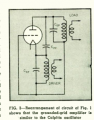
That type of circuit existed before transistors.
https://www.worldradiohistory.com/A...ounded-Grid-Power-Amplifiers-Spitzer-1946.pdf
1778120323866.png1778120446465.png
 

Thread Starter

tsmspace

Joined Mar 16, 2026
94
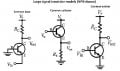
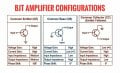
There are three BJT configurations, common base, common collector, and common emitter.

View attachment 366804

Each configuration has different operational characteristics. You need to learn all three.

View attachment 366805


View attachment 366799


What you are looking at is the common base configuration.
thanks all.

I see. this makes tons of sense. I feel a lot better now!
 

AnalogKid

Joined Aug 1, 2013
12,126
Is this a possible circuit?
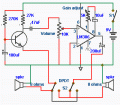
Yes. It is called a common-base amplifier. one of the three basic single-transistor amplifier configurations. It signature characteristic i that its input is more of a "current-mode", with a relatively ow input impedance. This works well if you have a signal source that expects a low impedance load. This circuit is more common in RF work than in audio or video, but it is part of an intercom circuit that has bounced around the innergoogle for decades.

Here is another version: https://freecircuitdiagram.com/3794-door-intercom/

ak
 

Attachments

Last edited:

vandveuser16776

Joined Feb 21, 2026
218
I think I understand why it works, but I do not see the purpose of the VEE in there as it seems redundant? If the voltage at "in" node drops below the GND, in most cases -0.7v, the base is more positive, transistor switches and the "out" node will drop near GND. If "in" node goes near -0.4v, the BJT stops conducting and the "out" node will be whatever the VCC is, with the current that the R1 allows to go across, whatever the R1 is? Can someone help me understand what VEE does or what I am missing?
 

WBahn

Joined Mar 31, 2012
32,823
I think I understand why it works, but I do not see the purpose of the VEE in there as it seems redundant? If the voltage at "in" node drops below the GND, in most cases -0.7v, the base is more positive, transistor switches and the "out" node will drop near GND. If "in" node goes near -0.4v, the BJT stops conducting and the "out" node will be whatever the VCC is, with the current that the R1 allows to go across, whatever the R1 is? Can someone help me understand what VEE does or what I am missing?
What that diagram glosses over is that the input voltage needs to be a small voltage that operates around the normal bias point of the transistor. This is generally achieved by capacitively coupling the signal source to the emitter.
 

WBahn

Joined Mar 31, 2012
32,823
What that diagram glosses over is that the input voltage needs to be a small voltage that operates around the normal bias point of the transistor. This is generally achieved by capacitively coupling the signal source to the emitter.
To put things more concretely, The output is constrained to be between V_CC (when the transistor cuts off) and a bit above 0 V (when the transistor saturates.

You want it biased to, roughly V_CC/2 when there is no input signal, which means you want a collector current of V_CC/(2Rc). That will also be, ignoring the base current, the collector current, which will be

I_E = (-V_BE + V_EE)/R2, so you want:

V_CC / (2R1) = (-V_BE - V_EE)/R2

R2 = 2R1 * (V_EE - V_BE)/V_CC

Or, if VCC = VEE and both are significantly greater than V_BE, you want R2 = 2·R1.

Think of this is a current-input amplifier that produces an output voltage, also known as a transimpedance amplifier. The input either pushes current into the emitter junction or it pulls current from it. If it pushes it into it, the transistor responds by reducing the emitter current by close to the same amount, which reduced the collector current by about that amount, which raises the output voltage by that amount of current multiplied by R1. Similarly, if it pulls current from the emitter, that results in an increase in collector current by that same amount. So the transimpedance of the amplifier is approximately R1.

Notice that, as you push and pull current into the input, the voltage at the input doesn't change much at all. This means that the input impedances if very low, which is just what you want for current-input devices (you want high input impedance for voltage-input devices).

You can turn it input a voltage-input circuit by adding a coupling capacitor and input resistor, R_in, between the signal source and the emitter. The resistor turns input signal voltage into input currents via Ohm's Law (when well above the cutroff frequency of the resulting RC high-pass filter), resulting in a voltage gain of about R1/R_in.

Often times, R1 is the load, which results in a current-controlled current-source (also known as a current amplifier) with low input impedance and high output impedance (basically the output impedance of the transistor due to the Early effect). With the input RC filter in place, it becomes (within the passband) a voltage-to-current converter.

It's actually a very useful building block in more complex circuits and particularly finds use in RF circuits.
 

LvW

Joined Jun 13, 2013
2,026
I think I understand why it works, but I do not see the purpose of the VEE in there as it seems redundant? If the voltage at "in" node drops below the GND, in most cases -0.7v, the base is more positive, transistor switches and the "out" node will drop near GND. If "in" node goes near -0.4v, the BJT stops conducting and the "out" node will be whatever the VCC is, with the current that the R1 allows to go across, whatever the R1 is? Can someone help me understand what VEE does or what I am missing?
...transistor switches"....""stop conducting".....

(1) The circuit is intended to amplify. Therefore, you need a suitable fixed DC bias point around which the collector current is forced to swing - controlled by the input signal. Hence, no "switching" at all.
However, for class AB operation a sinusoidal signal will appear at the output with distortion and one half wave may exhibit a clipping effect.

(2) Because the base is at ground potential we need in this case two DC sources. The source Vee makes the emitter potential app. 0.7 volts lower than the base potential: Vbe=+0.7 V. For class AB-operation the voltage Vbe is selected to be somewhat smaller (0.3.....0.6) V.
The second source (Vcc) is necessary to make Vce>Vbe (in practice: several volts).

(3) In many cases a common base circuit is realized with one DC source Vcc only. In this case, the base is positively biased with a voltage divider between Vcc and ground - similar to common emitter configuration.
 
Last edited:

AnalogKid

Joined Aug 1, 2013
12,126
I think I understand why it works, but I do not see the purpose of the VEE in there as it seems redundant?
Your description of "in" and "out" nodes sounds more digital than analog. As with any one-transistor *linear* amplifier, there must be a static base and collector currents in addition to the varying signal current. The relationship among these currents is such that

1. the sum of the static current plus the positive peak signal current must not be great enough to drive the transistor to saturation.

2. the difference of the static current and the negative peak signal current must be greater than zero so the transistor is not cut off.

ak
 

crutschow

Joined Mar 14, 2008
38,503
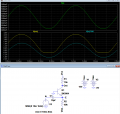
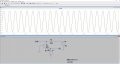
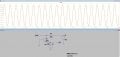
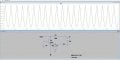
Below is the LTspice sim of the circuit with a capacitor in series with the signal input to not affect the DC bias:
I experimentally adjusted the values to get the output waveform shown, which is clipped at the opposite polarity from your post.
Note that the input signal in the plot is multiplied by 200 to compensate for the circuit gain and give a comparable plot amplitude.

1778167951572.png
 

vandveuser16776

Joined Feb 21, 2026
218
...........

Think of this is a current-input amplifier that produces an output voltage, also known as a transimpedance amplifier. T
........
Often times, R1 is the load, which results in a current-controlled current-source (also known as a current amplifier) with low input impedance and high output impedance (basically the output impedance of the transistor due to the Early effect). With the input RC filter in place, it becomes (within the passband) a voltage-to-current converter.

It's actually a very useful building block in more complex circuits and particularly finds use in RF circuits.
Thanks for informative and detailed reply. It makes more sense to replace load with R1.
 

vandveuser16776

Joined Feb 21, 2026
218
Your description of "in" and "out" nodes sounds more digital than analog. As with any one-transistor *linear* amplifier, there must be a static base and collector currents in addition to the varying signal current. The relationship among these currents is such that

1. the sum of the static current plus the positive peak signal current must not be great enough to drive the transistor to saturation.

2. the difference of the static current and the negative peak signal current must be greater than zero so the transistor is not cut off.

ak
Intresting. Yes, my poor literature did sound like the output is like square. And I think I understand now how it can have a real sine wave without clipping.
 

vandveuser16776

Joined Feb 21, 2026
218
Below is the LTspice sim of the circuit with a capacitor in series with the signal input to not affect the DC bias:
I experimentally adjusted the values to get the output waveform shown, which is clipped at the opposite polarity from your post.
Note that the input signal in the plot is multiplied by 200 to compensate for the circuit gain and give a comparable plot amplitude.
Thanks for your time. It align with the chart @MrChips posted that says "high voltage gain, low current"
 

vandveuser16776

Joined Feb 21, 2026
218
Your description of "in" and "out" nodes sounds more digital than analog. As with any one-transistor *linear* amplifier, there must be a static base and collector currents in addition to the varying signal current. The relationship among these currents is such that

1. the sum of the static current plus the positive peak signal current must not be great enough to drive the transistor to saturation.

2. the difference of the static current and the negative peak signal current must be greater than zero so the transistor is not cut off.

ak
This was very important if you want to get a sine wave.
 

Attachments

MisterBill2

Joined Jan 23, 2018
27,500
What that diagram glosses over is that the input voltage needs to be a small voltage that operates around the normal bias point of the transistor. This is generally achieved by capacitively coupling the signal source to the emitter.
The reason that Vee is shown is because it is present, but typically not supplied. The emitter voltage is developed across the emitter circuit resistance, which is not zero, while the emitter voltage is the sum of the collector current and the base current. I am not sure if the text adequately explained that part, and it may not have been clarified adequatly by the previous posts.
 

LvW

Joined Jun 13, 2013
2,026
The reason that Vee is shown is because it is present, but typically not supplied. The emitter voltage is developed across the emitter circuit resistance, which is not zero, while the emitter voltage is the sum of the collector current and the base current. I am not sure if the text adequately explained that part, and it may not have been clarified adequatly by the previous posts.
In case your comment concerns the circuits as shown in post#1 and post#12, the negative voltage Vee is absolutely necessary!
In order to make Vbe>0 (npn transistor) with Vb=0 (as shown) the emitter path must be negatively biased.
Otherwise, neither class-A nor class A-B operation is possible.
 

MisterBill2

Joined Jan 23, 2018
27,500
Given that current is flowing in the emitter circuit of the example, a voltage is indeed developed across the emitter resistor.So there is a Vee present . It may, or not, be entirely developed by emitter current passing thru the emitter resistor. Unfortunately I don'tunderstand the cryptic description of the input signal, so I am not able to explain the numbers. I see nothing describing the input voltage. Just a cryptic notation.
 
Last edited:
Top