Is there a way with a volt meter to determine the hot and neutral?

MisterBill2

Joined Jan 23, 2018
28,507
My point being that as long as the frame ground circuit is adequate, there is NO HAZARD for those usin the appliance, whatever it may be. AND the TS has already mentioned that it is a window air conditioner. If nobody is poking their hands inside while it is running then there is no problem! (See my very first sentence of this post.)It does not matter which side of the power cord is neutral and which is the LINE. Consider also that the TS has repeatedly stated that none of the circuit is accessible.
Answer this: WHEN was the last time you stuck your hands into an operating window air conditioner??? OR any other electrical appliance, while it was plugged in and operating, for that matter?????

It must be a miserable existence to live in constant fear of getting an electrical shock.
 

BobTPH

Joined Jun 5, 2013
11,666
Took apart an old air conditioner yesterday because I couldn’t lift it into the car to take it to recycling in one piece. The ribbed side of the power cord was connected to a terminal labeled neutral.
 

Tonyr1084

Joined Sep 24, 2015
9,744
My point being that as long as the frame ground circuit is adequate,
as long as the frame ground circuit is adequate,
If it IS "adequate". Do we know it is?
Took apart an old air conditioner yesterday because I couldn’t lift it into the car to take it to recycling in one piece. The ribbed side of the power cord was connected to a terminal labeled neutral.
TS has stated there are no ribs on his cord. I wasn't able to discern any ribs from his photograph either. The ONLY identifying feature is the printing on the cable on one side of the conductors. That MIGHT be the neutral, but I'm not going to say "it is" because - well - IDK!
 

BobTPH

Joined Jun 5, 2013
11,666
If it IS "adequate". Do we know it is?
TS has stated there are no ribs on his cord. I wasn't able to discern any ribs from his photograph either. The ONLY identifying feature is the printing on the cable on one side of the conductors. That MIGHT be the neutral, but I'm not going to say "it is" because - well - IDK!
Oh, OK, I looked at the wring picture. My guess would be that the side with the writing is neutral then.
 

MisterBill2

Joined Jan 23, 2018
28,507
Consider that for most of the years between 1930 and 1956 there was no polarization of AC mains plugs or outlets in the USA, that most of us never got shocked at all. Then along came the mandate of three wire outlets. Has that reduced the number of folks getting shocked?? I have never seen any results claimed about that. So it is a question about the actual benefit.
IF there is any question, and if the TS has a multi-meter with a high resistance range, just connect one lead of the meter to that green ground lead in the center of the cord and probe both of the other leads for any resistance less than open circuit. Select whichever lead shows any resistance less than open circuit assign to the neutral side of the mains plug.
 
Last edited:

DickCappels

Joined Aug 21, 2008
10,661
I have stopped making things powere by the AC Line but when I did do that I always verified Neutral with a DVM. I have heard enough horror stories about AC sockets being miswired. This is human life we are talking about, the safety of which should not be left to assumptions.
 

MisterBill2

Joined Jan 23, 2018
28,507
I have stopped making things powere by the AC Line but when I did do that I always verified Neutral with a DVM. I have heard enough horror stories about AC sockets being miswired. This is human life we are talking about, the safety of which should not be left to assumptions.
FIRST, over the many years, I have received any electrical shock, none of them have been fatal. and most of them were only startling, not even painful. So there are evidently many levels of shocks received. Of course I do observe basic cautions such as avoiding contact with bare wires, and never using plug-in appliances or devices while in the bath or the pool. In addition, if ever I need to touch anything that might possibly be electrically HOT, my first contact is a gentle soft touch with a finger tip. In the event that the item is "HOT", that leads to a minor tingle.
As for any shock hazard from a window air conditioner, safety says do not touch the metal parts while standing barefoot on a concrete slab floor. I actually did get a very startling shock that way once. Barefoot on the slab floor of a house. Very startling indeed. But far from fatal.

AND, I would guess that the side of the cord with the marking would be the hot side. BECAUSE the two unmarked ones would not be hot.
 

Tonyr1084

Joined Sep 24, 2015
9,744
Consider that for most of the years between 1930 and 1956 there was no polarization of AC mains plugs or outlets in the USA, that most of us never got shocked at all. Then along came the mandate of three wire outlets. Has that reduced the number of folks getting shocked?? I have never seen any results claimed about that. So it is a question about the actual benefit.
IF there is any question, and if the TS has a multi-meter with a high resistance range, just connect one lead of the meter to that green ground lead in the center of the cord and probe both of the other leads for any resistance less than open circuit. Select whichever lead shows any resistance less than open circuit assign to the neutral side of the mains plug.
Very true. But the question is "Which is HOT and which is NEUTRAL?"

I remember in high school electronics class. I had a signal generator and an oscilloscope on the workbench. I was using the generator to generate sine waves. I happened to rest my hand on the generator and the other hand on the scope. I got a good shock across the chest. Knocked me back and scared the hell out of me. Both machines had two wire AC cords. Something was wrong. I unplugged the generator (or the scope) and rotated the non-polarized plug over, figuring it might be related to the orientation of the plugs. This time I put my arm on one unit and my hand on the other. I still got a good shock.

I agree Bill, grounds are seldom a problem. But because they can be a problem they are now mandated. I had a power supply in an old victorian home, Knob & Tube wiring. The owner put a 3 prong plug in. I plugged my PS into that outlet and it immediately blew the fuse inside the PS. The polarity was wrong. I rewired the plug, replaced the fuse and plugged it in with no further issues. While many years ago there was no apparent problem, the problem still existed. In wood shop the teacher plugged a circular saw into an outlet. Cut some wood, then while still holding the saw he leaned against a metal pole. He got a shock. That cord got ripped out of the saw and the saw was THROWN into the corner. "Nobody's going to use that again" he said. It happens. And because it CAN happen - there's reason for the ground.

Today corded power equipment is double insulated so that even if there IS an electrical problem inside, the user is isolated from the danger.

Back on topic: Which lead do you think is Neutral Bill?
 
Last edited:

Tonyr1084

Joined Sep 24, 2015
9,744
I would guess that the side of the cord with the marking would be the hot side. BECAUSE the two unmarked ones would not be hot.
Guess you answered my question while I was still typing my post. OK, that's your answer - hot is the labeled side. I disagree, but I respect your answer. Thanks. If I recall correctly the neutral or negative lead of a common colored wire is often marked by a white stripe (or black or other contrasting color). It's the convention I have always defaulted to when building my projects. I could be wrong - but that's "my" thought.
 

MaxHeadRoom

Joined Jul 18, 2013
30,876
When I first came here I found the N.A. electrical practices very lacks-a-dasical !
I guess because I was used to practising in a higher service voltage source, i.e. 240vac.
They slowely got around to polarizing the "2 pin" plug arrangement,
After a while the plug design started changing and "double insulation" came on the scene.
The bottom line, now in N.A. , unless the appliance is "double Insulated" the appliance must ensure that the Live conductor is in the switched line.
 
Last edited:

MisterBill2

Joined Jan 23, 2018
28,507
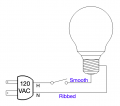
For electric lamp sockets the side of the cord with the rib always goes to the center contact. And with the newer molded polarized plugs the skinny blade usually goes to the side with the rib. THAT is the basis for my thinking.
 

MisterBill2

Joined Jan 23, 2018
28,507
I think it is the opposite. The center contact goes to the switch which interrupts LINE.
THAT is exactly what I was intending to state. The center, switched, connection is the line side! so we concur, but evidently I was not clear enough about it in my post! I did neglect to state that the circuit to the center was the switched connection.
Sorry about that, everybody.
 

Tonyr1084

Joined Sep 24, 2015
9,744
Screenshot 2025-04-27 at 5.35.42 AM.png
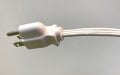
But we're not talking about 2 conductor lamp cord. The plug view is a partial side view. The narrow connector is the Hot and the wide connector is Neutral. Neutral is ribbed and connected to the shell of the lamp screw base. Hot is to the pit at the bottom of the light bulb.

It is more likely on the AC cord that the wire the TS has is PROBABLY Neutral on the same side as the printed text. I think someone pointed that out. Will have to double check.
 

Tonyr1084

Joined Sep 24, 2015
9,744
OK, Post #20 has a picture of the cord and is labeled. [edit) I think it's labeled backwards. But that's the exciting thing about AAC. You get a lot of different opinions. I think NEUTRAL is the printed side. Just another example of people who disagree. See post #57 for the correct view. Imagine plugging it into a socket where you KNOW which pin is hot - the hot is the one with the printing. Thanks @MrChips.
 
Last edited:

MaxHeadRoom

Joined Jul 18, 2013
30,876
Something I could never understand is why N.A. went with the Edison Screw lamp socket, I would bet there is still a few bedside table lamps etc that are pre-1960, when N.A. went to the polarized two pin socket.
These type of lamps were/are potentially dangerous.
The bayonet cap style is quite a bit safer when used where no guarantee of polarity is ensured.
 

bertus

Joined Apr 5, 2008
23,025
Hello,

Here in holland we have the E14 and E27 screwlamps.
The only bayonet lamp are the GU10 spotlights.
Also the G9 lamps are available here.

Bertus
 
Top