Is Practical Electronics For Inventors worth it?

nsaspook

Joined Aug 27, 2009
16,330
I agree that a short dabble in practical circuits helps build a base, but although I was fortunate that my personal journey started in the valve/tube era, through the transistor to the IC which resulted in a broad practical experience with electronics in general.
But today , in a practical sense, my first go-to when faced with a need to solve an electronics issue, is to look for an answer using a Pic Micro
It is nice having practical experience in tube circuits and tube equipment repair and operation in general. The first thing is does is teach you respect for high voltage. Second, it's more related to the fundamental electrical theory of charged particles, separation of those charged particles by usually Thermionic emission , electric fields across space (vacuum) and potential/kinetic energy of those particles being accelerated by electric fields. The fundamental solid-state physics of basic transistor theory is more involved in the material science properties of atoms in order and disorder due to doping and junctions. This makes the direct effect of charges and fields to their operation more obscured to the beginner.
 

nsaspook

Joined Aug 27, 2009
16,330
Practical Electronics For Inventors wasn't wrote by dummy's its a great book. https://mlp6.pages.oit.duke.edu/Med...rth_Edition_By_Paul_Scherz_and_Simon_Monk.pdf
It fine but it gives that old tired electrons pushing electrons in the wire to explain why electrical energy is so fast vs the physics of EM fields surrounding the wire being the conduit for electrical energy. It also uses the broken water analogy of the hose to explain the speed. And there are a few other shortcuts that will later come back to bite if you move on to more advanced electronics.
1744164141392.png

https://www.quora.com/Why-does-Veri...each-other-through-a-wire-How-is-this-correct
Eli Pasternak
MsEE, 29 patents EM fields, comm. relativity, quantum mech.1y
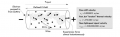
Electric conductors (wires) are not pipes with flowing electrons. An external electric field, say from a battery, is placed along the wire and this is pushing electrons. The electrons, instead of pushing each other, are accelerated by the field and then collide with atoms and lose most of their kinetic energy and now they have to start accelerating again. the electrons make extremely short hops before a collision - typically a mean free path of 40 nanometer. The energy lost by the collisions is causing atoms vibrations that end up as heat in the wire. This is a brief explanation of what is known as drift current.
It then properly (per EM physics) jumps back to reality with magnetic field energy when talking about inductors and electric field energy when talking about Field emission but then goes back to the black-box, Current Through a Capacitor model of capacitors and then properly back to electric field energy storage inside the capacitor.

It's not bad but IMO it teaches basic electrical theory in a confusing mis-mash of reality, analogy and misconception of some important basic elements you will need to relearn if you advance to RF, transmission lines EM theory and circuits that operate beyond circuit theory.

Practical theory, yes: 100%
Completely correct electrical theory, mixed bag: 90%
 
Last edited:

SamR

Joined Mar 19, 2019
5,491
Yup, I keep one on my bookshelf for when I need it. Also keep a PDF of it which can be scanned with find when looking for something not so obvious. You can also find them used in various conditions here. Practical Electronics For Inventors | Get Textbooks | New Textbooks | Used Textbooks | College Textbooks - GetTextbooks.com
I prefer the "Like New" completely unmarked almost like new condition if the price is right. Apparently, the demand is high and you know the old adage about supply and demand...
1744165669471.png
 

MaxHeadRoom

Joined Jul 18, 2013
30,674
Practical Electronics For Inventors wasn't wrote by dummy's its a great book. https://mlp6.pages.oit.duke.edu/Med...rth_Edition_By_Paul_Scherz_and_Simon_Monk.pdf
Like some other text books on the subject, I find it a little strange that in spite of an explanation of power common symbols etc, showing the difference between voltage sources, the earth GND symbol appears to be used indiscriminately throughout?
It is no wonder that many getting in to the subject also pick up this (bad) habit!! :confused:
 

nsaspook

Joined Aug 27, 2009
16,330
Like some other text books on the subject, I find it a little strange that in spite of an explanation of power common symbols etc, showing the difference between voltage sources, the earth GND symbol appears to be used indiscriminately throughout?
It is no wonder that many getting in to the subject also pick up this (bad) habit!! :confused:
I find the same thing about this book. It seems to be dual headed with not much communications between the heads on some basic subjects.
 
Top