Practical electronics

Thread Starter

Chinmaya kulkarni

Joined Sep 8, 2016
5
Hello all,

Could anyone please let me know any books or websites to learn practical electronics (mainly analog electronics)? I have studied theory of electronics, but I would like to be 'fluent' in applications. I hope I am being clear about my question. Thank you all in advance.
 

Parth786

Joined Jun 19, 2017
642
Hello all,

Could anyone please let me know any books or websites to learn practical electronics (mainly analog electronics)? I have studied theory of electronics, but I would like to be 'fluent' in applications. I hope I am being clear about my question. Thank you all in advance.
Hi Chinmaya

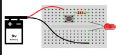
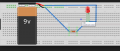
if you want to gain practical knowledge in electronics. You have to do some practical work. Suppose you have LED and 9V DC power supply and You want to turn ON LED. How will you turn ON LED. I am sure you will not directly connect LED to Power supply because it's dangerous. Your LED will damage. You need to Resistor to prevent damage

Hint : How will you select resistor. I am sure you have studied KCL and KVL law. Apply law to find right resistor. once you find right resistor then try to connect all component on breadboard

like this

upload_2017-11-13_19-48-37.png

Once you completed this project you can go for further steps. you can turn on /off LED by switch. your second experiment will be with button

like this
upload_2017-11-13_19-46-13.png

Hope it may be help you for starting

Parth
 
Last edited:

shortbus

Joined Sep 30, 2009
10,050
Best way to learn is build the simlpe led flashers, sound buzzers with 555 chips, or cmos 4000 series chips, cd4001, cd4011, cd4093, cd4060,
This is something I've been struggling with. Are circuits using the CD series truly analog? Being that their inputs and outputs are either a high or a low? Isn't that in the digital realm?
 

dl324

Joined Mar 30, 2015
18,287
This is something I've been struggling with. Are circuits using the CD series truly analog? Being that their inputs and outputs are either a high or a low? Isn't that in the digital realm?
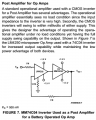
Technically they're digital, but there are a few analog multiplexers and switches. CMOS inverters can be biased as analog amplifiers. One trick to increase output voltage swing on opamps, before rail-to-rail outputs had been invented, was to use a CMOS inverter.

EDIT: Here's an example

CD4007 has an inverter and 2 complementary pairs. It can be configured for a number circuits: analog mux, 3 input NOR/NAND, high sink/source inverter, tri-state buffer, AOI, etc.

EDIT 2: Example of a CMOS inverter being used to increase output voltage swing to rail-rail:
upload_2017-11-13_8-5-56.png
 
Last edited:
Top