Facebook
 Google
 GitHub
 Linkedin
First of all i want to say hello to everybody on this site.
Since i am new i hope you would take my mistakes in english language as a minor problems.
I am not so ¨green¨ at electronic but i am still learning and a think that people learn through their whole life. I know that there was an subject like this already on this site but i want to get it more clearly so every help is welcome.
I want to build an IR transmiter and an IR reciever that would work up to 10 m if i am not to much pretencious(anything between 5-10 m would be great). So i have 2 Cmos 555 timer (TLC 555 CP) and a TSOP 1730(for reciever) so my desirable frequency is 30 khz.It is crucial that operating voltage of transmiter circuit if possible is 3 V since it would be operated from a 2 AAA bateries-1,5 V.I have already start building up this circuit but max. distance i can reach is about 10 cm.I try to use both PNP and NPN,i try to change duty cycle(from 5% to 80%),i try to sink and source but the result is the same.First i want to clear all doubts with a transmiter circuit and later with a reciecever(although i think/know that reciever circuit is not so complicated)
So far let me introduce in things that i know and that i already been able to do:
-first IC(IC1) must operate on frequency of 30 kHZ(R1,R2 i C must be on the values that would acomplished desired frequency and possible higher values that would lower the current)-DONE
-second IC(IC2) must operate on frequency so it can create a burst of signal and his output must connect on a reset pin of IC 1-DONE
-Between power suply should be decoupling capacitor so it can deliver current to IR led in transmiter circuit and would expand battery life-DONE
-IR led diode should be picked for a desireble forward current(in my case desirable current is about 80ma and a diode forward current is 150 mA with a forward voltage of 1.2-1.6 V)-DONE
-Wave lenght(nm) of a diode and a TSOP 1730 must be equal-DONE
-TLC 555 or every 555 can operate as a sink or source curent. Preferable is to sink current because he is able to sink more rather than source-DONE
-for acomplished desirable curent transistor must be introduced to output pin 3 of a first IC(type of transistor depends on sinking or sourcing current)
-transistor must operate in the folowing conditions:since i think my circuit is better to operate as a sinking source in this case i will use a NPN type.It must go to saturation and that would be acomplished when Vce is aprox. 0 V and a Vbe is about 0.7 V(emiter is lower than base voltage).
So in the collector circuit i must drop all voltage on a diode and a resistor for a desirable current and calculate depending on hfe of a transistor base current(considering voltage drop on base resistor and Vbe).So the current collector-emiter would be curent of a base gained by hfe factor.Preferable chose slighly higher base curent for ensuring full saturation mode.
Things i am not sure of:
-since my duty cycle is aprox 60% does this means that on the output at pin 3 of the first IC should i measure 1.8 V??(because depending on what i connect to output pin 3 measuring are different)
-How IC 2 affect on the IC1 (is he lowering the frequency of IC 1 ??because when i measure frequency on IC 1 witouth conected to IC2 freq is 30 khz and when i conect IC2 to reset pin on IC1 i am geting 18 khz)???
-i am not sure how load on pin 3 afect on IC1 and why??
-should i increase/decrease duty cycle??
-loking at a NPN datashet electric characteristic testin voltage is 6v,mine is 3V.How to define hfe of transistor??
Every information about everything would be apreciated because i want to learn,unfortunately despite i finished my energetic school i live in such society that electronic is on another plan.
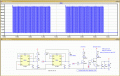
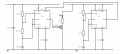
Attaching transmiter circuit.
NOTE: all resistors are variable , transistors that i have are NPN 2SC1740 ,PNP BC 328
Since i am new i hope you would take my mistakes in english language as a minor problems.
I am not so ¨green¨ at electronic but i am still learning and a think that people learn through their whole life. I know that there was an subject like this already on this site but i want to get it more clearly so every help is welcome.
I want to build an IR transmiter and an IR reciever that would work up to 10 m if i am not to much pretencious(anything between 5-10 m would be great). So i have 2 Cmos 555 timer (TLC 555 CP) and a TSOP 1730(for reciever) so my desirable frequency is 30 khz.It is crucial that operating voltage of transmiter circuit if possible is 3 V since it would be operated from a 2 AAA bateries-1,5 V.I have already start building up this circuit but max. distance i can reach is about 10 cm.I try to use both PNP and NPN,i try to change duty cycle(from 5% to 80%),i try to sink and source but the result is the same.First i want to clear all doubts with a transmiter circuit and later with a reciecever(although i think/know that reciever circuit is not so complicated)
So far let me introduce in things that i know and that i already been able to do:
-first IC(IC1) must operate on frequency of 30 kHZ(R1,R2 i C must be on the values that would acomplished desired frequency and possible higher values that would lower the current)-DONE
-second IC(IC2) must operate on frequency so it can create a burst of signal and his output must connect on a reset pin of IC 1-DONE
-Between power suply should be decoupling capacitor so it can deliver current to IR led in transmiter circuit and would expand battery life-DONE
-IR led diode should be picked for a desireble forward current(in my case desirable current is about 80ma and a diode forward current is 150 mA with a forward voltage of 1.2-1.6 V)-DONE
-Wave lenght(nm) of a diode and a TSOP 1730 must be equal-DONE
-TLC 555 or every 555 can operate as a sink or source curent. Preferable is to sink current because he is able to sink more rather than source-DONE
-for acomplished desirable curent transistor must be introduced to output pin 3 of a first IC(type of transistor depends on sinking or sourcing current)
-transistor must operate in the folowing conditions:since i think my circuit is better to operate as a sinking source in this case i will use a NPN type.It must go to saturation and that would be acomplished when Vce is aprox. 0 V and a Vbe is about 0.7 V(emiter is lower than base voltage).
So in the collector circuit i must drop all voltage on a diode and a resistor for a desirable current and calculate depending on hfe of a transistor base current(considering voltage drop on base resistor and Vbe).So the current collector-emiter would be curent of a base gained by hfe factor.Preferable chose slighly higher base curent for ensuring full saturation mode.
Things i am not sure of:
-since my duty cycle is aprox 60% does this means that on the output at pin 3 of the first IC should i measure 1.8 V??(because depending on what i connect to output pin 3 measuring are different)
-How IC 2 affect on the IC1 (is he lowering the frequency of IC 1 ??because when i measure frequency on IC 1 witouth conected to IC2 freq is 30 khz and when i conect IC2 to reset pin on IC1 i am geting 18 khz)???
-i am not sure how load on pin 3 afect on IC1 and why??
-should i increase/decrease duty cycle??
-loking at a NPN datashet electric characteristic testin voltage is 6v,mine is 3V.How to define hfe of transistor??
Every information about everything would be apreciated because i want to learn,unfortunately despite i finished my energetic school i live in such society that electronic is on another plan.
Attaching transmiter circuit.
NOTE: all resistors are variable , transistors that i have are NPN 2SC1740 ,PNP BC 328
Attachments
-
 18.8 KB Views: 46